
A scheduled utility outage is an advantage only if it gives the household time to prepare the functions that will change. The useful question is not “what should we buy before the lights go out?” It is what will be harder to do once they do, and what can be finished calmly now?
This is one route inside the Backup Power Systems hub; it does not replace a building, care, food-safety, or electrical plan.
Use this checklist for a short planned interruption or a utility notice with an uncertain restoration time. It does not replace a live-event response. If the event becomes a storm, fire, flood, evacuation, medical problem, or building hazard, switch to first actions when power goes out.
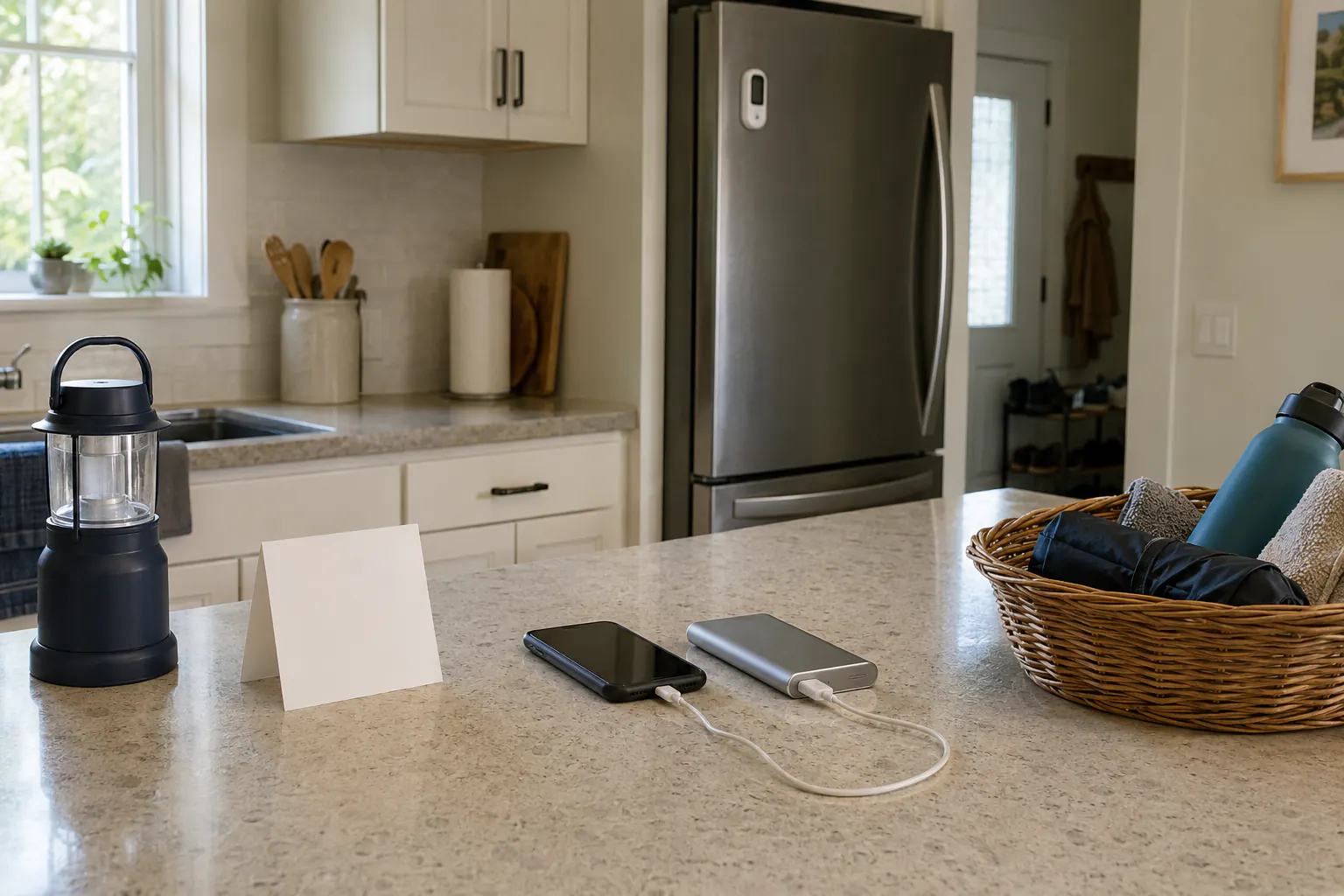
Read the notice like a household brief
Record the date, stated start and end window, address or service area, utility contact method, and any instruction that applies to your building. A planned window is an estimate, not a promise. It can shift with weather, field work, or an unrelated problem.
Then translate it into questions:
| Before the interruption | Household question |
|---|---|
| Duration | What changes at four hours, twelve hours, and overnight? |
| Timing | Will a person be asleep, working, collecting children, or away? |
| Weather | Could temperature, smoke, storm conditions, or flooding change the stay-or-leave decision? |
| Building | Are elevator, entry, garage, water, ventilation, or shared-system changes expected? |
| Care | Does anyone have an approved device, medication, mobility, or food-preparation dependency? |
| Work and school | Who needs one clear update before service changes? |
The power-continuity route turns those answers into a modest time-horizon plan.
The day before: charge, cool, communicate
Charge the devices that are part of the household plan: phones, approved batteries, lights, radios, and any equipment whose manual permits normal charging. Do not add unfamiliar devices or cables at the last minute. Inspect for damage, heat, swelling, loose connectors, or other abnormal condition and follow the manufacturer if anything is wrong.
Lowering a refrigerator or freezer setting beyond the manufacturer’s guidance is not a universal food-safety solution. Instead, verify appliance thermometers, limit planned door opening, know which food should be used first, and have a cooler only if you can keep it at the required temperature. FoodSafety.gov’s charts, not appearance or smell, control what happens after an interruption. Use power-outage food safety for the full decision path.
Send a concise message to the household: start window, where first lights are, who will be where, and when the next check-in happens. The family communication plan keeps key contacts available if a phone or home network is unavailable.
Finish ordinary chores before the outage
Do the tasks that assume power, water pressure, normal lighting, or a working network while those systems are available:
- prepare ordinary meals and drinking water access;
- charge the planned devices, then keep their cables together and reachable;
- run essential laundry, dishwashing, or hygiene tasks if appropriate;
- download the information you are permitted to keep offline;
- confirm the vehicle, transport, keys, and access plan if the interruption overlaps travel;
- make a short status update to work, school, caregivers, or a support person;
- identify the first light at every bedroom, stair, bathroom, and exit route.
Avoid turning preparation into a marathon. A stocked shelf and a clear note are more useful than an overfilled room of last-minute purchases.
Check the building and household access layer
Before the window begins, make sure each intended resident can enter, leave, and communicate without assuming a powered lock, elevator, garage door, intercom, or app will work. Put ordinary physical keys where the intended person can reach them. Do not prop a common, corridor, stair, or fire door open as a workaround. Ask property management about any announced change to shared water, elevators, building entry, parking access, or emergency lighting instead of guessing from a previous notice.
If children return from school, a caregiver arrives, or a visitor is expected during the outage window, agree on one ordinary fallback location and one way to confirm a change. A planned interruption can still coincide with a storm, traffic delay, medical appointment, or phone problem. The aim is not to track everyone constantly; it is to avoid a family member being surprised by a dark, locked, or inaccessible building.
Make one measured power plan
If a battery or power station is part of the plan, decide which single loads it will support and for how long. A typical first layer may be communication, task lighting, and a measured low-watt device. Do not add a refrigerator, heater, medical device, or full home office because a label sounds large enough.
The runtime calculator can show the watt-hour assumptions for a defined load. It cannot establish safe compatibility, medical adequacy, or an upstream internet connection. Keep a reserve for the next household decision, not just the first hour of use.
Never run a generator, grill, camp stove, charcoal, or other fuel-burning device indoors, in a garage, or in another partially enclosed area. Planned does not mean low-risk.
Prepare a short outage card
Put one small paper card where the household can find it in low light:
- outage start window and utility contact;
- first light location;
- household check-in contact and time;
- food and freezer start-time note;
- approved care or building escalation contact;
- the condition that changes the plan from staying to leaving.
Do not put passwords, account numbers, detailed medical records, or sensitive information on a card that may be visible to visitors or workers. The card should guide the next action, not become a household archive.
When the outage begins
Treat it as an actual outage, not a scheduled inconvenience. Confirm people and immediate hazards, use safe lighting, keep refrigerator and freezer doors closed, preserve communication energy, and check the official utility update. If the notice window passes without restoration, move to the next time horizon rather than repeatedly reopening appliances or recharging every convenience device.
The first-actions guide owns the live sequence. The planned notice simply gave you a better starting position.
Prepare for restoration too
Before the outage begins, decide who will check the home when service returns. Look for unusual smells, water, damage, alarms, or devices that were left on. Check food by the recorded time and temperature. Reconnect ordinary loads in a controlled order, not all at once.
Use the household reset after a power outage for the cross-household recovery list. Any wet, damaged, hot, odorous, buzzing, or otherwise abnormal electrical equipment remains outside the plan until the responsible utility, manufacturer, property authority, or qualified trade has cleared it.
Keep the notice useful after the event
Save the notice date, actual start and return times, and one or two conditions that differed from the expectation. A planned interruption that lasted longer than announced does not prove the utility acted improperly; it does show where the household plan needed a larger margin. Review whether food temperatures, access, work messages, care contacts, and lights were handled from the places you expected. Then update only the part that produced friction.
This small record is especially useful in a rental or shared building, where a later notice may involve different equipment or another manager. It helps the household ask precise questions next time without treating an old announcement as a permanent promise about power, water, elevators, or entry systems.
Sources reviewed
- Ready.gov power-outage hazard information sheet
- CDC Power Sources
- FoodSafety.gov food safety during a power outage guidance
Sources reviewed August 3, 2026. The utility’s current notice and local instructions control the actual interruption.