
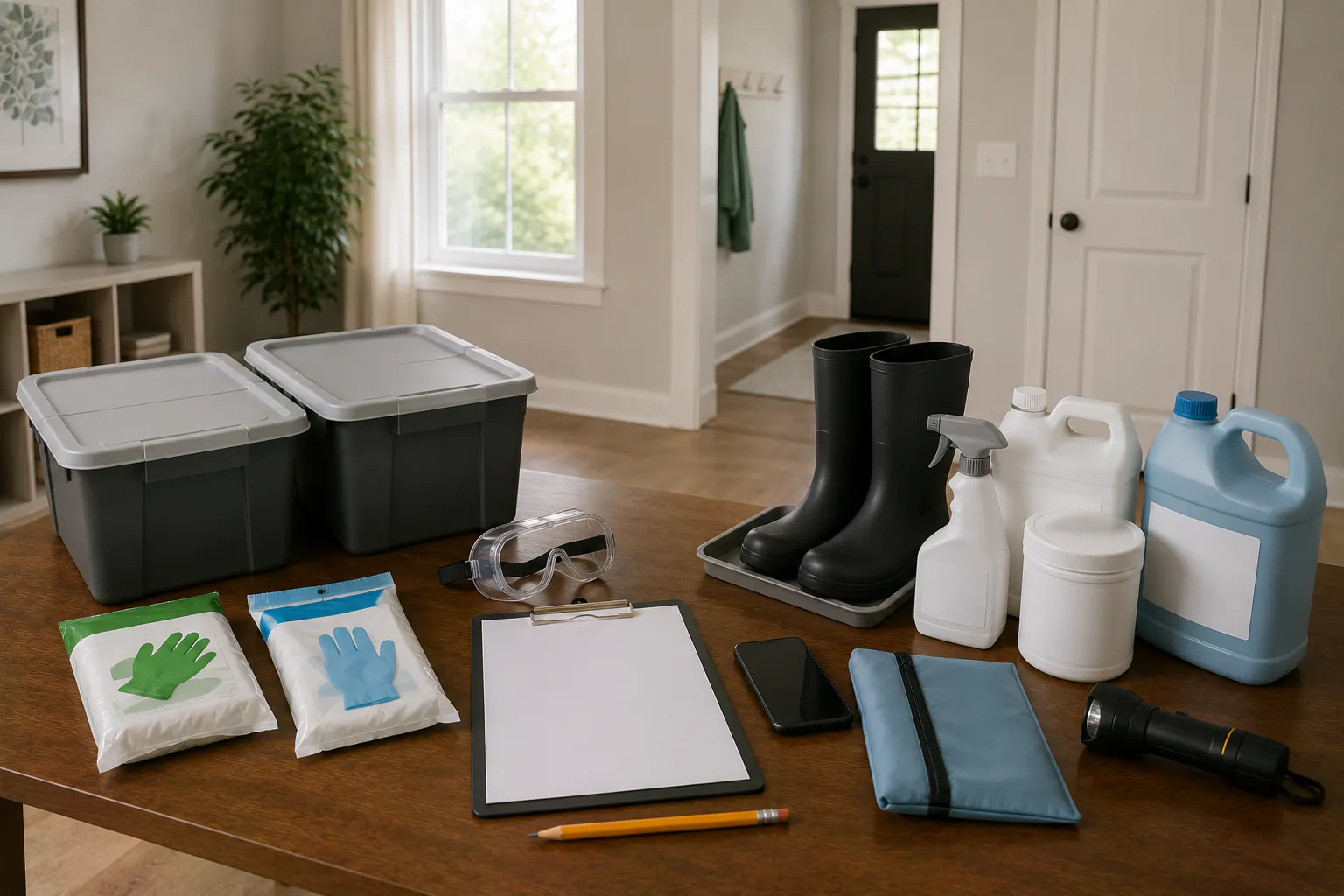
Cleanup begins with a decision about whether anyone should be inside. A wet floor, smoky room, fallen branch, or pile of belongings can conceal electricity, unstable materials, sewage, sharp debris, chemicals, heat, or contaminated dust. The first useful action may be leaving, calling an authority, and waiting.
This hub provides a household recovery sequence. It does not clear a building for entry, classify water, prescribe a universal disinfectant, identify hazardous material, or certify that a home is habitable. Local emergency instructions, the fire department, utility, building official, public-health authority, insurer, property owner, and qualified professionals control those decisions.
Use this order of operations
- Confirm that the area and building are open for reentry.
- Check for immediate life-safety, structural, utility, fire, and contamination stop conditions.
- Contact the insurer or responsible property authority and document from safe positions.
- Prevent additional damage only through authorized, non-hazardous actions.
- Divide the site into clean, transition, and affected zones.
- Match protective equipment and work methods to known hazards.
- Remove water or debris only after the relevant hazards are controlled.
- Clean, dry, inspect, and repair in an evidence-based sequence.
- Verify that contamination, moisture, utilities, exits, and essential systems are resolved before reoccupancy.
- Retain photos, receipts, reports, and recurrence checkpoints.
Speed matters for wet materials, but it never outranks reentry, electricity, structure, fire, gas, chemicals, or personal capability.
Stop at the first red flag
| Observable condition | Safer first route |
|---|---|
| Fire, smoke, active heat, gas odor, carbon monoxide alarm, explosion, collapse, severe injury, or trapped person | Leave and call 911 |
| Downed line, arcing, damaged service, wet panel, water near energized equipment, or uncertain electrical status | Stay out and contact emergency services or the electric utility |
| Leaning wall, sagging ceiling, displaced foundation, shifted stairs, fallen tree on the structure, or doors suddenly binding after impact | Keep out and request building or structural assessment |
| Sewage, septic failure, floodwater, medical waste, animal waste, fuel, pesticide, solvent, compressed cylinder, unlabeled container, or chemical odor | Isolate the area and contact the controlling utility, health, environmental, fire, or hazardous-material authority |
| Damaged suspect asbestos, lead-painted debris, ash, insulation, or unknown dust | Do not sweep, sand, cut, drill, or sample; request qualified assessment |
| Symptoms such as breathing difficulty, confusion, fainting, severe headache, chest pain, or chemical exposure | Move to safety and call 911 or Poison Control as appropriate |
Personal protective equipment does not make any of these conditions safe. A respirator does not supply oxygen, stop a chemical gas, prevent collapse, or protect against electrical contact.
Confirm reentry authority
An evacuation order ending does not prove that one address is safe. Before entering, determine who controls the property and incident:
- emergency management or law enforcement for area access;
- the fire department after a household fire;
- the electric or gas utility for service hazards;
- the building department or qualified structural professional for damaged construction;
- the wastewater utility or septic professional for sewage systems;
- the landlord or property manager for shared buildings;
- the environmental, health, or waste authority for chemicals and debris;
- the insurer for documentation and authorized loss-mitigation steps.
Enter only during daylight when possible, with a charged phone, another informed adult outside the affected zone, a clear exit, and no child or pet in the work area. Do not enter an attic, crawlspace, basement with standing water, confined space, roof, damaged outbuilding, or utility room merely to inspect.
Two event-specific checklists carry the full return sequence: the post-hurricane return checklist for wind events, and the flooded-home reentry and cleanup checklist whenever water entered the building. Use whichever matches the incident before continuing here.
Document before changing the scene
When the site is safe enough for documentation, contact the insurer or responsible property authority and follow its instructions. Record wide views before close views, then move room by room without touching hazards.
Capture:
- exterior sides, entry conditions, and the apparent route of damage;
- each room from its doorway and opposite corners;
- water lines, stains, soot boundaries, displaced materials, and debris fields;
- contents in place before they are moved;
- make, model, and serial information visible without energizing or handling wet equipment;
- dates, times, weather, alerts, utility notices, work orders, and authority instructions;
- every authorized temporary measure, contractor visit, disposal decision, and receipt.
Do not delay emergency action to photograph. Do not preserve food, medicine, sharp debris, sewage-contaminated soft goods, or another health hazard solely as claim evidence. The damage documentation checklist separates a useful claim record from unsafe evidence collection.
Identify the incident pathways
One room may contain several cleanup problems. Label what is known and what remains unknown.
Water and moisture
Record the source if an authority or qualified professional has established it, the time first noticed, affected materials, visible boundary, and whether electricity or HVAC is involved. Do not assume clear water is sanitary after contact with building materials, soil, a drain, chemicals, or floodwater.
Use the first-24-hours water triage to organize shutoff, evidence, extraction, material, drying, and escalation decisions. If drying was not completed promptly or mold is visible or suspected, move to the post-flood mold-risk guide.
Sewage and sanitation
Stop fixtures that add wastewater, isolate people and pets, and use the sewage-backup stop rules. Do not open a sewer, septic tank, cleanout, pump chamber, manhole, or contaminated confined area. Temporary toilet, hand-hygiene, and waste planning belongs in the emergency sanitation hub.
Smoke, soot, and ash
A fire department release is the starting point, not a cleanup certificate. Fire residues can coexist with structural damage, wet suppression materials, damaged wiring, broken glass, combustion products, and contaminated HVAC components. The small household fire cleanup guide begins with fire-department, insurer, utility, and restoration boundaries.
Wildfire smoke and ash require a different route. Use the wildfire smoke and ash cleanup guide and current local public-health instructions.
Storm and mixed debris
Do not treat every pile as ordinary trash. Separate only under local instructions. Vegetation, construction material, appliances, electronics, household hazardous waste, food waste, and contaminated contents may have different collection routes. Leave damaged or unlabeled containers undisturbed. The post-storm debris guide maps electricity, sharp objects, cylinders, batteries, chemicals, asbestos, lead, contamination, and lifting boundaries.
After freezing weather, snow, and ice, use the winter storm recovery guide before approaching roofs, trees, service equipment, exterior vents, or frozen plumbing.
Build zones before work begins
A simple site layout reduces cross-contamination:
- Clean zone: drinking water, first aid, phones, documents, unused PPE, and rest area.
- Transition zone: putting on and removing protective equipment, bagging work clothing, handwashing, and tool control.
- Affected zone: only authorized people, materials, and equipment needed for the defined task.
Keep clean supplies out of the affected area. Do not carry uncovered wet, moldy, ashy, or sewage-contaminated items through living space. Do not use central HVAC to dry or ventilate an affected building until it has been assessed and the relevant cleanup steps are complete. Do not point a fan from a contaminated area toward a clean one.
Match equipment to a defined task
Start with hazard removal, isolation, ventilation, professional control, and work limits. PPE is the final layer. Gloves must match the contact hazard; cut-resistant work gloves and chemical-resistant gloves are not interchangeable. Goggles should protect against the anticipated splash or dust. Footwear should match water, puncture, slip, and contamination conditions.
For mold or disaster dust, federal guidance may call for a NIOSH Approved respirator, but selection, fit, seal, medical tolerance, facial hair, duration, and the contaminant all matter. An N95 particulate respirator does not protect against gases or vapors. Stop if breathing becomes difficult or the device is damaged, wet, soiled, or cannot seal.
The cleanup PPE checklist is a selection and stop-rule aid, not permission to enter.
Clean and dry without improvising chemistry
Read every product label and building-material instruction. Do not mix cleaners. Never combine bleach with ammonia, acids, or another cleaner. Do not use a chemical because its odor seems stronger, and do not apply a household disinfectant to skin, food, porous structural material, electrical equipment, or a surface outside its label.
Cleaning removes soil and residue. Disinfection, when appropriate, is a separate label-directed step on a compatible pre-cleaned surface. Drying is another separate process. A fragrance, visually clean surface, or low-cost moisture reading does not prove that hidden material, cavities, HVAC components, or structural assemblies are clean and dry.
Use the cleanup-supplies comparison to choose containment, documentation, cleaning, drying, and disposal tools by incident rather than buying one generic disaster kit.
Decide what a household can reasonably handle
Qualified cleanup or assessment is especially important when the incident involves:
- structure, roof, utility service, electrical equipment, gas, combustion, or fire damage;
- floodwater, sewage, fuel, chemicals, asbestos, lead, pesticides, cylinders, or unknown residue;
- extensive, hidden, recurring, or HVAC-connected moisture or contamination;
- porous building assemblies, wall or ceiling cavities, insulation, or ductwork;
- heavy lifting, cutting, demolition, ladders, confined spaces, unstable debris, or power tools;
- infants, older adults, pregnancy, asthma, chronic lung disease, weakened immunity, disabilities, or medically necessary equipment;
- shared housing, childcare, food service, healthcare, rental, or regulated waste;
- a scope that cannot be isolated, completed, and verified with available competence and equipment.
A contractor estimate should define the source, affected area, exclusions, containment, material decisions, drying or cleaning criteria, disposal route, verification method, credentials, insurance, permits, and change-order process. It should not rely only on a product spray, odor treatment, or visual promise.
Verify before reoccupancy
Reoccupancy is not established by elapsed time. Confirm, as applicable, that:
- Public and property authorities permit access.
- Structural, electrical, gas, fire, water, wastewater, and HVAC restrictions are resolved in writing.
- Materials that cannot be safely cleaned and dried have been removed through an approved route.
- Remaining materials are clean, dry, stable, and free of visible contamination and persistent musty or smoke odor.
- Essential equipment, alarms, exits, sanitation, safe water, temperature, and accessibility are restored.
- A qualified professional has completed any required remediation and verification.
- Occupants can return without new or worsening symptoms.
- Photos, reports, receipts, samples authorized by the insurer, and disposal records are retained.
- Follow-up checks are scheduled for rain, HVAC operation, humidity, odor, staining, pests, and recurrence.
If symptoms appear or worsen after return, leave the affected area and seek medical and environmental guidance. Do not use a consumer mold test, air-quality monitor, odor counteractant, or surface wipe as a universal occupancy clearance.
Give renters a written recovery route
Report the incident through the lease emergency channel and retain the time, recipient, work-order number, photos, access instructions, temporary accommodation decision, and response. Ask who has cleared structure and utilities, which contractor controls cleanup, how unaffected belongings will be protected, and what completion evidence will be provided.
Do not operate shared shutoffs, enter locked utility spaces, discard building-owned material, hire structural work without authority, or move contamination into halls, elevators, balconies, or shared trash rooms. Escalate unresolved health, sanitation, utility, egress, and habitability concerns to the appropriate local housing, health, building, utility, or emergency authority.
Sources reviewed
- Centers for Disease Control and Prevention: Returning Home After a Natural Disaster; disaster-cleanup respiratory protection
- U.S. Environmental Protection Agency: Flooded Home; Dealing With Debris and Damaged Buildings
- National Flood Insurance Program: Document Flood Damage
- U.S. Fire Administration: After the Fire: Returning to Normal
- National Institute for Occupational Safety and Health: Personal Protective Equipment
Sources reviewed July 14, 2026. Current emergency orders, utilities, fire and building authorities, public-health and environmental agencies, insurers, property agreements, product labels, codes, and qualified professionals control actual reentry, cleanup, disposal, repair, and reoccupancy.