
Before trying to dry a flooded room, confirm reentry, utilities and the cleanup scope with the responsible authority or qualified professional. Keep children and higher-risk people away. Do not put a fan beside visible mold or use electrical drying equipment in an uncleared wet area.
Reducing mold risk requires source control, appropriate material decisions, cleaning and complete drying. Spraying a wet surface or lowering one room-humidity reading cannot replace that work.
EPA and CDC guidance emphasizes drying flooded homes and contents as quickly as possible, ideally within 24 to 48 hours. Treat that as a response target. It is not a biological countdown, a warranty against hidden growth, or proof that a material is salvageable.
Resolve reentry and utilities first
Do not enter until the responsible authority permits it. Leave and call the appropriate emergency service or utility for:
- standing water near electrical equipment or an uncertain electrical condition;
- gas, fuel, sewage, pesticide, solvent, or unknown chemical odor;
- sagging ceilings, shifted walls, unstable stairs, falling material, or collapse concern;
- active fire, smoke, carbon monoxide alarm, or severe symptoms;
- floodwater that is rising, moving, or blocking the exit.
Do not enter water to operate electricity. Do not open walls, ceilings, HVAC equipment, crawlspaces, attics, or confined areas to look for mold. Resolve the source and use the water-damage first-day guide before beginning a mold-cleanup decision.
Keep higher-risk people away
Children should not participate in disaster cleanup. People with asthma, chronic obstructive pulmonary disease, weakened immune systems, or other conditions that increase mold risk should stay away from moldy sites and discuss individual return decisions with a clinician. Older adults, pregnant people, and people with mobility, sensory, or cognitive limitations may also need a different access and relocation plan.
Do not use a respirator as a reason for a vulnerable person to enter. NIOSH Approved respirators are not designed for children, and tight-fitting respirators depend on model, approval, condition, fit, facial hair, seal, use, and medical tolerance.
Assume mold may be hidden after delayed drying
If a flooded home, furniture, or contents were not completely dried within 24 to 48 hours, federal guidance says mold is likely even when it is not visible. Hidden locations can include:
- behind cabinets, baseboards, paneling, and wall finishes;
- beneath carpet, pad, resilient flooring, and underlayment;
- inside wall, ceiling, floor, and roof assemblies;
- within insulation and paper-faced products;
- behind furniture and stored contents;
- around plumbing and exterior penetrations;
- in affected HVAC equipment, ducts, liners, and filters.
A musty odor, recurring stain, swelling, delamination, surface growth, or symptoms after entry all justify further assessment. Absence of odor does not prove absence of moisture or mold.
Build a source-and-material map
Before moving material, follow the safety and insurer instructions. A short record of the confirmed water route and affected area can help; it does not need to be complete before requesting qualified help. Record available facts established by an authority or qualified professional:
- source and stop time;
- outdoor floodwater, sewage, chemicals, or other contamination;
- rooms, levels, and adjacent spaces;
- duration and depth of wetting;
- structural, electrical, and HVAC involvement;
- porous, semi-porous, and hard materials;
- occupants and health vulnerabilities;
- drying equipment and monitoring already in place.
Do not call water clean based on appearance. Do not assume a surface cleanup addresses the material beneath it.
Separate clean, transition, and affected zones
Keep drinking water, food, medication, first aid, clean clothing, phones, paperwork, and unused PPE in a clean area. Use a transition point for putting on and removing protective equipment, bagging work clothing, handwashing, and controlling tools.
In the affected zone:
- limit access and time;
- keep doors to clean areas closed when that does not block egress or required ventilation;
- cover or isolate openings under the qualified cleanup plan;
- do not run affected HVAC;
- do not point fans toward clean rooms;
- avoid dry sweeping, ordinary vacuuming, sanding, grinding, or uncontrolled demolition;
- bag removed moldy material before carrying it through clean space.
If visible mold is already present, EPA cautions that fans can spread it. Clean visible mold before using fans in that area, and do not use affected ducts or HVAC for drying until a professional clears the system.
Match protective equipment to the hazard
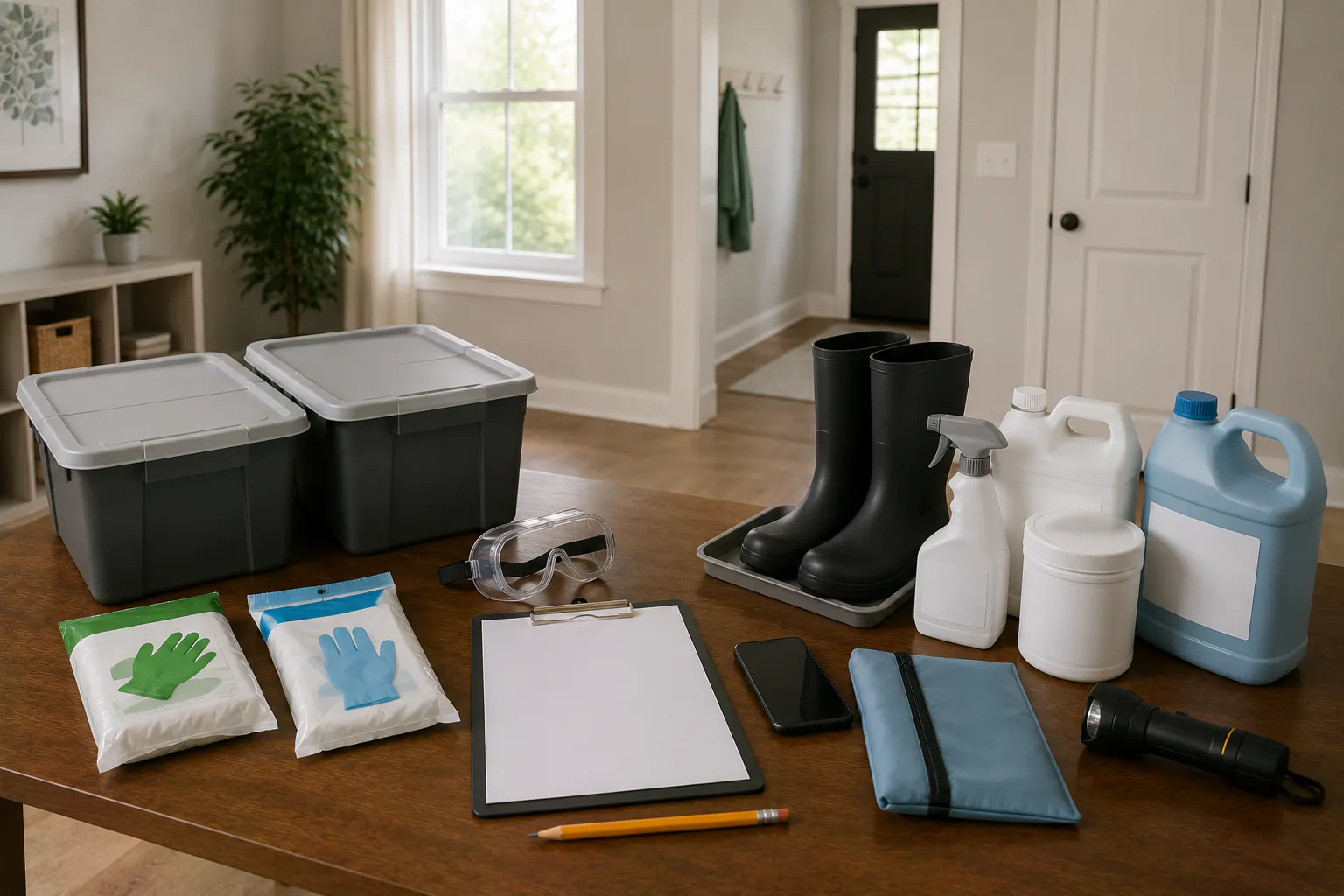
For a household mold task that has already been placed within a safe, defined scope, federal guidance commonly identifies at least:
- a NIOSH Approved N95 filtering facepiece respirator or greater particulate protection as appropriate;
- goggles without ventilation holes;
- protective gloves selected for the material and cleaning product;
- waterproof boots when standing-water or wet-surface protection is needed;
- long sleeves, long pants, and clothing that keeps contamination off skin.
Read the respirator and product instructions. Perform the user seal check required by the respirator manufacturer. An N95 does not protect against gases, vapors, oxygen deficiency, or every dust. PPE does not control electricity, unstable structure, sewage, chemicals, heat stress, sharp debris, or work beyond household competence.
Use the post-incident PPE checklist before work. Stop and move to clean air for breathing difficulty, dizziness, chest symptoms, heat illness, damaged PPE, failed seal, chemical odor, or an expanding scope.
Decide by material and contamination
| Material condition | Decision question |
|---|---|
| Nonporous surface with limited, accessible residue | Can it be safely cleaned, rinsed if required, and dried without disturbing another hazard? |
| Solid wood or other semi-porous material | Is the full thickness and concealed side accessible, structurally sound, cleanable, and dryable? |
| Drywall, insulation, carpet pad, ceiling tile, paper, cardboard, or composite material | Has water, contamination, swelling, delamination, or mold made removal the safer qualified scope? |
| Upholstery, mattress, stuffed item, or complex textile | Can a qualified contents specialist clean and dry the complete item, or should it be discarded? |
| HVAC component, lined duct, or air handler | Has an HVAC or remediation professional assessed contamination and system-wide spread? |
| Historic, valuable, or irreplaceable item | Can a conservator stabilize it without exposing occupants or contaminating clean space? |
This table does not authorize salvage. Floodwater or sewage exposure, hidden layers, hazardous materials, large areas, and vulnerable occupants change the decision.
Clean soil before any label-directed disinfection
Physical cleaning and drying are central. For compatible hard surfaces within a safe household scope:
- Remove loose contaminated material using a method that does not spread dust.
- Clean visible soil and growth with water and detergent using the product and material instructions.
- Remove cleaning residue as directed.
- If disinfection is appropriate, use only a registered product labeled for the exact surface, organism context, dilution, contact time, ventilation, and PPE.
- Dry the surface and surrounding assembly promptly.
- Inspect in good light and record the result.
Never mix cleaners. Never combine bleach with ammonia, acids, or another product. Do not use bleach or another disinfectant on skin. Do not create a stronger concentration than the label. Review the cleaning-products warning before staging supplies.
EPA notes that detergent and water are sufficient to remove microorganisms in many flood-cleanup situations after soil is removed. A chemical application cannot compensate for wet drywall, saturated insulation, a leaking source, contaminated cavities, or incomplete removal.
Remove and bag without spreading residue
Before removal, confirm insurance documentation, hazardous-material concerns, utilities, structural stability, and the approved disposal route. Avoid breaking, crushing, sanding, or dropping material. Use manageable pieces and controlled handling under the work plan.
Bag or wrap material before it crosses clean areas. Follow local waste instructions; do not burn debris, place it in storm drains, pour cleanup liquids outdoors, or combine household hazardous waste with ordinary contents. Keep a photo and item log without retaining a health hazard solely for evidence.
Do not ask untrained household members to lift waterlogged furniture, cut structural material, remove ceilings, or work overhead.
Dry the complete assembly
Drying requires source control, removal of material that cannot be retained, safe air movement, dehumidification, temperature management, and repeated checks. The finish surface is only one layer.
Track:
- indoor and outdoor temperature and relative humidity;
- equipment location, operating time, drainage, and electrical supply;
- consistent material locations and reference areas;
- wall bases, floor transitions, cabinets, subfloors, and adjacent rooms;
- odor, visible growth, condensation, and renewed staining;
- HVAC status and filter or component decisions.
EPA’s flooded-home guidance advises keeping indoor humidity below 60 percent after cleanup, ideally in the 30 to 50 percent range, while accounting for climate and building conditions. A humidity target alone does not prove that materials are dry.
Do not rely on a routine air test
EPA generally does not recommend routine mold sampling when visible growth is present. There are no federal airborne mold limits that turn a generic test result into a universal pass or fail for a home.
A qualified professional may use targeted investigation or testing to answer a defined question, but a consumer plate, swab, meter, or app cannot replace source control, visual inspection, material assessment, and complete drying. Testing that does not change the work plan can consume time while wet material remains.
Define professional completion
Ask the remediation provider to document:
- source repair and affected boundary;
- containment and occupant protection;
- materials removed, retained, and cleaned;
- hidden spaces and HVAC components assessed;
- cleaning methods and products;
- drying criteria, reference conditions, and final readings;
- visible and odor inspection;
- waste route and daily records;
- unresolved areas, repairs, and follow-up checks.
After remediation, EPA indicates there should be no visible contamination, dust, musty odor, or signs of water damage, and the home and contents should be dry. If occupants develop asthma attacks, allergy symptoms, skin, eye, or throat irritation after return, leave the affected area and seek medical and environmental guidance.
Prevent recurrence after the room looks normal
Schedule checks after rain, plumbing use, HVAC operation, seasonal humidity, and repair completion. Watch for renewed stains, condensation, swelling, odor, elevated humidity, drainage problems, or occupant symptoms.
Use the moisture-control guide for ongoing ventilation, drainage, indoor humidity, and maintenance. Keep photos and drying records with the property so a later recurrence can be compared to the incident rather than treated as an unrelated cosmetic issue.
Return to the post-disaster cleanup hub for the complete recovery sequence. Record material decisions with the damage documentation checklist, and use the cleanup-supplies comparison before selecting containment, cleaning, or drying equipment.
Sources reviewed
- U.S. Environmental Protection Agency: Flooded Home; Flood Cleanup and the Air in Your Home
- Centers for Disease Control and Prevention: Disaster-Cleanup Respiratory Health; Returning Home After a Natural Disaster; Mold Cleanup Shopping List
Sources reviewed July 14, 2026. Current reentry orders, health and environmental guidance, property authority, insurer requirements, product labels, material instructions, and qualified restoration, remediation, HVAC, environmental, electrical, structural, and medical professionals control actual cleanup and return.