
For water damage at home, keep people away from the affected area and make the first safety or maintenance call. Stop a known supply-water leak only through an established, safely reachable control. Do not enter standing water, touch wet electricity or pull up flooring to find the source.
Federal guidance urges households to clean and dry wet materials as quickly as possible, ideally within 24 to 48 hours. That interval is an action target, not a promise that mold cannot grow before it or that material is safe afterward.
The time windows below organize the first day, not appointments you must wait for. Emergency help, source control and authorized mitigation take priority over a photo, log or scheduled hour.
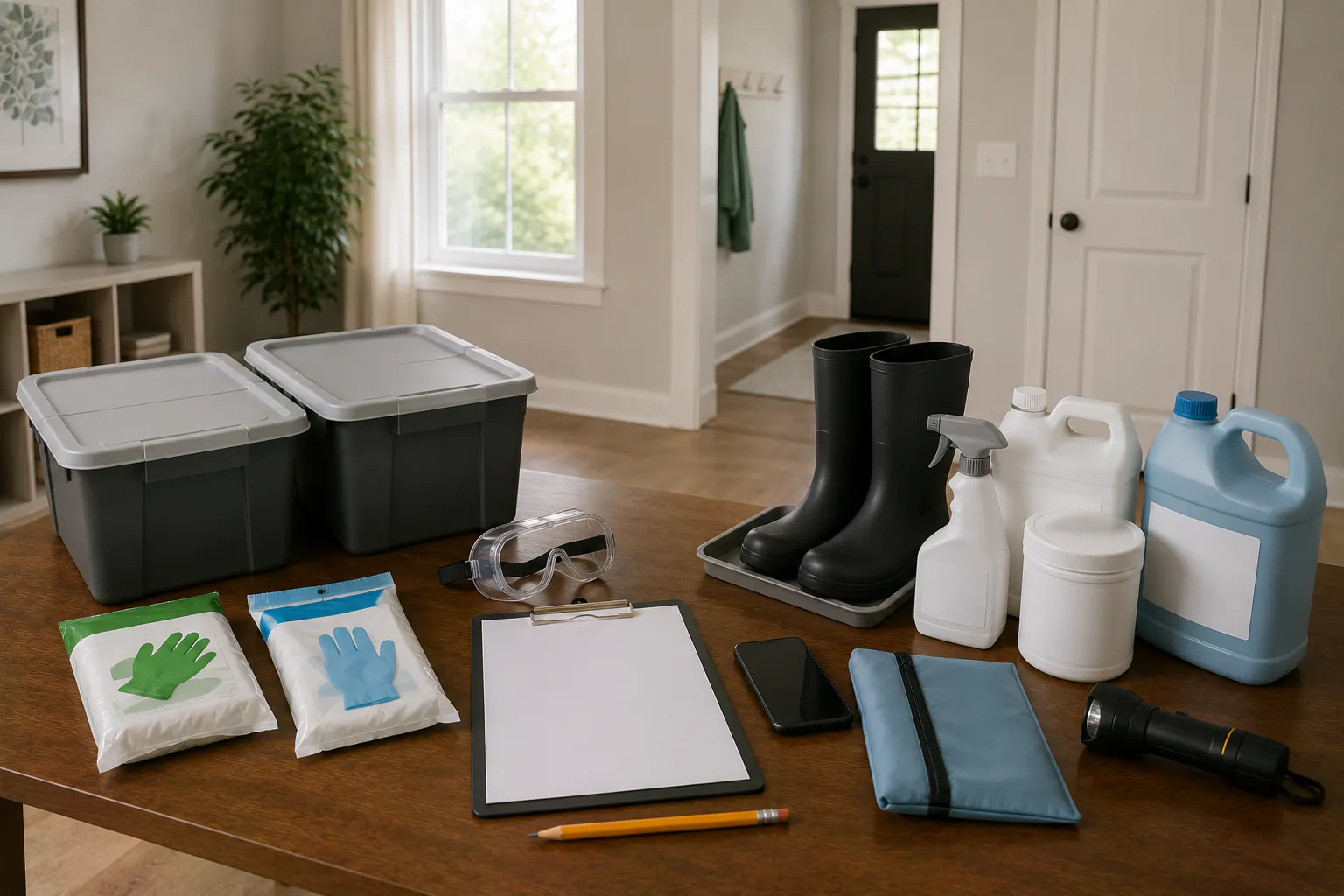
Leave before troubleshooting
Call 911 for collapse, fire, severe injury, trapped occupants, rapidly rising water, or another immediate danger. Leave and contact the controlling utility or emergency authority for:
- water touching outlets, panels, appliances, cords, service equipment, or unknown electrical sources;
- arcing, buzzing, smoke, burning odor, repeated breaker operation, or damaged wiring;
- gas, fuel, solvent, pesticide, sewage, or unknown chemical odor;
- sagging ceilings, leaning walls, shifted stairs, buckled floors, falling material, or impact damage;
- floodwater, sewage, storm surge, septic failure, or water from an unknown source;
- a route that requires wading, roof access, a ladder, a crawlspace, an attic, a confined space, or moving unstable debris.
Do not enter water to switch off electricity. Do not assume a tripped breaker removes every source. Solar, batteries, generators, neighboring circuits, utility faults, and damaged conductors can create additional hazards.
Minute 0 to 30: stop people and flow
Keep children, pets, visitors, and anyone with health vulnerabilities out. Mark the boundary from a dry position and preserve a clear exit.
If a known indoor supply pipe or fixture is leaking and the normal shutoff is safely reachable without entering water or approaching electrical, structural, gas, or contamination hazards, use the established household shutoff plan. The main-water shutoff guide explains preparation and normal operation; it is not permission to enter a hazardous area.
For renters or shared buildings, call emergency maintenance. Do not operate a building main, fire-suppression valve, shared pump, boiler valve, or locked utility control. For street flooding, sewer backup, or utility infrastructure, follow the public authority.
After flow stops, do not restore it for testing until the responsible plumber, property authority, or utility authorizes that step. A closed valve limits additional water; it does not prove the damaged system or building is safe.
Minute 15 to 60: make the calls
Call the party that controls the immediate problem first; you do not need to work through every contact below. A short call note can follow. Contact, as applicable:
- Emergency services or utilities for active hazards.
- Landlord, building manager, or homeowner responsible for the property.
- Insurer or flood insurer before cleanup and disposal.
- Qualified plumber for source control and system assessment.
- Electrician or utility for wet electrical systems and equipment.
- Water-damage restoration or remediation provider for extraction, assemblies, and drying.
- Building or structural authority for movement or storm damage.
- Public health, wastewater, or environmental authority for contaminated water.
Record the person, time, instructions, claim or work-order number, arrival estimate, and actions authorized. Do not let urgency turn an unsolicited contractor into the incident authority. Verify identity, insurance, credentials where required, written scope, payment terms, and who may approve changes.
Hour 1 to 2: document from the dry side
Once an authority says entry is permissible and immediate hazards are controlled, contact the insurer and record before moving items. Start outside the affected boundary.
Capture:
- wide room views, then medium and close views;
- the apparent source area without opening walls, equipment, or drains;
- visible water edge and height using a safe fixed reference;
- ceilings, walls, floors, trim, cabinets, contents, and adjacent rooms;
- model and serial labels that can be seen without touching wet equipment;
- time first noticed, estimated start if known, weather, alarms, and utility status;
- shutoff and temporary work performed by authorized people;
- every moved or discarded item and why immediate disposal was necessary.
Keep originals with date metadata. Avoid filters, annotations over the only copy, or a highlight that obscures context. Use the damage documentation checklist for a room-by-room record.
Documentation does not require wading, lifting, energizing, opening panels, preserving contaminated goods, or postponing emergency mitigation.
Hour 1 to 3: describe the water without overclassifying it
Write observable facts:
- known source and who confirmed it;
- start and stop time, if known;
- rooms and levels affected;
- materials visibly wet or exposed;
- contact with soil, drains, toilets, chemicals, appliances, insulation, or debris;
- odor, color, visible residue, and sewage or utility notices;
- occupants with exposure or symptoms.
Do not label water “clean” because it looks clear. Water can change after moving through construction, contents, drains, soil, or hidden cavities. Leave formal contamination classification and cleanup protocol to qualified professionals.
Use the sewage backup stop rules for wastewater. Use the flooded-home reentry guide for outdoor floodwater or storm surge.
Hour 2 to 4: map the wet boundary
A sketch may help the restoration provider once access is safe. If useful, mark these details from accessible, stable positions without touching affected material:
- visible wet area;
- adjacent rooms, closets, cabinets, and the level below;
- wall bases, transitions, penetrations, and built-ins;
- HVAC supply and return locations;
- electrical and appliance locations;
- known shutoffs and restricted areas;
- a clean route, transition point, and affected zone.
Photograph the same locations before and after authorized extraction. A consumer moisture meter or thermal camera can support a record when used correctly, but neither proves a material, cavity, or assembly is dry. Surface readings can miss layers, metal, temperature effects, insulation, and inaccessible moisture. Do not puncture materials to take a reading.
Hour 2 to 6: prevent cross-contamination
Set a clean area for drinking water, first aid, documents, phones, unused PPE, and breaks. Set a transition area for footwear, work clothing, waste bags, and handwashing. Keep occupants and unaffected belongings out of the work route.
Do not:
- run central HVAC if ducts or equipment were affected or contamination could spread;
- direct fans from the wet zone into clean rooms;
- use a household vacuum on water, wet dust, soot, or mold;
- dry sewage or contaminated floodwater into the indoor air;
- drag wet porous items through unaffected rooms;
- mix cleaning products or add fragrance to conceal odor.
If electricity has been cleared for use, a qualified drying plan may include extraction equipment, air movement, dehumidification, heat management, and monitoring. Equipment placement and electrical load must match the site, circuit, manufacturer instructions, and hazard assessment.
Hour 3 to 8: inventory materials by assembly
Record more than the finish surface.
| Visible component | Concealed questions for qualified assessment |
|---|---|
| Carpet or floating floor | Pad, underlayment, subfloor, perimeter, adhesive, and water route |
| Drywall or paneling | Insulation, framing, fire blocking, wiring, vapor layers, and opposite side |
| Base cabinet or vanity | Toe kick, cabinet base, wall, plumbing penetration, and floor beneath |
| Ceiling stain | Source above, insulation, fixture, joist space, and ceiling stability |
| Exterior wall | Cladding, flashing, sheathing, insulation, drainage plane, and interior finish |
| HVAC register | Duct, boot, air handler, filter, insulation, return path, and system status |
Do not remove trim, flooring, drywall, insulation, cabinets, or ceiling material until the structure, utilities, contamination, hazardous-material, insurance, and work-scope questions are resolved. Disturbing older material may create asbestos or lead hazards. Demolition can also destroy source evidence.
Hour 4 to 12: begin authorized removal and drying
The work order should state who is responsible for extraction, material removal, contents, HVAC, disposal, and drying verification. For a genuinely small, known, non-contaminated event that authorities and responsible professionals have placed within household capability:
- Wear task-appropriate protective equipment.
- Remove standing water with equipment rated and electrically supplied for the location.
- Move only stable, manageable contents through the designated route.
- Separate wet from dry items and record each decision.
- Clean soil from compatible hard surfaces using the appropriate method.
- Increase safe ventilation or mechanical drying only when it will not spread contamination or create security, weather, or electrical risk.
- Record temperature, relative humidity, equipment operation, and material checks at consistent locations.
Stop when the source recurs, water extends beyond the mapped boundary, odor changes, material moves, a circuit trips, equipment becomes hot or damaged, symptoms develop, or the task exceeds the written scope.
Hour 8 to 24: verify progress, not appearance
A dry-looking surface can cover wet backing or cavities. Review:
- whether the source is repaired and verified;
- whether the wet boundary changed;
- whether extraction and material decisions match the contamination and assembly;
- whether electricity and HVAC have written clearance;
- whether relative humidity and material conditions are trending in the intended direction;
- whether equipment runs safely on the planned circuits;
- whether odors, staining, swelling, delamination, corrosion, or symptoms are emerging;
- whether tomorrow’s professional, insurer, disposal, and access appointments are confirmed.
If the home and contents cannot be completely dried promptly, assume mold may be present even when it is not visible. Move to the mold-risk reduction guide rather than extending a casual fan-and-wait approach.
Protect vulnerable occupants
Children should not participate in disaster cleanup. People with asthma, chronic lung disease, weakened immune systems, significant allergies, pregnancy-related concerns, mobility limits, or other medical vulnerabilities may need to remain elsewhere. Ask a clinician about individual exposure, respirator, medication, and return questions.
Provide safe water, toilets, medication access, temperature control, charging, mobility, sleep, and a low-contamination route. If essential services cannot be maintained, temporary relocation is part of the recovery plan, not a cleanup failure.
Ask the restoration provider for measurable completion
A useful written scope identifies:
- source and affected assemblies;
- contamination assumptions and exclusions;
- pre-existing damage versus incident damage;
- containment and occupant plan;
- materials to clean, dry, remove, preserve, or test;
- equipment type, placement, electrical plan, and monitoring frequency;
- drying targets and how they were established;
- hazardous-material and HVAC decisions;
- disposal route, daily records, change approval, and completion evidence.
Do not accept odor removal, antimicrobial application, a single moisture reading, or “three days of equipment” as universal proof. Completion depends on the actual materials, baseline or reference conditions, source control, contamination, and verification method.
Keep the post-disaster cleanup hub as the incident-wide route. If the authorized work plan requires equipment, use the cleanup-supplies guide to understand its role and limits; a purchase is not a prerequisite to asking for help.
Sources reviewed
- U.S. Environmental Protection Agency: Flooded Home
- Centers for Disease Control and Prevention: Cleaning Safely After a Disaster; Returning Home After a Natural Disaster
- National Flood Insurance Program: Document Flood Damage
- Federal Emergency Management Agency: Don’t Wait to Clean Up or Make Repairs
Sources reviewed July 14, 2026. Current emergency and utility instructions, property authority, insurer requirements, product instructions, building conditions, and qualified plumbing, electrical, structural, HVAC, environmental, restoration, and remediation professionals control actual response.