
After entry is authorized and immediate hazards are controlled, notify the insurer or responsible property owner and take one safe overview photo if you can. Add detail as access permits. Do not delay emergency action or retain a health hazard just to improve an insurance record.
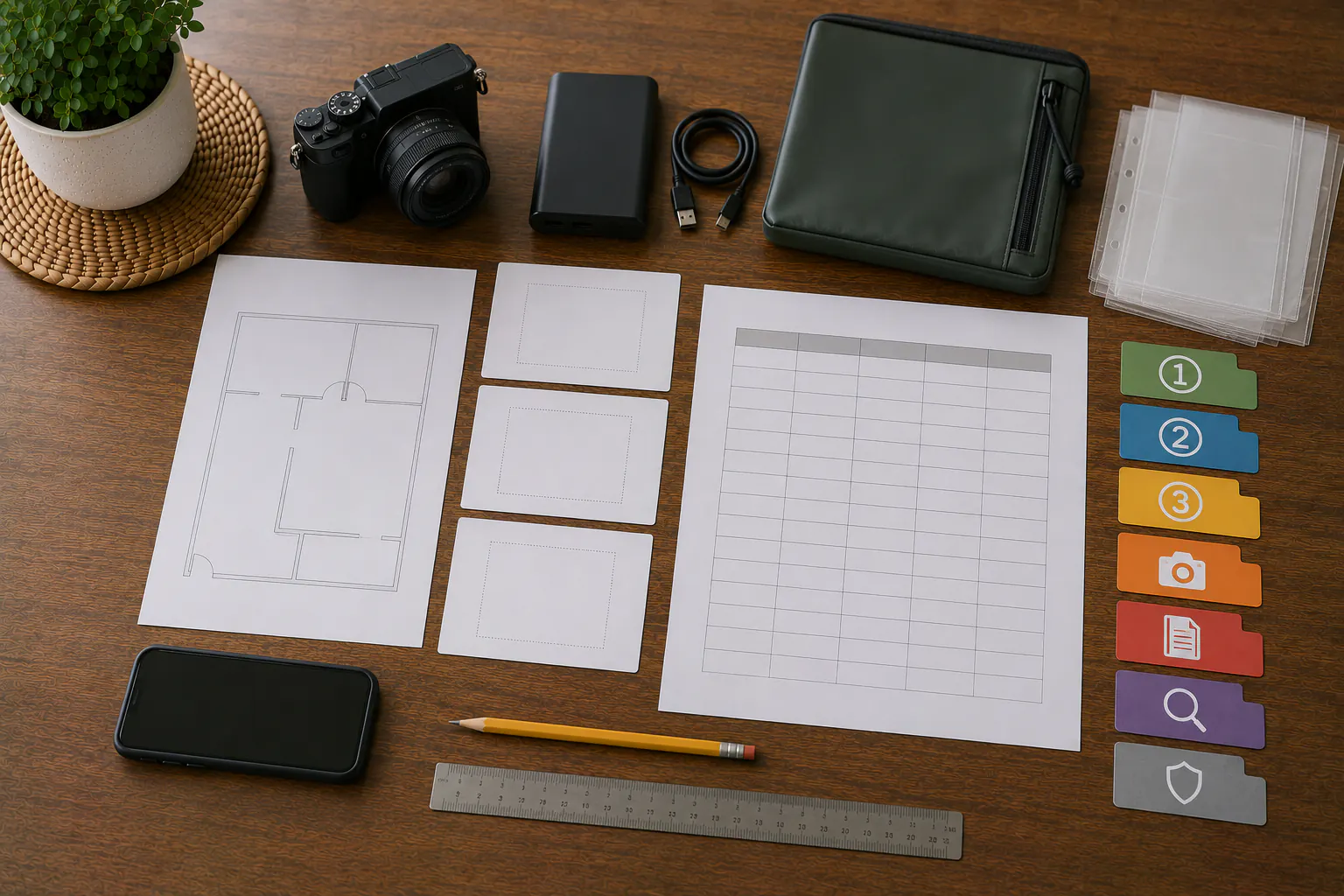
The sequence is simple: safety and reentry first, insurer or property notification second, wide-to-close documentation third, then authorized emergency mitigation. Do not postpone life-safety action, source control, or removal of a health hazard merely to improve the record.
Pass the safety gate
Do not enter for photos until the responsible authority permits access. Stay out for:
- fire, smoke, hot spots, gas or fuel odor, carbon monoxide alarm, or severe symptoms;
- standing water near electricity, wet panels or appliances, arcing, or damaged service;
- unstable roofs, ceilings, walls, stairs, floors, trees, glass, or debris;
- sewage, moving floodwater, chemical spills, unlabeled containers, cylinders, or unknown residue;
- an attic, crawlspace, roof, confined space, basement with water, or blocked exit.
Call 911 for immediate danger. A photograph is never worth crossing water, climbing, touching equipment, moving debris, or entering a restricted area.
Contact the controlling parties
As soon as practical, notify:
- the insurer or National Flood Insurance Program carrier;
- landlord, building manager, or property owner;
- emergency maintenance or the responsible utility;
- local emergency, building, health, wastewater, or environmental authority as applicable;
- mortgage servicer if the policy or loss process requires it.
Record the time, number used, person, claim or work-order identifier, exact instructions, promised response, and authorized temporary measures. Ask:
- What must be documented before movement or disposal?
- Are samples required, and who may collect or store them?
- Which emergency measures can begin immediately?
- Which contractors or estimates require prior authorization?
- How should food, medicine, sewage-contaminated goods, sharp debris, or other health hazards be handled?
- Where should photos, inventories, receipts, and reports be submitted?
Do not interpret a generic claim hotline script as clearance to enter or perform work.
Create an incident header
A note with the location, discovery time and first contact is enough to start. Add these details privately as they become useful or are requested:
- incident name and property identifier that avoids unnecessary public disclosure;
- date and time discovered;
- estimated start time and basis, if known;
- weather, alert, outage, fire, leak, or service context;
- occupants present and evacuation time;
- emergency, utility, fire, police, or building incident numbers;
- source status and who stopped or confirmed it;
- reentry restrictions and issuing authority;
- insurer, claim, landlord, and contractor contacts;
- immediate accessibility, medication, pet, sanitation, and temporary-housing needs.
Separate observation from inference. Write “water visible beneath the north kitchen cabinet at 8:15 p.m.” rather than “dishwasher valve failed” unless a qualified person has confirmed the cause.
Preserve original files
Use a charged phone or camera from dry, stable positions. Confirm automatic date and time are correct. Keep original full-resolution files and make working copies for annotation.
An optional folder structure is:
2026-07-14-incident/
  00-incident-log/
  01-exterior/
  02-room-kitchen/
  03-room-living/
  04-contents/
  05-utilities-equipment/
  06-contractors-reports/
  07-receipts-expenses/
  08-correspondence/
  09-disposal-samples/
Use sequential filenames such as 20260714-1422-kitchen-west-wall-wide-001.jpg. A simple description is more reliable than a guessed cause.
Back up the record to a second controlled location when connectivity and power permit. Keep access recovery information separate. Do not publish claim numbers, addresses, signatures, serial numbers, security devices, keys, children, medical information, or damaged access points on social media.
Photograph wide, medium, then close
For each accessible area:
- Photograph the doorway and overall room.
- Photograph each wall, floor, and ceiling plane.
- Photograph the relationship between source area and affected material.
- Photograph each damaged item in place.
- Add close views of marks, water lines, soot, cracks, swelling, and labels.
- Photograph the route to adjacent rooms or the level below.
- Repeat from a consistent position after authorized mitigation.
Include an ordinary reference object or ruler only when it can be placed without touching contamination or altering evidence. Do not insert a ruler into a crack, press a ceiling, lift flooring, open a cabinet over water, or remove a cover.
Avoid digital zoom when a clear optical or normal image is possible from the safe position. Do not apply beauty filters, erase clutter, or overwrite originals with arrows and text.
Record video as a narrated map
Video can preserve spatial context. Begin with the date, location within the property, and where you are standing. Pan slowly, describe only what is visible, and identify restricted areas without entering them.
Keep clips short by room. Avoid rapid movement, commentary about blame, or unsupported diagnosis. Do not record private conversations without considering applicable law and consent.
Video supplements still photos; it does not replace clear item and label images.
Build a room-by-room contents inventory
For each item, record:
- item number and room;
- general description;
- brand, model, serial, size, and quantity when safely visible;
- approximate purchase date and source;
- condition before the incident, if known;
- observed exposure and damage;
- photo and video filenames;
- receipt, statement, registration, warranty, manual, or prior photo available;
- current location and disposition;
- professional or insurer instruction;
- replacement, cleaning, storage, disposal, or pending status.
Do not guess an exact purchase price or age. Label estimates as estimates and retain the basis. Older household photos, email receipts, card statements, manuals, and cloud libraries may corroborate ownership without reconstructing false precision.
Capture equipment information safely
Photograph make, model, serial number, rating plate, and visible condition only when the label can be accessed without touching wet, hot, energized, contaminated, unstable, or fire-involved equipment.
Never plug in, charge, start, reset, open, move, or dry an appliance for documentation. Do not remove a fire-origin appliance, battery, detector, wiring component, or utility tag until the fire department, investigator, insurer, and qualified professional release it.
Record recalls and manufacturer instructions later from a clean location using the exact model information.
Map building damage by assembly
Create a simple floor plan and mark:
- visible boundary, height, and direction of water, soot, or debris;
- roof, wall, ceiling, floor, cabinet, door, and window damage;
- plumbing, electrical, HVAC, gas, appliance, and alarm involvement;
- adjacent rooms, floors above and below, and shared walls;
- restricted zones and source status;
- temporary openings, tarps, extraction, drying equipment, and containment.
Record the contractor’s material readings and locations, but do not represent a consumer reading as a professional conclusion. Keep the raw value, instrument model, material, location, time, and operator.
Log every temporary measure
Emergency mitigation can change the scene. Before and after each authorized action, record:
- who requested and approved it;
- contractor or person performing it;
- start and completion time;
- area and purpose;
- material moved, removed, cleaned, dried, tarped, boarded, or isolated;
- photos before, during when safe, and after;
- equipment installed and daily status;
- receipts, contracts, estimates, and work orders;
- newly discovered damage and change authorization.
Do not make permanent repairs before the insurer, property authority, permits, and qualified scope are resolved. Temporary work should prevent additional damage without hiding the original condition.
Document disposal without keeping hazards
Federal and insurer guidance may ask for photos, item lists, and small material samples, but health protection controls. Do not retain contaminated food, medicine, sewage-soaked soft goods, sharp debris, leaking batteries, chemicals, unknown residue, or another hazard solely for a claim.
Before disposal when safe:
- Photograph the item in place.
- Photograph identifying information.
- Add it to the inventory.
- Record why immediate disposal was necessary.
- Record the authority, insurer, contractor, or public-health instruction.
- Photograph the separated disposal pile or handoff.
- Keep the collection, weight, haul, or disposal receipt.
Follow local waste categories. Do not place hazardous waste, batteries, appliances, electronics, or suspect asbestos in ordinary debris without authorization. Use the post-storm debris guide.
Keep a communication ledger
For every call, visit, email, text, and letter, record:
- date and time;
- organization and verified contact;
- role and authority;
- what you reported;
- instructions and restrictions;
- commitments and deadlines;
- documents exchanged;
- unresolved questions;
- next action and responsible person.
After an important phone call, send a concise written summary through the approved channel and ask for correction. Do not secretly alter a contractor record or present a personal summary as their professional report.
Protect against contractor and payment confusion
Photograph contractor identification, vehicle, and posted permit only with consent and when relevant. Verify business identity, licensing where required, insurance, references, and complaint channels independently.
If water or fire restoration is proposed, use the restoration contractor questions to clarify access authority, the written scope, exclusions, and completion records. Do not delay urgent safety measures or insurer notification while comparing providers.
Keep:
- written estimate and scope;
- material and method descriptions;
- exclusions and completion criteria;
- deposit and payment schedule;
- cancellation and change-order terms;
- permits and inspection records;
- daily logs and equipment records;
- warranties, lien releases where applicable, and final invoice.
Do not pay in untraceable cash merely because systems are disrupted. A disaster does not eliminate the need to understand a contract.
Give renters a parallel record
Renters should document personal property and the observable building condition without diagnosing ownership or cause. Record all reports to management, access restrictions, temporary sanitation or housing, work orders, contractor visits, and effects on essential services.
Do not discard building-owned materials, operate shared systems, or authorize structural work. Ask management to identify the responsible insurer and contractor, resident access rules, contents protection, completion evidence, and return conditions.
Keep a copy outside the landlord’s portal in case access changes.
Review the record each day
When time and capacity allow, make a short check of the records you have. Useful checks include:
- new photos are named and backed up;
- room and item records match the files;
- emergency and contractor actions are logged;
- receipts and expenses are captured;
- restricted and resolved areas are clear;
- outstanding calls and deadlines have owners;
- temporary housing, food, laundry, transport, pet, and medical costs are separated;
- no private or security-sensitive information was shared publicly.
The goal is a traceable recovery history, not a perfect documentary film. Consistent ordinary records are more useful than dramatic images without dates, room context, or disposition.
Route the record to the right cleanup plan
- Use the post-disaster cleanup hub for the complete authority, reentry, cleanup, and reoccupancy sequence.
- For a water loss, pair the record with first-day water-damage triage and the mold-risk reduction guide.
- For wastewater, keep documentation on the dry side of the sewage-backup stop rules.
- For storm debris, record categories without handling prohibited material under the debris-hazard guide.
- After a released household fire, use the smoke and soot cleanup guide before wiping or energizing anything.
- Use the cleanup PPE checklist and supplies comparison only after the task is authorized.
Sources reviewed
- National Flood Insurance Program: Document Flood Damage
- Federal Emergency Management Agency: Don’t Wait to Clean Up or Make Repairs
- Centers for Disease Control and Prevention: Returning Home After a Natural Disaster
- U.S. Fire Administration: After the Fire: Returning to Normal
- Ready.gov: Recovering From Disaster
Sources reviewed July 14, 2026. Current emergency orders, property authority, insurer and adjuster instructions, policy terms, local law, permits, product instructions, and qualified restoration and trade professionals control actual documentation, mitigation, disposal, repair, and claim handling.