
There is no responsible all-purpose disaster cleanup kit. Water extraction, mold cleanup, sewage isolation, soot control, household hazardous waste, and ordinary post-storm housekeeping have different hazards, materials, and stop rules.
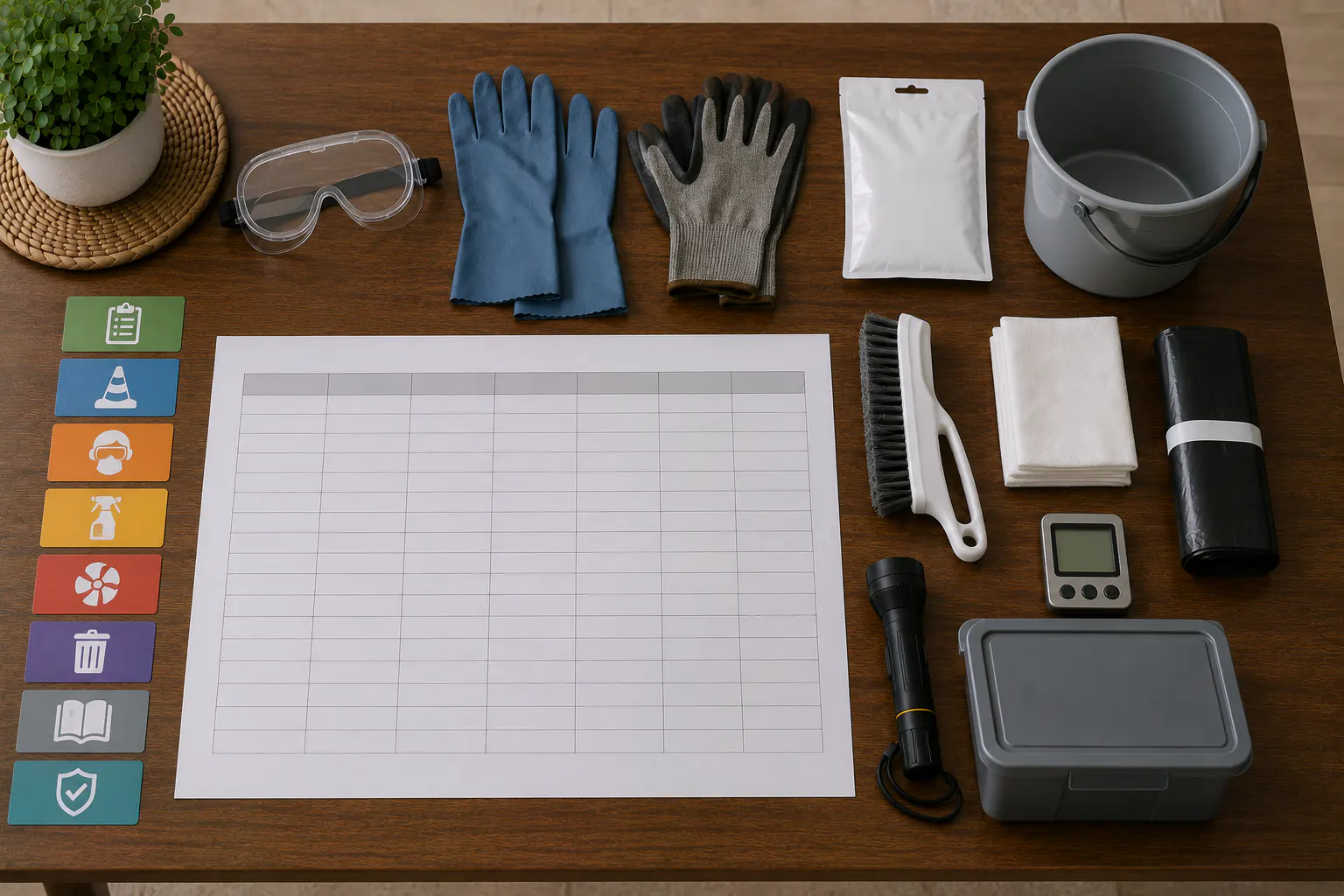
Buy supplies for a defined, authorized task. Do not buy equipment as a substitute for reentry clearance, source repair, utility control, hazardous-material assessment, or professional remediation.
ReadyLience has not placed affiliate links or model rankings on this page. Future recommendations must pass current recall, certification, instructions, availability, price, safety, and use-case review before monetization.
Start with the incident gate
Do not enter or begin cleanup for:
- fire, smoke, hot spots, gas or fuel odor, carbon monoxide alarm, or severe symptoms;
- standing water near electricity, wet panels or appliances, arcing, or uncertain service;
- unstable ceilings, walls, floors, stairs, roofs, trees, or debris;
- sewage, floodwater, chemical spills, unlabeled containers, cylinders, or unknown residue;
- suspect asbestos, lead, demolition dust, battery fire, or contaminated HVAC;
- a crawlspace, attic, roof, confined space, moving water, or blocked exit.
Call 911 for immediate danger. A wet/dry vacuum, respirator, disinfectant, or protective suit does not make these conditions safe.
Build six modules instead of one pile
Organize supplies by function so clean equipment is not contaminated before it is needed.
| Module | Purpose | Typical contents |
|---|---|---|
| Documentation | Preserve context and decisions | phone or camera, power bank, notebook, waterproof labels, measuring reference, bags for clean documents |
| Zone control | Separate clean, transition, and affected areas | barrier material, tape, signs, clean bins, waste containers, handwashing station |
| Personal protection | Reduce defined residual exposure | task-selected gloves, goggles, clothing, footwear, hearing protection, NIOSH Approved respirator where appropriate |
| Cleaning | Remove soil and residue from compatible surfaces | buckets, detergent, brushes, wipes, disposable towels, HEPA-controlled equipment where specified |
| Drying and monitoring | Remove moisture after hazard control | extraction equipment, dehumidification, air movement, temperature and humidity records, professional moisture monitoring |
| Waste and decontamination | Control removed material and dirty equipment | local-category bags or containers, labels, boot tray, clothing bags, approved hazardous-waste route |
Keep first aid, drinking water, food, medication, clean clothes, phones, and unused PPE in the clean zone, not in the cleanup tote.
Compare needs by incident
| Supply category | Limited known water loss | Mold after flooding | Sewage or wastewater | Released small-fire residue | Ordinary dry storm debris |
|---|---|---|---|---|---|
| Documentation kit | Essential | Essential | Essential from clean side | Essential before wiping | Essential before sorting |
| Zone barriers | Often useful | Usually important | Important | Often important | Depends on site and traffic |
| Wet/dry extraction | Only after electrical and contamination clearance | May support water removal before mold work | Professional scope is often appropriate | Only for suppression water under plan | Usually not relevant |
| Air movers | After source and spread controls | Not before visible mold is cleaned | Do not aerosolize contamination | Do not spread soot | Dust control comes first |
| Dehumidifier | Useful in a safe drying plan | Often useful after removal and cleaning | Only in controlled remediation | Useful for water component, not soot removal | Rarely central |
| HEPA vacuum | Task and material dependent | HEPA-controlled method may be specified | Not an ordinary household sewage tool | Restoration method dependent | Not for unknown or hazardous dust |
| Detergent and brushes | Compatible hard surfaces | Central for many compatible hard surfaces | Product and professional protocol dependent | Surface and residue specific | Ordinary washable material only |
| Disinfectant | Only when the exact need and label support it | Not a substitute for mold removal and drying | May be part of a defined protocol after cleaning | Not a universal soot treatment | Usually not needed |
| Particulate respirator | Based on dust or mold assessment | CDC guidance identifies NIOSH Approved protection | Does not address every biological or chemical hazard | Only for assessed particles, never fire gases | Based on assessed dust and task |
| Heavy work gloves | Moving released rough material | May be incompatible with cleaning chemicals | Separate chemical and puncture needs | Contents handling only after release | Common for visible, stable debris |
This is a planning comparison, not a clearance matrix. The actual source, material, extent, product label, and professional work plan control.
Documentation supplies deliver the highest early value
A phone or camera, power bank, notebook, labels, and clean storage bags help every incident without touching damage. Choose:
- a power bank with intact cells and the correct cable;
- a simple waterproof notebook or clipboard;
- pre-numbered removable tags that will not damage valuable surfaces;
- permanent markers stored in the clean zone;
- a folding ruler or reference scale used only where placement is safe;
- clean resealable bags for receipts and uncontaminated small records.
Do not attach labels to wet electrical equipment, fire evidence, suspect hazardous material, or contaminated contents. Use the damage documentation checklist for filenames and inventories.
Compare containers and barriers
Clear storage bins
Best for clean PPE, tools, documentation supplies, and sealed replacement clothing. Their rigid sides protect contents and make inventory visible. They are not disposal containers for leaking chemicals, hot material, sharps, or contaminated liquid.
Heavy plastic bags
Useful for bagging certain removed porous materials, disposable PPE, or work clothing under the cleanup plan. Thickness, closure, size, local waste rules, and load matter. Large bags become dangerously heavy and can tear or hide sharps.
Plastic sheeting
Can support temporary separation when the work plan specifies it. It can also block exits, trap moisture, create slip or fire hazards, or interfere with ventilation. Never cover a heat source, electrical equipment, alarm, sprinkler, combustion opening, or required egress.
Tape and signs
Use for clear boundaries and labels, not structural repair, electrical insulation, chemical containment, or permanent weatherproofing. Choose a tape compatible with the clean surface and removal duration.
Compare glove types by hazard
Disposable examination-style gloves
Useful for some light, low-abrasion tasks and as an inner layer where the work plan permits. They tear easily, provide limited cuff coverage, and are not universal chemical gloves.
Reusable chemical-resistant gloves
Useful only when the glove material is compatible with the exact cleaner or contaminant. Read both product label and glove manufacturer’s chemical-resistance information. Longer cuffs can help with splash but can also channel liquid inside when used incorrectly.
Cut- and puncture-resistant work gloves
Useful for authorized handling of visible rough debris. They may absorb contaminated water and may not resist chemicals. A high cut rating does not make blind reaching safe.
Layered gloves
Sometimes used when both chemical and mechanical hazards exist, but layering can reduce dexterity, alter fit, trap contamination, and create incompatible interfaces. Use a professionally defined method instead of improvising.
Review the complete cleanup PPE checklist.
Compare eye protection
Safety glasses
Designed primarily for impact protection. Side shields improve coverage, but glasses do not seal against splash or fine dust.
Indirectly vented goggles
May reduce splash or dust exposure depending on their design and rating. Vents can still matter for the exact hazard.
Non-vented goggles
CDC flood and mold guidance identifies goggles without ventilation holes for relevant cleanup. They can fog and must fit with respiratory protection without disturbing its seal.
Face shield
An additional face-splash or impact layer in certain tasks. It is not primary eye protection and not respiratory protection.
Select certified equipment for the defined hazard and inspect lenses, straps, vents, and markings before use.
Compare particulate respiratory options carefully
NIOSH Approved N95 filtering facepiece
Compact and disposable, with at least 95 percent filtration efficiency against the specified non-oil particulate test aerosol under NIOSH approval conditions. Effectiveness depends on current approval, model, fit, seal, condition, and correct use. It does not protect against gases or vapors.
Higher-efficiency disposable particulate respirator
Models such as N99 or P100 filtering facepieces may offer greater laboratory filtration against their approved particle class, but breathing resistance, fit, availability, oil resistance, and task still matter. A higher number is not automatic overall protection.
Elastomeric half-mask respirator
Reusable facepiece with replaceable filters or cartridges. It requires correct component selection, fit, cleaning, inspection, storage, and a change schedule. Chemical cartridges are not selected by guesswork.
Powered air-purifying respirator
Can reduce breathing resistance and accommodate some users or work contexts, but it is more complex, costly, battery-dependent, and hazard-specific. It is not a household solution for unknown atmospheres.
Verify NIOSH approval in the official database. Workplace use is governed by respiratory-protection program requirements. No air-purifying respirator supplies oxygen or makes a confined or unknown atmosphere safe.
Compare cleaning tools
Buckets and hand brushes
Low-cost, controllable, and useful for compatible hard surfaces. Use separate, labeled equipment for clean solution, dirty solution, and incompatible incident types. Do not create an unlabeled chemical mixture or return used solution to the original container.
Disposable towels and reusable cloths
Disposable towels simplify containment for limited residue but create more waste. Reusable cloths may spread contamination unless laundering and segregation are controlled. Neither substitutes for material removal.
Wet/dry vacuum
Useful for authorized water extraction when the electrical supply, equipment rating, contamination, and disposal route are appropriate. It is not a household sewage, chemical, ash, or hazardous-dust vacuum by default. Never use an ordinary dry vacuum for liquid.
HEPA vacuum
A true HEPA-filtered system and a vacuum merely marketed for fine dust are not necessarily the same. Seal quality, filtration, collection, exhaust, accessories, and professional method matter. Do not use any vacuum on unknown dust, asbestos, lead, hot ash, chemicals, or fire debris without the applicable qualified protocol.
Pressure washer or leaf blower
These can spread contamination, damage materials, drive water into assemblies, aerosolize residue, and contaminate neighboring property. They do not belong in a generic indoor disaster-cleanup kit.
Compare cleaning chemistry
Detergent
Cleaning with water and detergent is central for many compatible hard surfaces. Choose a product labeled for the material and soil, with clear ingredients, dilution, ventilation, and handling instructions.
Disinfectant
Use only when disinfection is actually needed and the EPA registration label covers the surface, organism context, dilution, contact time, application, ventilation, and PPE. Clean soil first. More product or longer contact is not automatically safer.
Bleach products
Bleach is not a universal mold, sewage, soot, or porous-material solution. Never mix it with ammonia, acids, or another cleaner. Follow the exact label and incident guidance; do not create a home recipe from memory.
Fragrance, odor counteractant, fog, or ozone
Odor suppression does not remove moisture, mold, soot, sewage, or damaged material. Ozone can harm health and materials. Do not use an occupied-space odor treatment as proof of cleanup.
EPA’s Safer Choice label can inform routine product selection for human-health and environmental characteristics, but it does not establish that a product is suitable for a disaster contaminant or disinfectant purpose. The incident and label still control.
Review cleaning products that should never be mixed before assembling chemicals.
Compare drying equipment
Air mover or fan
Useful after source control, electrical clearance, material decisions, and contamination control. It can spread mold, soot, dust, sewage aerosol, or contaminated air when used too early or in the wrong direction.
Dehumidifier
Removes water vapor and can support a controlled drying system. Capacity claims depend on test conditions; real performance changes with temperature, humidity, airflow, drainage, and enclosure. A unit must be electrically safe, drained correctly, and sized as part of the plan.
Portable heater
Heat changes drying but creates fire, electrical, combustion, and material risks. Do not improvise heat or use fuel-burning equipment indoors. The restoration plan should control temperature.
Temperature and humidity monitor
Useful for trend records. Accuracy, placement, calibration, outdoor conditions, and local microclimates matter. Room humidity does not prove a wall or floor assembly is dry.
Moisture meter
Can support professional or careful comparative records, but readings depend on material, mode, depth, density, temperature, metal, calibration, and reference. Do not puncture suspect material or treat one reading as clearance.
Use the water-damage first-day guide before running equipment.
Build a small clean-side readiness tote
A conservative household can stage supplies that are useful before any hazardous cleanup:
- charged power bank and cables;
- headlamp or flashlight with spare compatible batteries;
- notebook, pencils, labels, and waterproof document pouch;
- first-aid kit, soap, safe water, and clean towels;
- barrier tape and plain warning signs;
- clean bins and work-clothing bags;
- current insurer, landlord, utility, remediation, Poison Control, and local waste contacts;
- copies of the PPE, damage documentation, and incident stop-rule checklists.
Store task-specific PPE and products separately with instructions, sizes, inspection dates, and expiration information. Do not pre-mix chemicals. Keep all supplies away from children, food, heat, moisture, and incompatible materials.
Apply a product gate before monetization
Before ReadyLience recommends or links to a product, the candidate should pass:
- Defined incident and task.
- Applicable certification, approval, listing, or registration verified at the source.
- Current CPSC recall and manufacturer safety-notice check.
- Instructions and limitations available before purchase.
- No marketing that implies PPE creates permission to enter.
- Size, fit, electrical, chemical, storage, maintenance, and disposal review.
- Price and availability recorded with date, without claiming permanence.
- Clear distinction between hands-on test, document review, and untested candidate.
- Non-affiliate alternative or selection criteria so the advice remains useful without purchase.
- Affiliate disclosure placed before qualifying commercial links.
Until that evidence exists, category criteria are more honest than “best cleanup kit” rankings.
Inspect the supplies twice a year
Record model, size, quantity, purchase date, expiration or service date, storage condition, recall status, and intended task. Replace damaged packaging, degraded gloves, scratched eyewear, expired products, corroded batteries, deformed respirators, missing instructions, and anything contaminated.
Do not donate questionable PPE or chemicals. Use the local hazardous-waste route for products and batteries that cannot enter household trash.
Return to the post-disaster cleanup hub before applying this comparison. The incident-specific guide, authority release, product instructions, and qualified work scope decide which module is appropriate; the presence of a supply never expands the task.
Sources reviewed
- U.S. Environmental Protection Agency: Flooded Home; Safer Choice Products; Managing Debris After a Natural Disaster
- Centers for Disease Control and Prevention: Mold Cleanup Shopping List
- National Institute for Occupational Safety and Health: Respirator Selection and Use
- U.S. Consumer Product Safety Commission: Recalls
Sources reviewed July 14, 2026. Current emergency and property authority, hazard assessment, product labels and instructions, NIOSH approvals, EPA registrations, recalls, local waste rules, and qualified cleanup professionals control actual selection and use.