
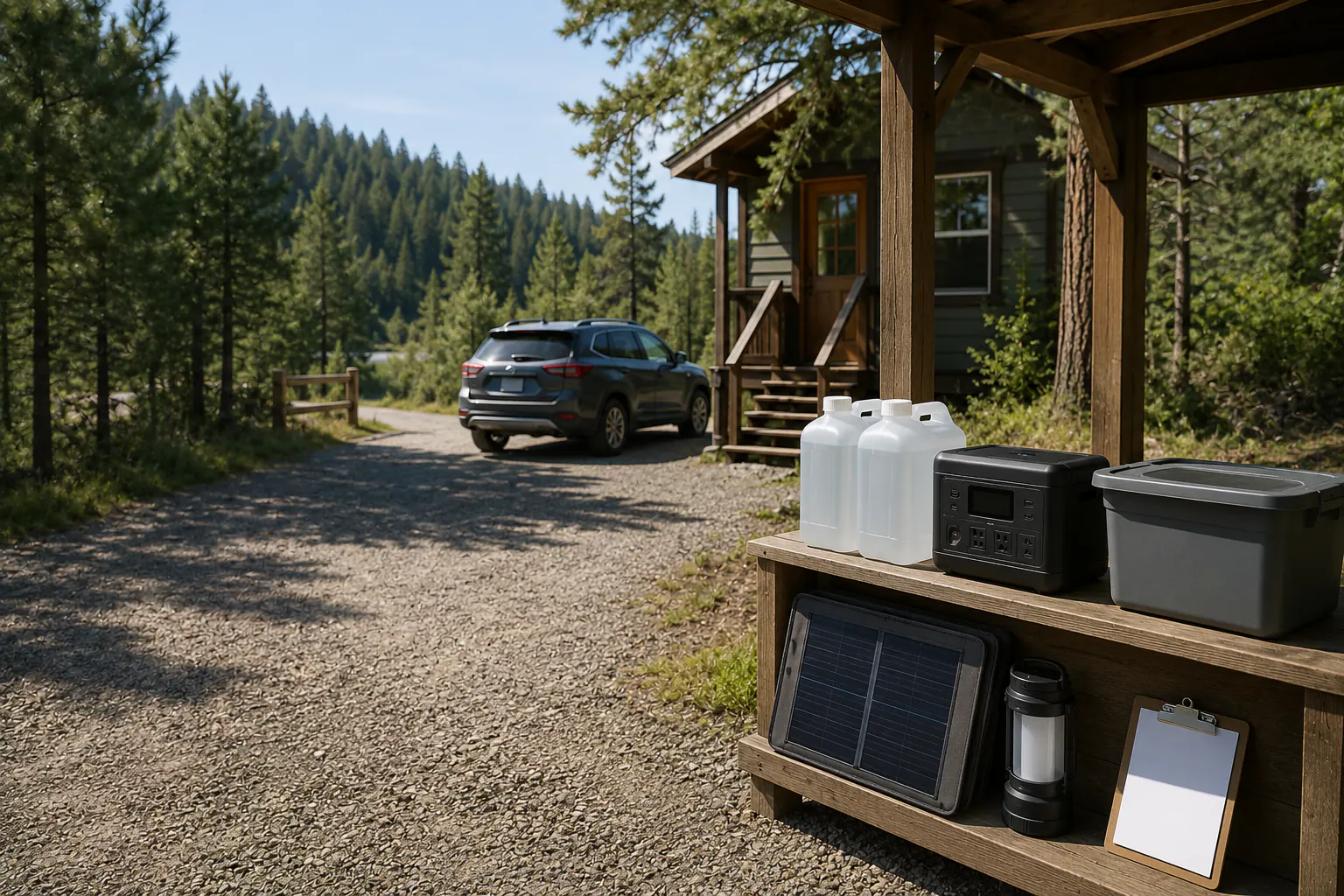
Name one proposed stay: who will be there, which utilities are missing, the permitted dates, and how everyone can leave. Ask the site operator about services and restrictions before buying equipment. Short-term off-grid practice should be reversible, not a test of how long a household can tolerate failing support.
A sound plan begins with permission, site conditions, weather, safe shelter, and an exit. Water, sanitation, energy, food, communication, medication, animals, and accessibility then become measurable daily systems. Equipment comes last.
Use this short-term off-grid family
- How to Run a 24-Hour and 72-Hour Off-Grid Trial turns ordinary preparation into a controlled, reversible practice sequence.
- Temporary Off-Grid Power for Cabins and Campsites connects measured loads, batteries, solar, generators, cords, weather, and carbon monoxide boundaries.
- Off-Grid Site Rules and Seasonal Go/No-Go Checklist creates one current record for permission, stay limits, fire restrictions, sanitation, food storage, access, weather, and exit triggers.
- Off-Grid Daily Water, Energy, and Waste Planner combines quantities already approved in specialist plans and exposes arithmetic gaps without declaring a setup safe.
The Emergency Water Storage hub owns safe stored-water quantities, containers, and rotation. The water-treatment limits guide owns source and contaminant decisions. The Emergency Sanitation hub owns toilet, hand-hygiene, waste, and sewage controls. The Backup Power hub owns load, output, capacity, recharge, and transfer planning. This family composes those systems for a temporary place; it does not rewrite them.
Define the exact stay before buying anything
Write a plain-language operating statement:
Two adults and one dog will use an owner-approved cabin from Friday afternoon to Sunday morning. Grid power and piped water are unavailable. The site has a verified toilet arrangement, a maintained road, current permission, and a named severe-weather exit.
That sentence identifies people, animals, duration, location, missing utilities, confirmed services, and exit. “Weekend off grid” identifies none of them.
Record whether the plan is for a developed campground, dispersed public-land site, private cabin, vehicle-supported camp, rented property, or a utility practice at home. Rules and realistic equipment change with the setting. BLM explains that developed sites range from serviced campgrounds to primitive facilities, while dispersed camping is short-term recreation subject to local closures, stay limits, vehicle rules, permits, and fire restrictions. A rule from one forest, park, county, or private parcel is not portable to another.
Build eight operating systems
| System | Question to answer before arrival | Owner or authority |
|---|---|---|
| Permission and site | May this exact group use this exact place on these dates and in this way? | Owner, permit issuer, land manager, lease, posted rules |
| Shelter and weather | What is the safe shelter, warning path, temperature range, and exit trigger? | NWS, local emergency management, site operator |
| Water | Which supply is confirmed safe, how much is stored, and what is the fallback? | Water authority, public health, EMR-WA plan |
| Sanitation and waste | Which toilet, wastewater, trash, food-waste, pet-waste, and handwashing route is approved? | Site operator, health/wastewater/solid-waste authority, EMR-SA plan |
| Energy | Which measured loads run, for how long, through which approved connections, and how do they recharge? | Equipment manuals, PWR-BP plan, qualified professionals |
| Food | Which meals fit the water, fuel, refrigeration, wildlife, and waste rules? | Food-safety guidance, site food-storage rules |
| Communication and exit | How are alerts received, who knows the itinerary, and what route remains usable? | NWS, emergency management, land manager, household contact |
| People and animals | Which medication, device, mobility, infant, service-animal, pet, sleep, and temperature needs change the plan? | Clinicians, manufacturers, accessibility providers, veterinarians |
A bin of gear can support these systems, but it cannot substitute for an unknown water source, prohibited toilet method, closed road, fire restriction, unsafe temperature, or missing medication plan.
Separate a controlled trial from an actual emergency
A practice stay should be voluntary, reversible, and close enough to support that a small failure becomes a lesson rather than an incident. Do not create danger by turning off medical equipment, disabling required alarms, draining the household’s only emergency water, using questionable food, testing an unfamiliar flame device, or placing a child, older adult, animal, or person with a disability beyond the plan’s support.
An actual outage is governed by the incident, utility, weather, evacuation, and public-health authorities. It may require early relocation rather than a longer demonstration of self-reliance. Use the evacuation-planning hub when the location is no longer supportable.
Treat weather as a system limit
Season changes every capacity. Heat increases water and cooling needs. Cold reduces some battery performance and raises shelter and heating consequences. Smoke can make outdoor air and solar assumptions unreliable. Snow and rain affect access, panel placement, cords, drainage, and dry storage. Wind can remove a shelter or make flame use prohibited. Flash flooding can isolate a route quickly.
The National Weather Service campground framework emphasizes planning, practice, monitoring, action, multiple warning methods, and a named weather watcher. A tent or open-sided shelter is not safe lightning shelter; the current NWS plan and a substantial building or hard-topped vehicle control that decision. If the site has no timely safe response to the forecast hazard, the correct off-grid skill is postponement.
Keep combustion outside the living space
Never move a generator, charcoal device, fuel-burning heater, or portable gas camp stove into a cabin, tent, vehicle, garage, shed, porch, or improvised enclosure to solve weather or theft concerns. Carbon monoxide cannot be detected by smell. CDC says generators belong outdoors more than 20 feet from windows, doors, and vents, and portable gas camp stoves are not for indoor use.
The complete generator carbon monoxide warning controls placement and emergency action. If a CO alarm sounds or anyone may have symptoms, move to fresh air and call 911; do not search the building for the source.
Make water and waste end-to-end systems
“We have a filter” is not a water plan. Name the stored safe supply, its volume, containers, dispensing method, protected location, and fallback. If treatment is proposed, record the source, identified contaminant, exact certified claim, operating limits, maintenance, and authority instruction. Appearance and taste cannot establish safety.
“There is a bucket” is not sanitation. Name the approved toilet route, hand-hygiene station, clean and dirty zones, sealed storage, disposal authority, trash route, food-waste protection, pet-waste route, and relocation trigger. Do not bury, dump, burn, disperse, or store waste from a generic internet instruction. The specific land manager and health, wastewater, or solid-waste authority control the method.
Reduce loads before adding energy
Measure the intended lights, communication devices, refrigeration, pumps, fans, and medically necessary equipment. Record watts, hours, surge, voltage, connector, and manufacturer requirements. Then calculate daily watt-hours and a conservative recharge range. Nameplate solar output is not daily harvest, and battery capacity is not the same as usable energy or output power.
A temporary plan should retain a non-electric route for light, communication, food, and safe exit where practical. Medical-device continuity belongs with the medical power plan, not a recreational battery estimate.
Write stop and exit triggers before arrival
Leave, relocate, or call the responsible authority when:
- permission, access, posted rules, or a required permit is unresolved;
- a closure, evacuation order, fire restriction, or severe-weather warning conflicts with the stay;
- no safe lightning, heat, cold, smoke, wind, flood, or wildfire response remains;
- safe water drops below the documented reserve or a source becomes uncertain;
- toilet, wastewater, trash, food, or pet waste cannot be contained and disposed of under current rules;
- medication, medical-device, mobility, infant, or animal support approaches its trigger;
- energy loss removes communication, safe lighting, critical refrigeration, or another protected function;
- fire, carbon monoxide, fuel leak, damaged electrical equipment, downed line, floodwater, sewage, illness, injury, or violence creates immediate danger;
- the exit route, vehicle, driver, phone, or designated contact is no longer viable.
Do not wait for every system to fail at once. The plan is strongest when it leaves early with margin.
Practice for repeatability, not hardship
Use ordinary meals, familiar equipment, a written inventory, and scheduled check-ins. Record water dispensed, energy used, recharge obtained, waste created, temperature, weather, tasks missed, and the moment a person became uncomfortable or overloaded. Restore the site fully and follow every food, trash, wildlife, and fire rule.
Afterward, remove gear that had no job, repair the failure path, and repeat only the smallest useful step. The objective is not to prove toughness. It is to build a household system that another responsible adult can understand and stop safely.
Sources reviewed
ReadyLience reviewed current Bureau of Land Management camping guidance, National Park Service camping practices, National Weather Service campground planning, federal emergency-kit guidance, and CDC carbon monoxide guidance on July 15, 2026. Current site-specific rules, restrictions, permits, forecasts, product instructions, and qualified professional decisions control the stay.