
An off-grid site can be physically accessible and still be unavailable, unsuitable, or illegal for the intended stay. A map pin does not establish ownership. An old campground review does not establish that water or toilets work. A fire ring does not prove a fire is currently allowed. Cell signal at the parking lot does not guarantee alerts at the site. A permit for one activity does not authorize another.
Use one dated go/no-go record for the exact place, people, vehicles, animals, dates, and equipment. Recheck it shortly before departure and again on arrival.
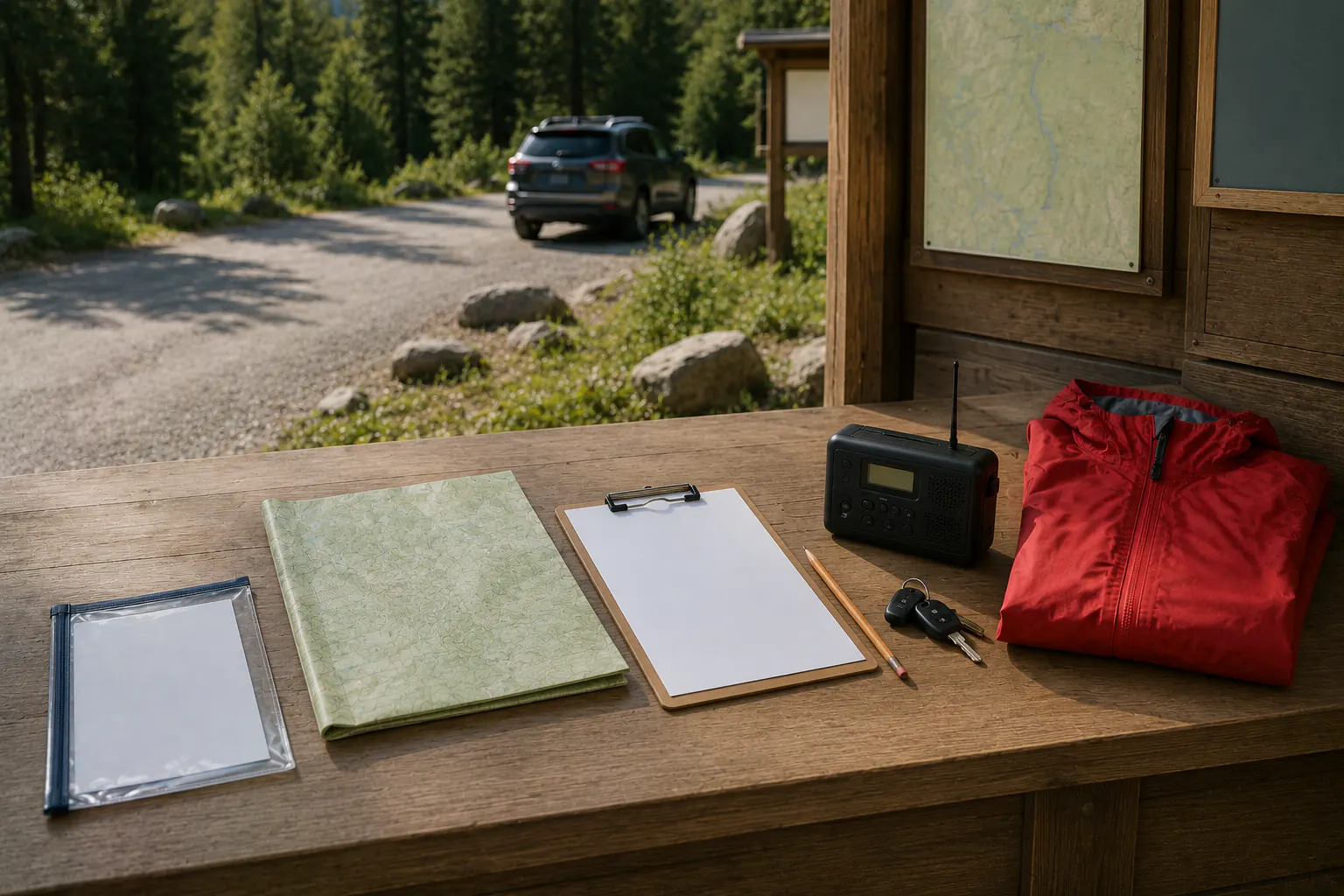
Start with the short-term plan
Use Off-Grid Living Basics to define the eight operating systems. Use the 24-hour and 72-hour trial before extending duration, and the temporary power guide for electrical and combustion boundaries.
This checklist deliberately merges the proposed “legal/site rules” and “seasonal limits” pages. Permission, fire, access, weather, water, sanitation, and exit are one decision. Splitting them could produce a legal yes for a seasonally unsafe site or a comfortable-weather plan that violates current rules.
Record the authority trail
Create a header with:
- official site or parcel name and precise location;
- owner or managing agency and local office;
- reservation, permit, or written permission identifier;
- dates and arrival/departure times;
- group size, ages or support needs relevant to the plan, and emergency contact;
- vehicles, trailers, generators, fuel, animals, and activities;
- official page, bulletin, closure map, or office contact checked;
- name or role of the person who provided clarification;
- date, time, and time zone of every check;
- next recheck time and the person responsible.
Keep a paper or offline copy. Do not publish private gate codes, exact unattended-cabin details, medical information, permit numbers, or a vulnerable person’s itinerary.
Permission and occupancy
Verify all that apply:
- the exact land is public, private, leased, rented, or otherwise identified correctly;
- the intended use is allowed, not merely access or day use;
- camping, overnight occupancy, a cabin stay, vehicle sleeping, dispersed camping, or a trial at home is permitted;
- group size, length of stay, check-in, checkout, reservation, fee, and unattended-property limits are met;
- parking, trailer, RV, off-road, gate, road, and seasonal vehicle rules are met;
- structures, tents, tarps, stakes, hammocks, lines, panel placement, and ground disturbance are allowed;
- generator, quiet-hour, lighting, drone, hunting, fishing, gathering, firewood, and commercial-use rules are understood;
- landlord, condominium, homeowner-association, insurer, mortgage, zoning, occupancy, building, and local code questions are resolved where relevant.
BLM describes dispersed camping as short-term recreation and warns that closures, stay limits, vehicle rules, permits, and fire restrictions vary by state, field office, and site. Do not convert a general federal summary into permission for a specific parcel.
Access and exit
Verify the route in both directions, not just the destination:
- current road, bridge, gate, ferry, trail, parking, and seasonal closure status;
- vehicle clearance, fuel or charge, tire, weather, and recovery limits;
- whether a gate can close before the planned departure;
- alternate route and the conditions that invalidate it;
- distance and time to safe shelter, medical help, fuel, potable water, and an approved waste route;
- mobility, transfer, carrying, child, animal, and darkness constraints;
- the point at which rain, snow, ice, heat, smoke, wind, flood, wildfire, or fatigue triggers early departure;
- a person outside the group who has the itinerary and missed-check-in action.
Do not rely on a route that requires trespass, closed roads, moving barricades, driving through floodwater, or capability beyond the driver and vehicle. Use the evacuation-planning hub for household movement and destination decisions.
Fire, combustion, and fuel
Check current fire restrictions on the date of use through the authority responsible for the site. Record whether each exact device is allowed: wood fire, charcoal, liquid-fuel stove, propane appliance, generator, heater, spark-producing tool, or vehicle use. A permitted device may still be unsafe under the weather or product instructions.
Verify:
- permit requirements and whether the permit remains valid under current restrictions;
- approved locations, fire rings, fire pans, clearances, supervision, water or extinguishing tools, and ash disposal;
- fuel transport, quantity, container, storage, refueling, and spill rules;
- generator placement, noise, operating-hour, and exhaust constraints;
- who can extinguish, shut down, report, and leave;
- a no-flame meal and lighting plan.
Do not collect firewood, cut vegetation, move rocks, build a ring, burn trash, dump ash, or leave a device unattended unless the specific rules allow the action. “Cold to the touch” is not a substitute for the land manager’s extinguishing and ash instructions.
Weather and safe shelter
Use the forecast for the site, not the home ZIP code. Identify multiple alert paths and a named watcher. Record action thresholds for lightning, flash flooding, severe thunderstorm, tornado, high wind, heat, cold, snow, ice, smoke, wildfire, and any local hazard.
For every credible hazard, write:
- where the group goes;
- how long movement takes with the slowest person and all animals;
- who gives the instruction;
- what equipment is abandoned rather than delayed for;
- when the group leaves before the hazard arrives;
- how an all-clear is confirmed.
The National Weather Service states that a tent and open-sided picnic shelter are not safe lightning shelter. A substantial building or hard-topped vehicle is the preferred safe place. If the group cannot reach appropriate shelter before thunderstorm conditions, choose another date or site.
Water
Confirm whether a tap, pump, spring, stream, lake, well, tank, or cistern is present and whether the responsible authority currently identifies it as potable. “Water available” may mean untreated, seasonal, shut off, frozen, contaminated, or intended only for another use.
Bring the protected stored supply defined in the Emergency Water Storage hub. If treatment is part of the fallback, use the filtration and treatment limits guide. Record the source, identified hazard, exact product claim, volume, maintenance, and alternative supply. Never assume boiling or a portable filter addresses chemicals, fuel, harmful algal toxins, salt, or an unknown contaminant.
Toilets, wastewater, trash, and hygiene
Ask the site operator or local authority:
- which toilets are open and whether they require water, power, a pump, or pack-out supplies;
- whether dispersed human-waste burial is allowed, prohibited, seasonally impossible, or replaced by pack-out rules;
- how toilet paper, hygiene products, diapers, sharps, medicines, graywater, dishwater, pet waste, food waste, ashes, batteries, fuel containers, and ordinary trash must be handled;
- whether trash service is operating and what must leave with the group;
- where handwashing occurs without contaminating a water source or food area;
- what capacity or closure condition triggers relocation.
Do not copy a cathole depth or distance from another park. Soil, rock, snow, desert crust, groundwater, water proximity, use intensity, wildlife, and local regulation change the method. The Emergency Sanitation hub and toilet continuity guide own containment and hygiene; the site authority owns what is allowed there.
Food, wildlife, and animals
Verify current food, trash, scented-item, cooking, cleaning, cooler, vehicle, locker, and wildlife rules. National Park Service guidance emphasizes keeping food secured and following park-specific storage methods; requirements can include lockers or approved resistant containers and can change by location and species.
Record pet and service-animal rules separately. A pet-friendly campsite claim does not define leash, vaccination, wildlife, heat, unattended-animal, waste, trail, or shelter conditions. Service-animal access is not the same as a pet policy. Use the pet emergency hub for medication, records, identification, carrier, destination, heat, and cold planning.
Power and communication
Confirm whether outlets are present, active, correctly described, and permitted for the intended load. Do not assume a cabin receptacle, campground pedestal, vehicle outlet, or old wiring is suitable because a plug fits. Fixed electrical work and transfer equipment require qualified review.
Verify cell coverage only as one layer. Register for applicable local alerts, identify radio coverage, keep a paper contact and route record, and establish scheduled check-ins. Use the multi-channel alert guide. A lack of signal can be acceptable only when the risk, itinerary, alternate communication, and missed-check-in response are deliberately planned.
Make the final go/no-go decision
Mark no-go when any of these is unresolved:
- permission, reservation, permit, stay limit, or legal access;
- current closure, fire restriction, weather warning, or safe-shelter plan;
- potable water quantity and fallback;
- toilet, wastewater, trash, food, pet-waste, and hand-hygiene route;
- medication, medical device, accessibility, infant, animal, or temperature support;
- compatible power and protected communication reserve;
- viable exit, competent driver, vehicle, route, external contact, and daylight margin.
Do not use money already spent, distance traveled, group enthusiasm, or equipment purchased as evidence to continue. Conditions can change after a valid go decision. Recheck on arrival and at scheduled points during the stay.
Sources reviewed
ReadyLience reviewed current BLM camping guidance, National Park Service camping and packing guidance, and National Weather Service campground and lightning planning on July 15, 2026. The exact owner, land manager, authority, posted rule, closure, forecast, permit, and qualified professional control the real decision.