
List the essential plug-in loads for one permitted stay before choosing a battery, solar panel, or generator. Check exact equipment compatibility, available energy, recharge, and site restrictions separately. Medical support, safe shelter, communication, and the exit reserve cannot depend on a consumer runtime estimate alone.
Start with a daily operating plan, not an equipment category. The short-term off-grid basics guide connects power with water, sanitation, shelter, and the exit plan.
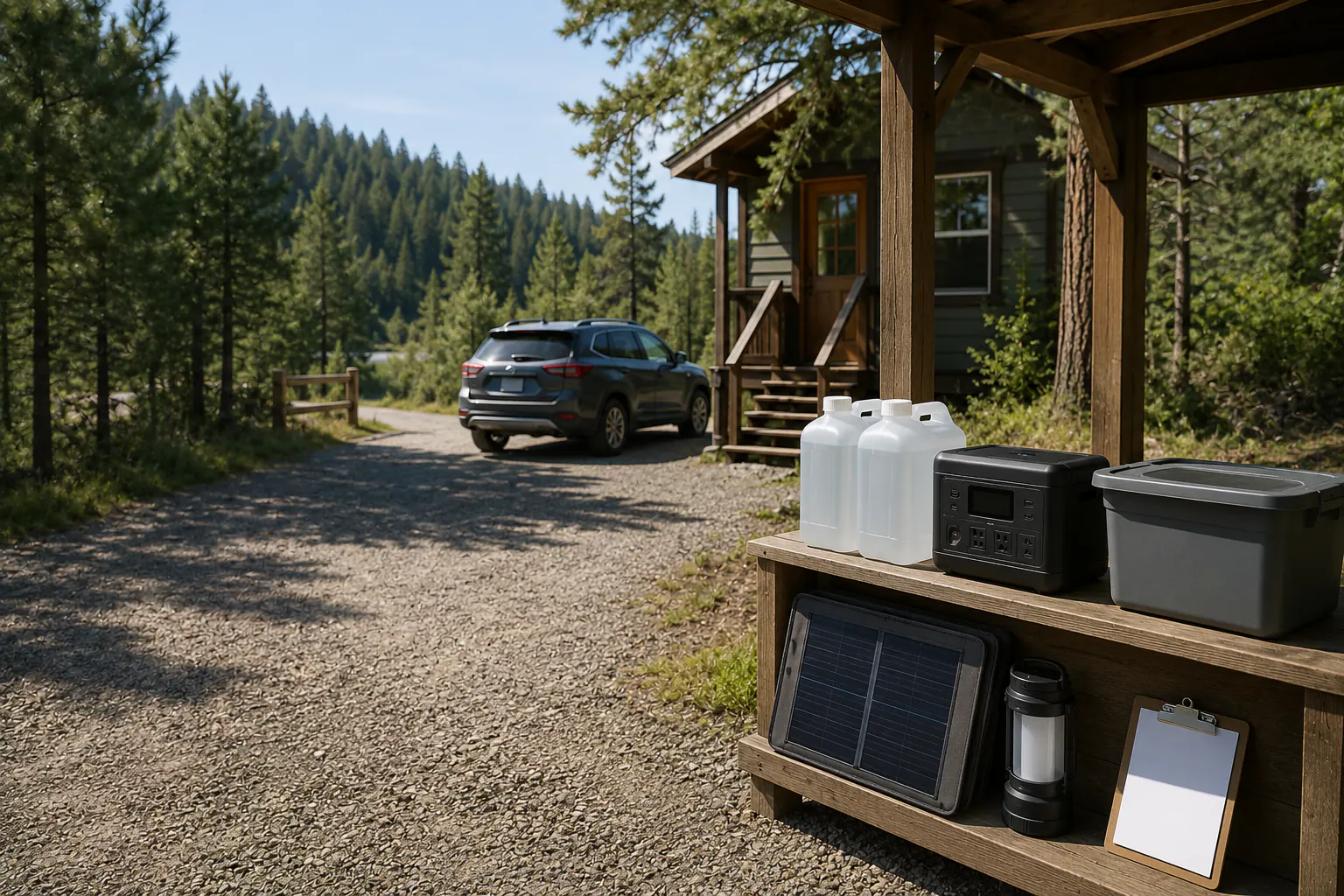
Keep system ownership clear
The Backup Power hub owns the full watts, watt-hours, surge, transfer, fuel, and technology decision. Its load worksheet provides the detailed arithmetic, and the runtime calculator provides a bounded estimate. Portable Solar Panels for Outages owns field-recharge limits.
This guide adds temporary-site questions: permission, transport, stable placement, weather exposure, security without enclosure, wildlife and food separation, quiet hours, fire restrictions, safe shelter, and the ability to leave with an energy reserve.
Define three energy budgets
Do not put every device in one undifferentiated list.
Protected continuity
These loads retain reserve and an independent fallback where possible:
- official alerts and essential communication;
- safe task and exit lighting;
- clinician-approved medical equipment and medication support;
- required mobility or accessibility devices;
- essential temperature monitoring;
- a safety system explicitly designed and approved for the setup.
Daily operation
These may include efficient food refrigeration, a water pump from a confirmed safe system, modest fans, task lighting, camera batteries, and device charging. They are scheduled around measured demand and current conditions.
Convenience
Entertainment, decorative lighting, high-draw cooking, electric resistance heat, nonessential tools, and redundant devices do not consume the protected reserve. Some should remain off the temporary system entirely.
The category depends on the household. A phone may be convenience during ordinary use but critical for a remote check-in. A fan may be modest electrically but important during heat. A refrigerator may protect essential medication or only replace a menu that could have been shelf stable. Record the consequence, not just the appliance name.
Measure both power and energy
For every intended load, record:
| Field | Why it matters |
|---|---|
| Running watts | Simultaneous output demand |
| Startup or surge watts | Whether a motor or compressor can start |
| Hours or duty cycle | Daily energy estimate |
| Watt-hours per day | Capacity and recharge budget |
| Voltage, waveform, port, polarity | Compatibility with the source |
| Cord and connector | Weather, current, trip, and damage control |
| Minimum reserve | The point at which convenience loads stop |
| Fallback and exit trigger | What happens when the source fails |
Use labels, manuals, manufacturer data, or an appropriate measuring device. Do not open equipment or probe wiring. The Department of Energy notes that actual demand can differ from a nameplate estimate; compressors and motors also create startup behavior that a simple energy total does not capture.
Treat a battery as equipment, not furniture
Place a portable power station on a stable, dry, protected surface with every ventilation clearance its manufacturer requires. Keep it away from rain, snow, condensation, standing water, direct flame, cooking grease, bedding, combustible storage, children, animals, vehicle heat, and an exit path. Do not place it inside a sealed box to prevent theft or weather exposure. Do not charge or operate a swollen, cracked, wet, dropped, recalled, unusually hot, odorous, smoking, or otherwise damaged battery.
Verify the exact operating and charging temperature range. Cold can reduce available performance; heat can increase risk and shorten life. Moving cold equipment into warm humid air can create condensation. Follow the manual’s acclimation and storage instructions rather than inventing a warming or cooling method.
Use only approved cables, adapters, chargers, and solar inputs. Similar-looking connectors can have different voltage, current, polarity, communication, or weather ratings. Never create a male-to-male cord, backfeed a receptacle, bypass grounding, defeat a protective device, or connect temporary equipment to cabin wiring unless the system is specifically designed, permitted, and installed for that purpose.
Keep generators out of every occupied enclosure
A cabin, tent, vehicle, trailer, shed, vestibule, porch, carport, garage, or open doorway is not a generator location. CDC says a portable generator must run outdoors, more than 20 feet from windows, doors, and vents, with exhaust directed away. The required separation also has to account for neighboring occupied spaces. A site too small or dense for compliant placement is a no-generator site.
Rain, snow, wind, noise, and theft do not justify moving a generator closer or enclosing it. Use only a manufacturer-approved weather solution that preserves every required clearance and exhaust condition. Never operate a generator while asleep unless the exact installed system and operating plan are designed and approved for that use; a portable unit beside a sleeping area is not such a system.
Review Generator Carbon Monoxide Safety before planning fuel-powered generation. A carbon monoxide alarm or possible symptoms mean fresh air and 911, not troubleshooting.
Make solar a conservative recharge path
Start with the station’s exact solar-input voltage, current, power, polarity, and connector limits. Confirm that the panel, configuration, cable, and controller are approved together. More panel nameplate wattage is not automatically compatible.
Then assess the actual site:
- unobstructed sun during the intended hours;
- tree, ridge, cabin, vehicle, smoke, cloud, and moving-shade effects;
- panel stability in wind without stakes, anchors, or lines that violate site rules or create trip hazards;
- dry, protected cable routes that do not cross roads, doors, paths, or drainage;
- safe handling around children, animals, and other visitors;
- a plan to secure or stow the panel before severe weather or departure.
Record measured watt-hours returned over the real window. Do not multiply panel nameplate power by daylight hours and call it guaranteed harvest. Preserve a non-solar fallback because multiple cloudy, smoky, shaded, or short winter days can occur together.
Schedule loads around recharge and reserve
Create a morning and evening energy check. At each check, write starting charge, protected reserve, expected loads until the next check, current recharge conditions, and the load that will be shed first.
Operate flexible loads when energy is genuinely available, not merely when the sun is visible. Charge small devices in a supervised block. Cool a refrigerator under its own food-safety plan. Avoid simultaneous surge loads. Do not drain communication reserve to complete an optional task.
The off-grid daily planner can compare an entered multi-day demand with starting usable energy and a conservative total recharge. Its positive result does not prove compatibility, battery health, solar output, or safe operation.
Plan cords as part of the site
Use only cords and distribution equipment approved for the load and environment. Inspect plugs, jackets, strain relief, grounding features, receptacles, and covers before use. Keep connections dry and off wet ground as instructed. Do not run cords through standing water, under rugs or bedding, through a closed door or window that can crush them, across a vehicle path, or where someone can trip in darkness.
Do not daisy-chain power strips or rely on an adapter to create a missing rating. The outage extension-cord guide explains inspection, load, route, wet-condition, and backfeed boundaries.
Protect medical and accessibility plans separately
Do not use a consumer runtime estimate as a medical guarantee. The clinician, device manufacturer, supplier, battery instructions, and care plan must define compatibility, charging, backup duration, alarms, storage, and relocation trigger. Keep a protected reserve and a destination with confirmed support. Use the medical-device power plan for this work.
Mobility equipment may require a ramp, transfer space, charger, vehicle capacity, or accessible destination that the power source cannot solve. A temporary site is unsuitable when the person cannot use it safely or leave before the reserve expires.
Use immediate stop rules
Shut down, disconnect only when safe, leave, or call the responsible authority for:
- a carbon monoxide, smoke, fire, gas, medical, or equipment alarm;
- damaged, wet, hot, swollen, leaking, sparking, smoking, or recalled equipment;
- fuel odor, spill, unstable generator operation, or unsafe exhaust direction;
- lightning, flooding, wildfire, high wind, extreme temperature, closure, or changed fire restriction;
- loss of protected communication, light, medication, medical-device, or exit reserve;
- a tripped protective device that will not remain reset after the load is removed;
- any proposed panel, transfer, grounding, fixed wiring, or electrical repair beyond the approved system.
Do not repeatedly reset a breaker, fuse, GFCI, battery fault, or generator shutdown to force operation. Preserve the evidence and use qualified help.
Test at home before transport
Run the exact approved plug-in loads for a short supervised cycle in a safe ordinary environment. Record startup, running demand, energy used, noise, heat, cables, charge time, and shutdown. Then test the packed system: every cable labeled, manuals available offline, ports protected, battery secured against movement, and fuel transported only under current law and instructions.
At the site, repeat inspection before connection. Conditions, permissions, weather, and fire rules may have changed since planning.
Sources reviewed
ReadyLience reviewed Department of Energy appliance-use guidance, current CDC carbon monoxide guidance, BLM camping rules, and National Weather Service campground planning on July 15, 2026. Product manuals, listings, site restrictions, authorities having jurisdiction, and qualified electrical and fuel professionals control actual use.