
Start with the heating system you already have: what stops working without electricity, and who can confirm its backup requirements? Then compare any other option against the room, power supply, instructions, supervision, and household needs. An “indoor safe” headline cannot answer those questions.
This page compares categories, not products or prices. It helps you rule out an unsuitable option before buying anything. The space-heater warning owns placement and stop rules; no table here authorizes a heater in your home.
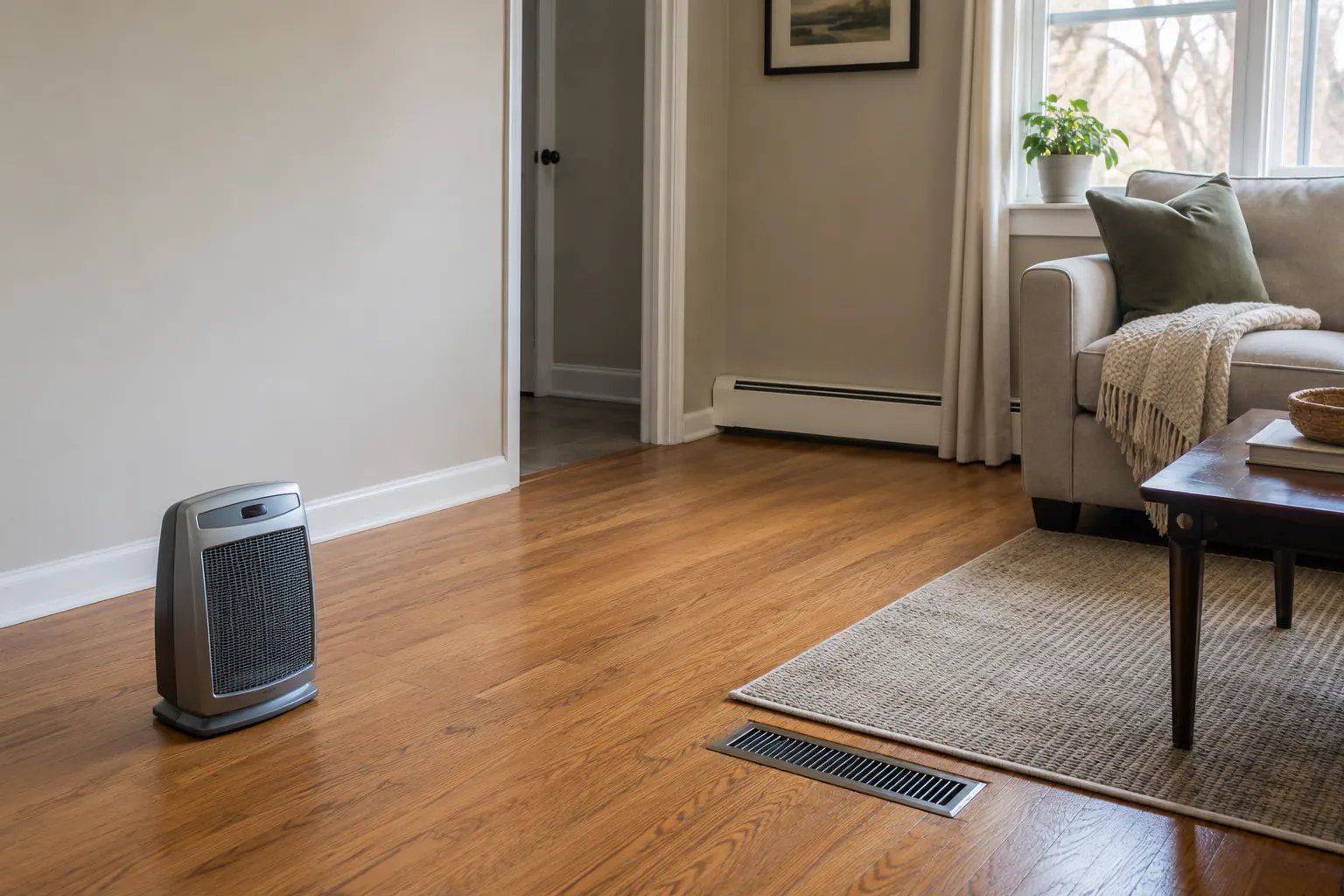
The safety picture before the comparison
Two federal patterns should frame every choice.
Portable heaters are a small share of home heating fires but a large share of the deadly ones. The U.S. Fire Administration reports that home portable heater fires were about 3% of home heating fires for 2017–2019, yet accounted for roughly 41% of fatal home heating fires. The leading contributing factor was a heat source placed too close to combustible objects, at about 48%, and these fires most often started in bedrooms. (Source: U.S. Fire Administration, Portable Heater Fires in Residential Buildings.)
Combustion equipment intended for outdoor use produces carbon monoxide that can accumulate to lethal levels indoors. CPSC repeats this every winter because households improvise heat during outages. (Source: CPSC, Carbon Monoxide Information Center.)
Those are national historical patterns, not a forecast for your home. Check clearance, supervision, power connection, and exhaust separately rather than treating one protective feature as approval.
The categories
| Category | Needs grid power | Exhaust hazard | Realistic emergency role |
|---|---|---|---|
| Installed central system (furnace, boiler, heat pump) | Often; exact system controls | Fuel-burning systems require designed exhaust; electric heat pumps do not burn fuel at the point of use | Ask qualified professionals what the actual system needs during an outage |
| Installed vented fuel heater / fireplace / wood stove | Sometimes no | Vented by design; requires intact chimney or flue and maintenance | Can work during an outage where already installed, inspected, and fueled |
| Electric portable heater | Requires a permitted electrical supply | No combustion at the point of use; fire and burn risks remain | Supervised use within both equipment instructions; backup supply is not automatically compatible |
| Unvented fuel-burning portable heater | Model-specific | Releases combustion products into occupied air | Confirm exact indoor approval, legal/property restrictions, and all operating conditions; otherwise rule it out |
| Outdoor combustion equipment (grill, camp stove, generator, patio heater) | No | Lethal indoors | Never used inside any enclosed or partly enclosed space, including a garage or porch |
| Unpowered clothing/bedding, occupied room, heated destination | Clothing/bedding do not need an electrical supply; a destination still needs safe heat | No burner added by the clothing or bedding | Person-specific fit, safe sleep, clear exits, assistance, and transport still matter |
The last row is not a consolation prize. In many households it is the plan.
Installed systems: the real backup question
If your home already has a furnace, boiler, or heat pump, the emergency question is not which heater to buy. It is what your system needs to run when the grid is down, and that answer is system-specific.
Even where a heat pump moves more heat per unit of electricity than resistance heat, startup behavior, controls, blowers, pumps, defrost cycles, auxiliary resistance stages, and cold-weather capacity all change the demand. (Source: U.S. Department of Energy, Heat Pump Systems.) None of that can be estimated from a nameplate during an outage.
Two rules hold regardless of equipment:
- Never feed an installed system through an improvised cord, and never backfeed household wiring. Any connection to a furnace, boiler, or panel requires listed transfer equipment and a qualified electrician.
- Fuel supply, venting, and maintenance are part of availability. A vented fuel system with an empty tank, a blocked flue, or a skipped service is not a backup.
Plan this through the backup power hub with qualified HVAC and electrical professionals, and keep system records in the HVAC resilience hub. This is the one category where the correct action is often a scheduled professional conversation months before the cold arrives.
Electric portable heaters: supply and supervision both matter
An electric portable heater does not burn fuel at the point of use. It still needs a suitable supply, room, connection, clearance, and awake supervision.
Its constraints are structural:
- Power is a separate constraint. A backup source must be permitted by both manufacturers and have adequate output and usable energy. The battery-and-heater guide separates compatibility from runtime.
- Clearance is essential, not the whole safety margin. Keep the required distance from bedding, furniture, curtains, and clothing, alongside stable placement, connection, and supervision rules.
- Connection matters. Manufacturer instructions typically require a direct wall outlet, not an extension cord or power strip. Repeated breaker trips are a stop condition, not a prompt to find another outlet — see signs of an overloaded circuit and extension cord safety.
Every placement, supervision, and stop rule for this category lives in the space-heater safety guide. Do not operate one from this comparison alone.
Unvented fuel-burning portable heaters: the category to treat as restricted
These devices burn fuel and release combustion products into the occupied space by design. Some are marketed for indoor use with oxygen-depletion sensors and specific ventilation instructions.
Treat this category as restricted rather than available:
- Check the actual lease, property rules, local code, and restrictions. A prohibition is not overridden by a product claim.
- Their required ventilation, room volume, fuel storage, and supervision conditions are exacting, and an outage is the worst moment to satisfy them for the first time.
- A carbon monoxide alarm is a warning device, not permission or proof that equipment is operating safely. Follow the alarm-response instructions if it sounds.
If a household is considering this category, the honest sequence is: confirm legality and lease terms in writing, confirm the exact manufacturer conditions, confirm working CO alarms, and then seriously compare the option against relocating instead. Read the carbon monoxide safety guide before, not after.
Outdoor combustion equipment: never indoors
Grills, charcoal appliances, camp stoves, patio heaters, and generators are not heating options for occupied space. Never operate them inside a home, garage, basement, shed, porch, tent, or any other enclosed or partly enclosed area, and never use a cooking oven or range to heat a home.
There is no open-window, partly open door, or alarm-based exception for outdoor-only equipment indoors.
Clothing, bedding, and a heated destination
These belong in the plan even if the household has heating equipment. They are not a guarantee that everyone can remain in the same cold room:
- Dry layers and bedding. CDC notes that hypothermia can occur even at cool temperatures above 40°F when a person is chilled by rain, sweat, or wet clothing, and recommends loose, dry layers. (Source: CDC, Preventing Hypothermia.) The indoor cold sleeping-system comparison separates clothing, blankets, and sleeping bags honestly.
- One occupied room. Keeping people together can make check-ins and supplies easier to manage. The warmer safe-room guide preserves exits, ventilation, alarms, and plumbing awareness; room choice does not guarantee a temperature.
- Envelope work done in advance. Weatherization slows the rate of heat loss; it does not make an unheated home safe indefinitely. See the weatherproofing hub.
- Relocation. CDC’s guidance for a home that cannot be kept warm is to make temporary arrangements to stay elsewhere. That is a legitimate primary plan, not a failure.
A conservative decision sequence
- Identify what you already have installed, and ask a qualified professional — before winter — what it needs to run during an outage.
- Assume the grid is down when evaluating any electric option, and check the honest runtime math rather than a capacity number.
- Rule out every outdoor combustion device for indoor use, permanently and without exception.
- Treat unvented fuel heaters as restricted until legality, lease, manufacturer conditions, and CO alarms are all confirmed in writing.
- Check clothing, suitable bedding, assistance, and a heated destination. Keep infant sleep rules and individual care needs intact; none of these measures guarantees continued safe occupancy.
- Write down the departure trigger. Temperature, medical need, alarm activation, fuel exhaustion, or an unsafe device all mean leave, not improvise.
The extreme cold and emergency heating hub holds the full plan and the escalation boundaries. No comparison table on this page authorizes a device in your specific home; product instructions, local code, lease terms, and qualified professionals do.
Sources reviewed
ReadyLience reviewed current heating-fire, portable-heater, carbon-monoxide, hypothermia, winter-weather, and heat-pump guidance from the U.S. Fire Administration, CPSC, CDC, Ready.gov, and the Department of Energy. Federal statistics are cited as national patterns, not predictions for any individual home. Current emergency orders, utilities, property authority, clinicians, equipment instructions, recalls, and qualified fire-safety, HVAC, fuel, chimney, and electrical professionals control the actual decision. ReadyLience has not tested any heating product and does not recommend one.