
Find the heater’s rated input and the power station’s permitted continuous output before estimating runtime. An outlet that looks compatible is not enough, and a battery capacity headline does not establish an overnight heating plan. Compare usable energy only after both exact manuals permit the arrangement.
The emergency heating hub puts this choice in the wider household plan. The space heater safety guide controls heater use regardless of the arithmetic.
The safe question has four parts:
- Is the heater permitted, intact, stable, and suitable for the room?
- Can the power station supply its continuous watts without exceeding any output or connection limit?
- How much usable energy remains after conversion losses and reserve?
- What critical loads and relocation capacity would that heating load displace?
Do not buy or connect equipment from an online runtime claim alone. Use the exact manuals and labels for both products.
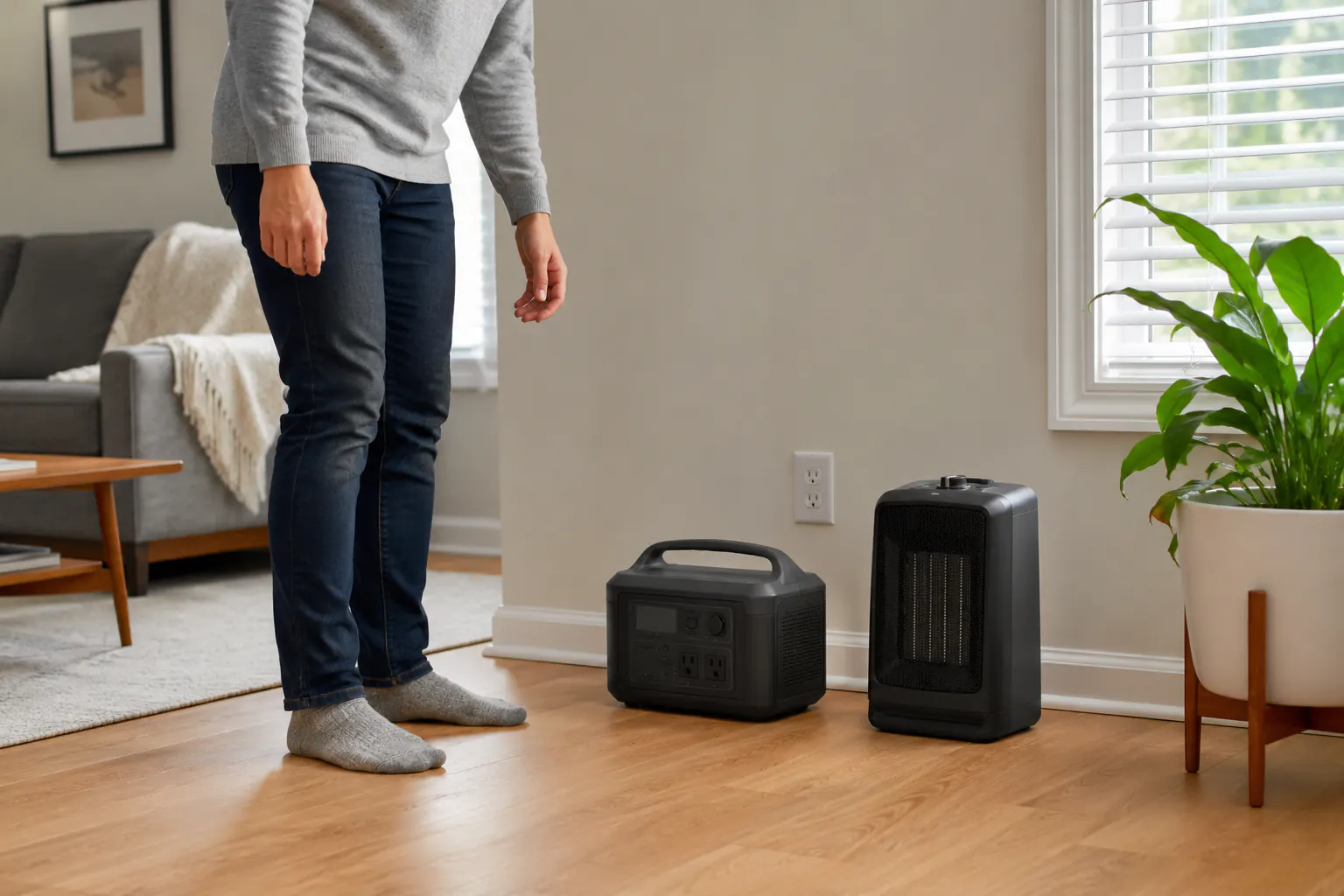
Separate watts from watt-hours
Watts describe power at a moment. Watt-hours describe a quantity of stored energy. A heater labeled 1,500 watts demands roughly that power while its heating element runs. A battery advertised at 1,000 watt-hours does not therefore run it for 1,000 hours, or even necessarily for 40 minutes.
Use this planning estimate:
Runtime hours = usable output watt-hours / average running watts
Usable output energy depends on state-of-charge limits, conversion losses, reserve, temperature, age, and overhead. A thermostat’s duty cycle also depends on the room and conditions. Use documented values or explicitly stated assumptions; do not depend on favorable cycling you have not established. A household calculation is not product-test evidence or permission to connect the equipment.
For illustration only, suppose a station advertises 1,024 Wh. If a cautious planning model makes 80% available after conversion and reserve, usable output is about 819 Wh. At a continuous 1,500 W load:
819 Wh / 1,500 W = about 0.55 hour, or roughly 33 minutes.
That is a mathematical scenario, not a product test or runtime promise. Cold batteries, protective shutdown, heater controls, cable or outlet restrictions, and actual conversion behavior can change the result.
Use the power-station runtime calculator with the actual equipment values and record every assumption.
Pass the power limit before estimating runtime
Check the power station’s continuous AC output, not only a marketing surge figure. Check whether the manufacturer permits high continuous resistive loads and whether cold-weather operation, ventilation, grounding, neutral configuration, outlet use, and charging-while-discharging create restrictions.
Check the heater’s nameplate input. Do not infer watts from a heat-setting label such as low or eco. Do not use an adapter, modified plug, power strip, extension cord, splitter, or daisy chain to make an incompatible connection appear possible.
The power station must sit on a stable hard surface with the clearances and airflow its manual requires. It must remain dry, undamaged, visible, and away from the heater’s hot-air path and required three-foot combustible-clearance zone. Never place either device on bedding or upholstered furniture.
If a plug, receptacle, cable, case, or surrounding surface becomes unusually warm, stop use. The overloaded-circuit warning and extension-cord safety guide explain why a functioning outlet is not proof of a safe connection.
Protect essential-load reserve
A short heating run can consume energy reserved for:
- a phone, radio, or internet equipment needed for alerts;
- lighting and an accessible exit path;
- a prescribed medical device or medication storage;
- alarm backup, communication aids, or mobility equipment;
- transport coordination and navigation;
- a refrigerator or other explicitly prioritized load.
List these loads first in the home backup-load worksheet. The winter medical plan and device instructions control medical priorities. Do not trade a clinician-approved runtime reserve for general comfort.
Reserve also protects the ability to respond if restoration slips, a destination changes, or the battery must power communication during relocation. A display reading of 20% is not a universal safety reserve; choose the reserve from the household consequence of losing power.
Compare heat delivered, not outlet convenience
Electric resistance heaters convert electrical input into heat at the point of use, but battery storage is finite. Heat pumps move heat and can use substantially less electricity for the same heating service under appropriate rated conditions, yet installed heat pumps involve system-specific cold-weather capacity, startup, defrost, auxiliary resistance heat, controls, and backup-power design. DOE notes that modern heat pumps can use much less electricity than electric resistance heating; that does not authorize powering an installed system from a portable outlet.
A heated blanket or pad may have a lower nameplate wattage than a room heater, but it introduces different fire, burn, supervision, moisture, medical-device, age, pet, and sleep-use restrictions. Use only a product explicitly suitable for the person and setting, exactly as instructed. Never place a powered product in an infant sleep space or treat low wattage as automatic safety.
Often the most resilient battery strategy is to power information, light, medical continuity, and transportation while using dry layers and unpowered bedding to warm people. The indoor cold sleeping guide covers that decision.
Do not improvise installed heat
Do not plug a furnace, boiler, heat pump, baseboard circuit, fireplace blower, pellet appliance, or building system into a power station unless the exact system was designed and professionally approved for that supply arrangement. Installed heating may involve fixed wiring, transfer equipment, grounding and neutral requirements, pumps, controls, combustion safety, and loads that are not apparent from one label.
Never backfeed a receptacle or panel. Never create a male-to-male cord. Never open the power station, heater, panel, or heating equipment. Plan installed backup through the home backup-power hub, the equipment manufacturer, and qualified HVAC and electrical professionals.
Run a paper decision before a heater
Record:
| Input | What to verify |
|---|---|
| Heater watts | Exact nameplate and manual, including each mode |
| Station output | Continuous AC limit and high-load restrictions |
| Battery energy | Rated Wh, usable percentage, conversion loss, reserve |
| Conditions | Permitted temperature, moisture, ventilation, clearances |
| Average load | Measured or conservatively assumed duty cycle |
| Essential reserve | Medical, communication, lighting, transport, refrigeration |
| Stop point | Minimum remaining energy and maximum planned run |
| Alternative | Layers, occupied zone, heated destination, transport trigger |
Calculate at least a conservative continuous-load case. If that runtime is not useful, do not let an optimistic thermostat assumption justify the plan.
When the math says no, what actually works
If the conservative calculation leaves too little useful runtime or essential reserve, rule out that combination for this job. That result does not establish what every station or household can do. It gives you a reason to revisit the actual plan before buying a larger battery.
- Check suitable clothing and bedding. The indoor cold sleeping guide keeps fit, assistance, infant sleep, and departure limits visible. Bedding is not a substitute for required room heat or clinical care.
- Choose a practical occupied room. The warmer-room guide helps organize check-ins, supplies, exits, alarms, and required ventilation; it does not guarantee a temperature.
- Preserve essential reserve. Communication, medical equipment on a clinician-approved plan, alarms, and light still need their own power plan. Do not spend their reserve on general comfort.
- Leave while leaving is easy. A heated destination is not a failure of the plan; it is the plan working. Decide the trigger in advance rather than after the reserve is gone.
Read the emergency heating options comparison before buying any device on the theory that a bigger battery will solve this. The category limits described there apply regardless of capacity.
A worked example, and its honest caveats
Suppose a station advertises 1,000 Wh and a heater draws 1,500 W on its high setting.
Rule out the full 1,500 W operating mode if permitted continuous output is below that load. Even with adequate output, both manuals and connection limits must allow it. The idealized arithmetic is 1,000 Wh ÷ 1,500 W ≈ 0.67 hours, or 40 minutes before losses and reserve; that is not usable runtime or permission to connect.
Actual output energy, protective limits, reserve, temperature, and cycling can change the result. A lower documented power setting changes the calculation, but do not assume a setting label states its wattage or that it can maintain suitable room conditions.
Treat this as a planning illustration, not a measurement. Use actual documented ratings in the runtime calculator. Uncertain compatibility belongs with the manufacturers or qualified professionals, not a trial connection during an outage.
Use heating equipment under its own safety rules
Even a mathematically compatible pair must pass the space-heater safety guide. Keep the heater stable, supervised, and at least the instructed distance from anything combustible. Turn it off when leaving the room or sleeping. Never use it to dry clothes or warm bedding directly.
A battery power station removes combustion from the electricity source; it does not remove heater fire, burn, tip-over, clearance, cord, or supervision hazards. It also does not make a cold home safe for an unlimited period.
Sources reviewed
ReadyLience reviewed current DOE heat-pump and resistance-heat context, Ready.gov outage guidance, and CPSC and USFA portable-heater safety guidance. Calculations are transparent planning examples, not laboratory or household tests. Exact product instructions, recalls, site conditions, clinicians, property authority, and qualified electrical, HVAC, fire-safety, and medical professionals control actual use.