
When a home loses heat, the fastest safe improvement is almost never a device. It is what people wear and sleep in. Clothing, blankets, and sleeping bags need no fuel, no exhaust, no watts, and no supervision, which makes them the one category that scales to a whole household without creating a fire or carbon monoxide risk.
They also carry a specific honesty problem: the numbers printed on the products do not mean what shoppers assume, and improvising warmth around an infant can be lethal. This comparison separates the categories and states the limits plainly.
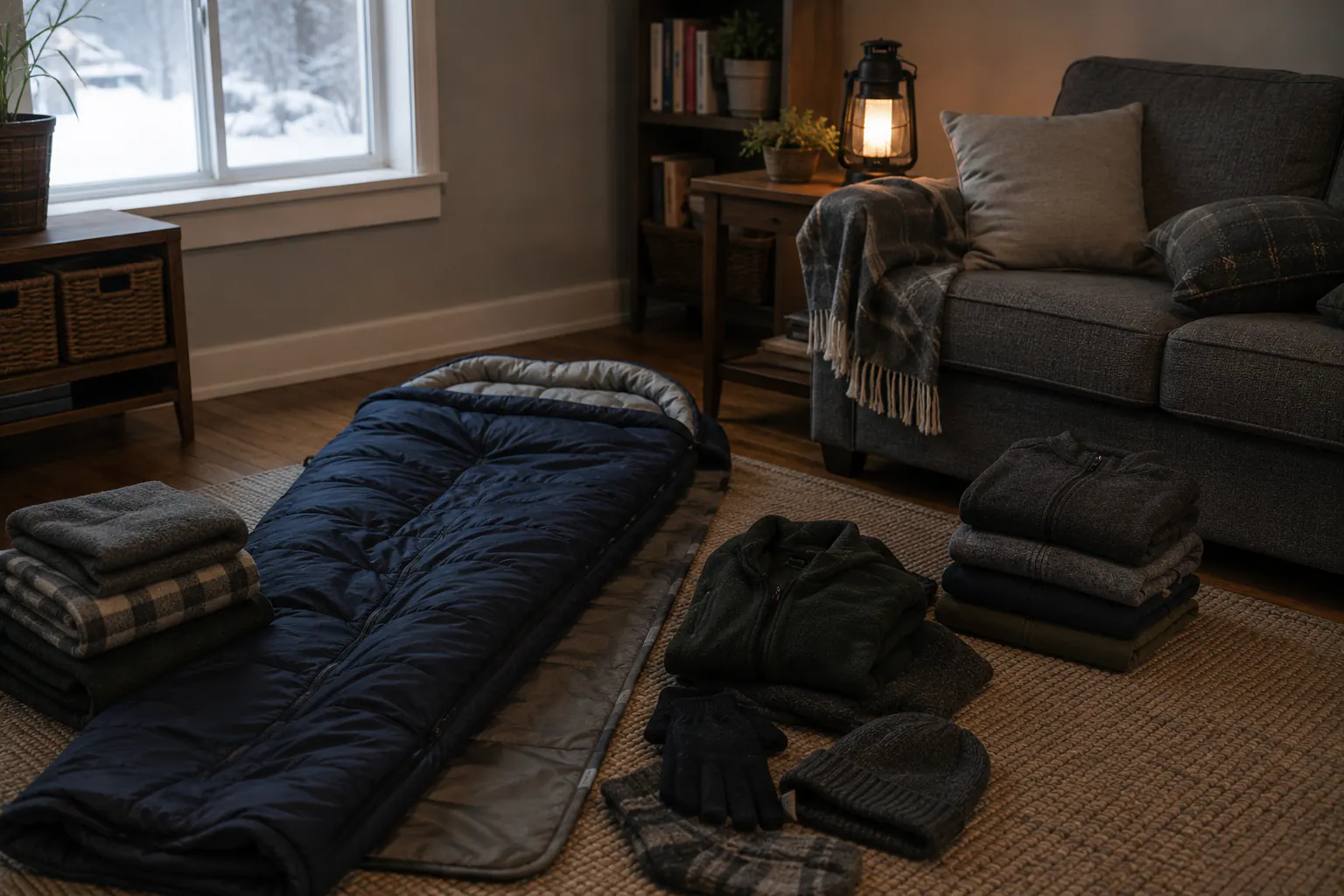
What the cold actually does indoors
Hypothermia is not only an outdoor, sub-freezing event. CDC notes it can occur even at cool temperatures above 40°F if a person becomes chilled from rain, sweat, or wet clothing, and it recommends loose, dry layers. (Source: CDC, Preventing Hypothermia.) In an unheated home the drivers are usually time, damp clothing, inactivity, and age or medical vulnerability — not a dramatic temperature reading.
That shapes the whole comparison: dry beats thick, and layered beats single.
The three categories
| Category | Strongest use | Main limit |
|---|---|---|
| Clothing layers | Worn during waking hours; adjustable as activity changes | Only works while dry; a sweated-through layer becomes a cooling layer |
| Blankets | Familiar, shareable, easy to add or remove | Warmth depends on trapped air and dry loft, not weight; loose bedding is unsafe for infants |
| Sleeping bags | Concentrated warmth for one person during sleep | Temperature ratings are not household guarantees; poor fit for shared beds and limited mobility |
Most households need all three, used for different hours of the day.
Clothing layers: the adjustable base
Layering works because trapped air insulates and because layers can be removed before sweating starts. The practical structure is familiar:
- a base layer that moves moisture away from skin;
- a middle layer that traps air;
- an outer layer that blocks draft;
- a hat, because an uncovered head loses heat and is the easiest thing to forget indoors;
- dry socks, changed as often as needed.
Two rules do the work. Remove a layer before you sweat, because damp clothing accelerates cooling — this is exactly the mechanism CDC flags above 40°F. And change out of anything damp immediately, even if the room feels tolerable.
Dress children in one more layer than an adult would wear in the same conditions, and check them more often than you check yourself.
Blankets: familiar, but warmth is loft, not weight
A blanket insulates by holding still air. That means loft and dryness matter more than heft. Several lighter blankets with air between them generally outperform one heavy compressed one, and a damp blanket is worse than none.
Practical use in an unheated home:
- Layer blankets rather than searching for one thick one.
- Put an insulating layer under people as well as over them; a cold mattress, sofa, or floor pulls heat away continuously.
- Share body heat where appropriate. CDC describes skin-to-skin contact under loose, dry layers of blankets, clothing, towels, or sheets as an emergency warming measure. (Source: CDC, Preventing Hypothermia.)
- Keep bedding well clear of any heat source. The USFA contributing-factor data for fatal portable-heater fires points at combustibles near the heat source, most often in bedrooms — bedding is exactly that combustible.
Sleeping bags: real warmth, unreliable numbers
A sleeping bag concentrates insulation around one person and can be genuinely effective for overnight cold. The problem is the label.
Temperature ratings are produced under standardized laboratory conditions with a defined sleeping pad, a defined base layer, and a defined test manikin. They are not a promise that a specific person will be safe or comfortable at that number in a cold living room. Real outcomes vary with metabolism, age, hydration, food, illness, medication, fatigue, humidity, what is underneath the bag, and whether the occupant is already chilled.
Treat a rating as a rough category marker, never as a safety threshold. In practice:
- What is under the bag matters as much as the bag; an insulating pad or layered blankets beneath prevents conduction into a cold surface.
- Fit matters; a bag far too large for a child wastes the trapped air it depends on.
- Mobility matters; anyone who may need to exit quickly, or who has limited strength or mobility, should not be zipped into a restrictive bag.
- Bags are poor for shared beds and for caregivers who must reach someone during the night.
ReadyLience has not tested sleeping bags and does not rank them. A credible comparison would have to record the pad used, the base layer, the ambient conditions, the occupant, and repeated measurements — none of which a product page provides.
Infants: the hard boundary
This is the section that overrides convenience. Cold-weather improvisation does not create an exception to safe-sleep guidance.
- Infants under one year old should not sleep in a cold room; they lose body heat more easily than adults.
- Dress a baby in warmer clothing designed for sleep — footed pajamas, a one-piece wearable blanket, or a sleep sack — rather than adding loose blankets.
- Keep pillows, loose blankets, soft bedding, and padded improvised sleep spaces out of the sleep area; these increase the risk of suffocation and sudden infant death. (Source: NICHD, Safe Sleep Environment; CDC winter-weather guidance.)
- Skin-to-skin contact under loose dry layers is an emergency warming measure, not a sleeping arrangement.
- If the home cannot be kept warm enough for an infant, relocate. That is the guidance, and it is the answer.
Follow your clinician and current safe-sleep guidance over anything in a cold-weather article, including this one.
Older adults, medical conditions, and medication
Age, chronic illness, some medications, alcohol, and reduced mobility all change how quickly someone loses heat and how well they notice it. Someone who says they are “fine” may not be a reliable sensor.
Check on vulnerable household members and neighbors on a defined interval rather than on impression, and hold their departure trigger lower than your own. The winter medical-device and vulnerable-household plan owns clinician-approved thresholds and device continuity; a bedding decision never overrides it.
Where bedding stops
Bedding buys time. It does not heat a building, and it does not have a stop rule of its own — which is why it needs one imposed from outside.
Leave for a heated location when indoor temperature keeps falling, when anyone shows signs of cold illness, when an infant cannot be kept warm, when medical equipment or medication continuity is at risk, or when the route out is about to become unusable. CDC’s instruction for a home that cannot be kept warm is to make temporary arrangements to stay elsewhere; the warmer safe-room guide and the safe winter outage sequence both end at the same place.
Use the emergency heating options comparison to see why the non-heating layer is usually the scalable one, and the extreme cold hub for the complete plan.
Sources reviewed
ReadyLience reviewed current hypothermia-prevention, winter-storm safety, cold-weather, and safe-infant-sleep guidance from CDC, Ready.gov, the National Weather Service, and NICHD, plus U.S. Fire Administration heating-fire context for keeping bedding away from heat sources. Temperature ratings are described as standardized laboratory categories rather than safety thresholds. Current emergency orders, clinicians, current safe-sleep guidance, product instructions, and qualified professionals control the actual decision. ReadyLience has not tested any sleeping bag, blanket, or clothing product and does not recommend one.