
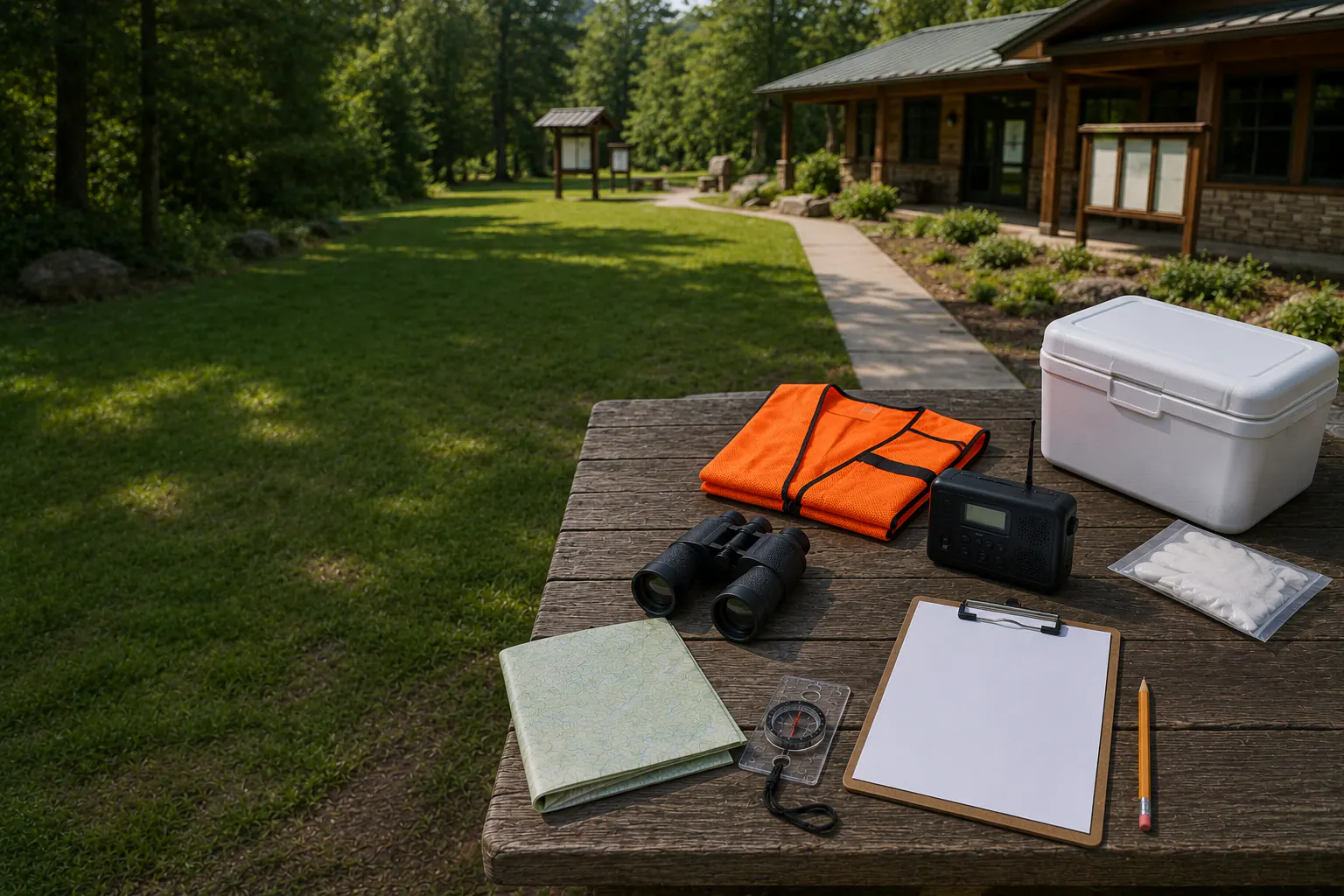
Hunting can provide food, outdoor knowledge, and a closer understanding of local wildlife management. It is also a regulated activity with consequences that cannot be reduced to buying gear and walking into the woods. A lawful hunt depends on the person, jurisdiction, species, date, location, land status, legal method, education record, license, tag, reporting duty, current closure, and public-health conditions. A usable harvest adds another system: field hygiene, wildlife-disease instructions, rapid cooling, protected transport, processing, storage, and cooking.
For a beginner, those systems should be learned in order. ReadyLience treats hunting as a planned, ordinary-season skill developed through official education and supervised experience. It is not an emergency shortcut, a promise of calories, a self-defense subject, or a reason to ignore closures, seasons, property rights, conservation rules, or food-safety limits.
Use this hunting family
- How Hunter Education Works for Adult Beginners explains how to start with the agency-recognized course and a qualified mentor rather than informal weapon instruction.
- How to Research State Hunting Licenses, Seasons, and Rules creates a dated compliance file for the exact person, species, place, date, and method.
- Wildlife Observation and Responsible Hunt Planning Basics develops low-consequence observation, identification, route, weather, communication, and go/no-go habits before a live hunt.
- Non-Offensive Hunting Clothing, Navigation, and Safety Checklist covers visibility, weather, communication, first aid, navigation, water, and carcass-care logistics without recommending a weapon.
- Field Dressing Education and Wildlife-Disease Precautions explains why hands-on instruction, dedicated tools, protective equipment, disease checks, and stop rules belong in the plan.
- Game Meat Cold Chain: Cooling, Transport, and Storage Handoff connects the field to refrigerated processing without pretending that appearance or cold weather proves safety.
The Transferable Outdoor Skills hub owns benign map, compass, weather-cover, communication, and practice skills. The Food Preservation hub begins only after the harvested food has remained suitable under the applicable game, disease, handling, temperature, and processor rules.
Reject the emergency-harvest fantasy
A household cannot responsibly make “hunt for food after the disaster” a primary food plan. Seasons may be closed. Emergency orders may restrict travel, fire, access, or methods. Wildlife may be displaced or stressed. Roads, communications, refrigeration, processors, testing stations, and emergency response may be unavailable. Other people may be present on land where visibility and identification are already difficult. A person who has not completed training and lawful practice does not become competent because groceries are scarce.
Build stored food, water, cooking, sanitation, medical, communication, and evacuation systems first. The Emergency Food Storage hub owns household reserves. Hunting, where lawful and already practiced, remains supplemental and uncertain. Record no projected pounds in an emergency menu until food is legally harvested, handled, accepted, and available.
This boundary improves planning rather than diminishing the skill. It moves hunting into a repeatable calendar with current rules, realistic costs, mentors, maintenance, and post-trip review.
Build the pathway in seven gates
Treat each gate as incomplete until there is dated evidence.
| Gate | Evidence before moving forward | Stop condition |
|---|---|---|
| State-recognized education | Completion path confirmed with the responsible agency | Course recognition or eligibility is unclear |
| Legal identity and permission | Exact person, species, date, unit, land, method, license, tag, and permission confirmed | Any rule, boundary, closure, or ownership conflict |
| Qualified practice | Instructor or mentor, approved location, equipment rules, and emergency plan confirmed | Informal practice exceeds the learner’s course or site limits |
| Observation and identification | Species and no-take distinctions learned from official materials and in person | Identity, sex, age class, boundary, target area, or surroundings are uncertain |
| Trip system | Route, check-ins, weather, visibility, access, medical, and retrieval limits documented | Plan depends on unavailable communication, unsafe weather, or excessive effort |
| Disease and food system | Current disease notices, testing, PPE, trained field-care support, cooling, processor, and storage confirmed | Sick or found-dead animal, unsafe exposure, missing testing route, or failed cooling capacity |
| Review | Rules, observations, deviations, temperatures, handoffs, and lessons recorded | Memory or tradition is being used in place of the current record |
Passing one gate does not pass the next. A license is not proof of field competence. A course completion card is not permission for a location. Accurate observation is not authority to act. A legal harvest is not automatically safe food.
Keep weapons ownership separate
ReadyLience does not provide weapon buying guides, caliber or ammunition selection, bow setup, shooting technique, shot placement, concealment, stalking tactics, trapping instruction, modifications, reloading, homemade weapons, offensive use, or methods intended to injure a person. Those subjects are outside this cluster.
Weapon and archery safety requires the current state-recognized course, qualified in-person instruction, site rules, manufacturer instructions, secure storage, lawful transport, and direct supervision appropriate to the learner. The future Weapons Safety & Legal Awareness family owns only tightly bounded storage, child prevention, transport, evacuation, and official legal-resource topics. It will not turn this food-planning cluster into a weapons channel.
This separation also protects the editorial record. A clothing checklist can be assessed for weather and visibility without implying that a weapon system was tested. A cold-chain article can examine temperature and handoff controls without claiming a successful hunt.
Make the rule file specific
The U.S. Fish and Wildlife Service directs hunters to the fish and wildlife agency for the state where the hunt occurs. That is a starting directory, not a universal license. The final file may also require tribal, territorial, refuge, federal-land, local, private-land, public-health, transportation, and processor requirements.
Record the original issuing page or document, title, effective season or year, revision date, date accessed, and the exact question it answers. Verify definitions as well as tables. “Legal method,” “possession,” “loaded,” “transport,” “bait,” “electronic device,” “hunter orange,” “tagging,” “validation,” “reporting,” “transfer,” and “carcass movement” may have jurisdiction-specific meanings.
Do not publish a copied season table as evergreen advice. Do not rely on a search excerpt, retailer summary, forum, social post, or last year’s screenshot. Recheck the file shortly before departure and again when an emergency order, disease notice, fire restriction, severe weather event, or access change is possible.
Plan the harvest before the trip
The plan must work even if no animal is taken. It must also work immediately if one is. Before departure, identify who has the education and permission to perform each task, how the group will stop and communicate, the maximum distance and retrieval effort, where clean protective equipment is stored, how dedicated tools remain separated, how temperature will be measured, where testing is available or required, which processor is open, how transport rules are met, and which refrigerator or freezer has verified capacity.
Weather is not the cooling plan. Shade, night air, snow, or a cold forecast can change, and a large warm carcass does not instantly reach safe storage temperature. The field-care and cold-chain guides keep the planning principles separate from hands-on instruction and species-specific directions.
If the route requires carrying, lifting, steep terrain, water crossing, remote travel, or work beyond a participant’s fitness, mobility, medical, or daylight limit, reduce the plan before departure. Hunting does not override medication, hydration, temperature, caregiver, animal, work, or family responsibilities.
Treat wildlife health as a live input
Wildlife can carry hazards not visible to the hunter. CDC guidance for chronic wasting disease, brucellosis, and avian influenza includes different species, regions, testing questions, protective measures, tool separation, and consumption boundaries. State wildlife and health agencies may add current surveillance areas, mandatory sampling, carcass-movement restrictions, disposal rules, or reporting instructions.
Do not handle an animal found dead or one that appears sick or behaves abnormally. Stop when an animal, tissue, odor, contamination event, damaged container, failed glove, cut, splash, temperature history, test identity, or processor handoff is uncertain. Use the responsible wildlife, public-health, medical, veterinary, or food-safety authority instead of diagnosing the situation yourself.
Measure readiness without claiming mastery
Useful evidence is modest:
- the beginner found the correct agency course and verified recognition;
- the rule file answers the exact person/species/place/date/method questions;
- two independent group members can identify the unit and property boundary;
- the communication and return triggers work on an observation-only trip;
- the clothing and safety system fits the actual forecast and participant;
- the field-care instructor, disease page, test route, processor, and cold storage are confirmed;
- the group can cancel without sunk-cost pressure;
- post-trip notes distinguish observation from assumption.
None of those records certifies a hunter, a legal interpretation, an animal identification, a safe shot, a safe carcass, or safe food. They demonstrate that the household is replacing vague confidence with traceable decisions.
Use a conservative stop rule
Cancel or end the activity when permission, identity, boundary, method, backstop, other-person location, weather, fire, communication, daylight, medical support, animal condition, field-care capacity, testing, cooling, transport, or storage is not clearly within the current plan. Do not let travel cost, tag cost, a limited season, group pressure, or food expectations lower the standard.
Return to this hub after each education session, observation trip, or lawful supervised hunt. Update the rule file first, then the trip and food systems. Responsible hunting is not demonstrated by bringing food home at any cost. It is demonstrated by remaining lawful, conservative, accountable, and willing to leave with nothing.