
Hunter education is the correct first operational step for an adult beginner in the United States, but there is no single national card that answers every state, species, or activity. The U.S. Fish and Wildlife Service supports state and territorial programs, and notes that most states require course completion before a person can purchase a hunting license. The responsible licensing agency decides which course, age rule, field component, exam, prior certification, deferral, apprentice option, or reciprocity arrangement it accepts.
Begin with that agency. A retailer, video channel, friend, national directory, or course platform may help you find a lead, but it cannot promise that a particular completion record satisfies the place where you intend to hunt.
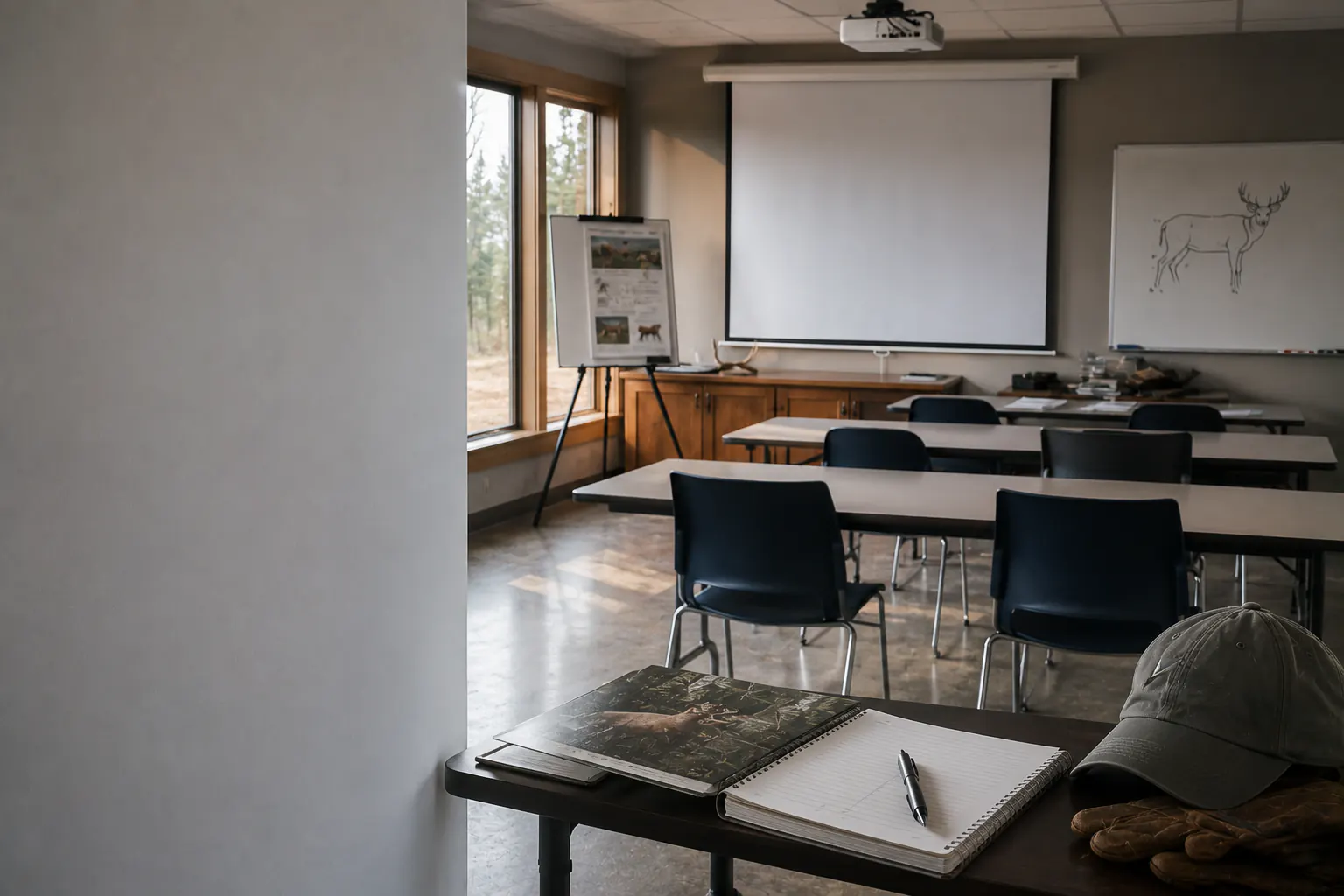
Define the intended pathway first
Before registering, write down:
- the learner’s legal name, age, residency, and accessibility needs;
- state, territory, tribal jurisdiction, or other licensing authority;
- whether the learner intends only to observe, accompany, or eventually hunt;
- expected species category without selecting a weapon or method here;
- anticipated public, private, refuge, tribal, or mixed land context;
- previous course completion, if any, with issuing jurisdiction and card number;
- preferred language and whether an interpreter or accommodation is needed;
- transportation and scheduling constraints;
- a named emergency contact.
Then ask the agency which education route applies. Do not assume an online-only course, an out-of-state card, a military or professional background, prior range use, or an older paper certificate creates an exemption. Ask how to replace a lost record and whether the education identifier must match the license profile exactly.
The state rules research guide keeps the dated agency record. Course enrollment and legal permission are related, but they are not the same file.
Understand what education can cover
The Fish and Wildlife Service describes state-supported hunter education as including firearm and archery safety, wildlife management, conservation, ethics, game laws, outdoor survival, and wilderness first aid. The exact curriculum and assessment vary. Some programs combine self-study with an in-person field day. Others offer classroom, online, live-fire, practical, or hybrid components under their own rules.
ReadyLience does not reproduce weapon handling, shooting, archery, trapping, or live-hunt instruction. Those skills lose essential context when detached from the qualified instructor, controlled site, equipment inspection, commands, supervision, and immediate correction. A written article also cannot assess whether a learner understood or performed them.
Use the official course to identify every required component. Save the current syllabus, registration confirmation, location, arrival instructions, equipment policy, accessibility contact, weather cancellation channel, identification requirements, and completion-record process. If the page is unclear, ask the issuing program rather than inferring what to bring.
Prepare without practicing hazardous material alone
Safe preparation focuses on logistics and foundational knowledge:
- Confirm the course is listed or accepted by the responsible agency.
- Read the official course instructions from beginning to end.
- Learn the agency vocabulary for licenses, tags, seasons, legal methods, reporting, and wildlife management.
- Review the location, parking, access, weather, clothing, food, water, and medication plan.
- Ask how personal equipment is handled; do not bring any weapon, ammunition, bow, arrow, or restricted item unless the instructor explicitly directs it under the course rules.
- Arrange corrective vision, hearing support, mobility accommodations, language access, or another approved aid before the session.
- Set a communication and transportation fallback if the course ends early or weather changes.
- Bring only the identification, writing materials, clothing, and other benign items the program names.
Do not rehearse an unfamiliar weapon system from an article or social video. Do not borrow equipment without the course and instructor approving its role. Do not use a backyard, informal property, or public land as an assumed practice site.
The outdoor family practice plan can support low-consequence map, communication, weather, and packing routines, but it explicitly excludes weapons and life-safety certification.
Choose a mentor for the missing layer
Course completion establishes that the learner met that program’s completion requirements. It does not prove judgment across every species, landscape, weather condition, legal method, equipment system, field-care task, or unexpected event. A qualified mentor helps bridge the gap without replacing the agency course.
Look first for a formal mentor, apprentice, learn-to-hunt, range, conservation, or field-skills program identified by the state wildlife agency or recognized partner. Ask the organizer:
- who supervises and what qualifications or program role they hold;
- whether the activity is observation, classroom, controlled practice, or a live hunt;
- what the learner may and may not do;
- how ratios, commands, equipment, storage, transport, and site control work;
- whether background, waiver, license, permit, insurance, or guardian requirements apply;
- how wildlife identification, field care, disease notices, and food handoff are taught;
- how disability, medical, language, religious, dietary, or caregiver needs can be accommodated;
- what happens when any participant says stop.
A useful mentor welcomes current rules, conservative decisions, questions, and cancellation. Avoid anyone who dismisses the course, treats property boundaries or game laws as technicalities, pressures a learner to act, mixes alcohol or impairing substances with the activity, promotes unsafe shortcuts, or cannot describe the emergency and food-care plan.
Add observation-only experience
An observation trip can teach a beginner a great deal without creating pressure to harvest. Use a lawful public wildlife-viewing area, guided education event, or other permission-confirmed setting. Practice reading the weather, identifying access points and boundaries, noticing other land users, maintaining communication, comparing map and landmarks, and ending on time.
No weapon is needed for this stage. Do not shadow active hunters, approach wildlife, enter a closed area, leave a designated route, use calls or attractants, or interfere with animals or another person’s activity. Follow the site’s ordinary visitor rules.
The wildlife observation planning guide turns the visit into a documented go/no-go exercise. Record what was observed and what remained unknown. Do not convert a distant shape, track, sound, photograph, or app result into a legal species determination.
Separate five kinds of completion
Beginners often collapse distinct milestones into “ready.” Keep them separate:
| Milestone | What it can establish | What it cannot establish |
|---|---|---|
| Course registration | A place in the named program | Completion or license eligibility |
| Course completion | The learner met that program’s stated requirements | Permission for every jurisdiction, species, place, date, or method |
| License or tag issuance | The named privilege was issued under current conditions | Competence, land access, safe conditions, or food safety |
| Supervised practice | The learner practiced named tasks in that controlled setting | Independent mastery in a different setting |
| Mentor sign-off or debrief | Observations from that program or person | Legal certification unless the agency explicitly gives it that effect |
Keep the original completion record and a protected digital backup. Record the issuing organization, course name, completion date, identifier, learner name as printed, and replacement instructions. Do not publish the number or expose it in a social image.
Plan for accessibility and family roles
An adult beginner may manage limited grip, hearing, vision, mobility, temperature tolerance, medication, fatigue, anxiety, caregiving, or transportation constraints. Contact the official program early. The appropriate accommodation must work with the curriculum, site, safety commands, supervision, and legal requirements; a household should not invent a workaround around a safety-critical component.
Family members who are not enrolled can still support scheduling, childcare, transport, food, record storage, emergency contacts, and post-course review. Children should not be present at a restricted activity unless the official program permits and supervises them under its rules. A supportive family role never means handling restricted equipment or informally coaching a skill the person is not qualified to teach.
Use a post-course debrief
Within a day, complete a factual review:
- Which components were completed and which remain?
- What official record was issued, and where is replacement information stored?
- Which safety commands or legal terms need review from the course material?
- What tasks require further qualified instruction?
- What equipment was merely discussed versus actually inspected or used?
- What accessibility or communication friction appeared?
- What questions should go back to the agency or instructor?
- Is an observation-only outing the next appropriate step?
Do not immediately buy equipment because it appeared in class. First complete the non-offensive clothing and safety checklist for the real location and season. Any weapon-related choice remains outside ReadyLience and belongs with lawful qualified instruction.
Return to the Hunting for Food hub when the education record is secure. The next gate is not confidence. It is a current, exact compliance file and a supervised pathway that remains easy to stop.