
Identify the responsible wildlife agency for the intended place and season before buying a license or arranging travel. Use this page to collect current answers for one exact plan and to identify questions for that authority. A personal worksheet does not interpret law, grant access, or approve a hunting method.
Use this page to build a dated research file. It helps expose missing answers; it does not interpret law or declare an activity legal.
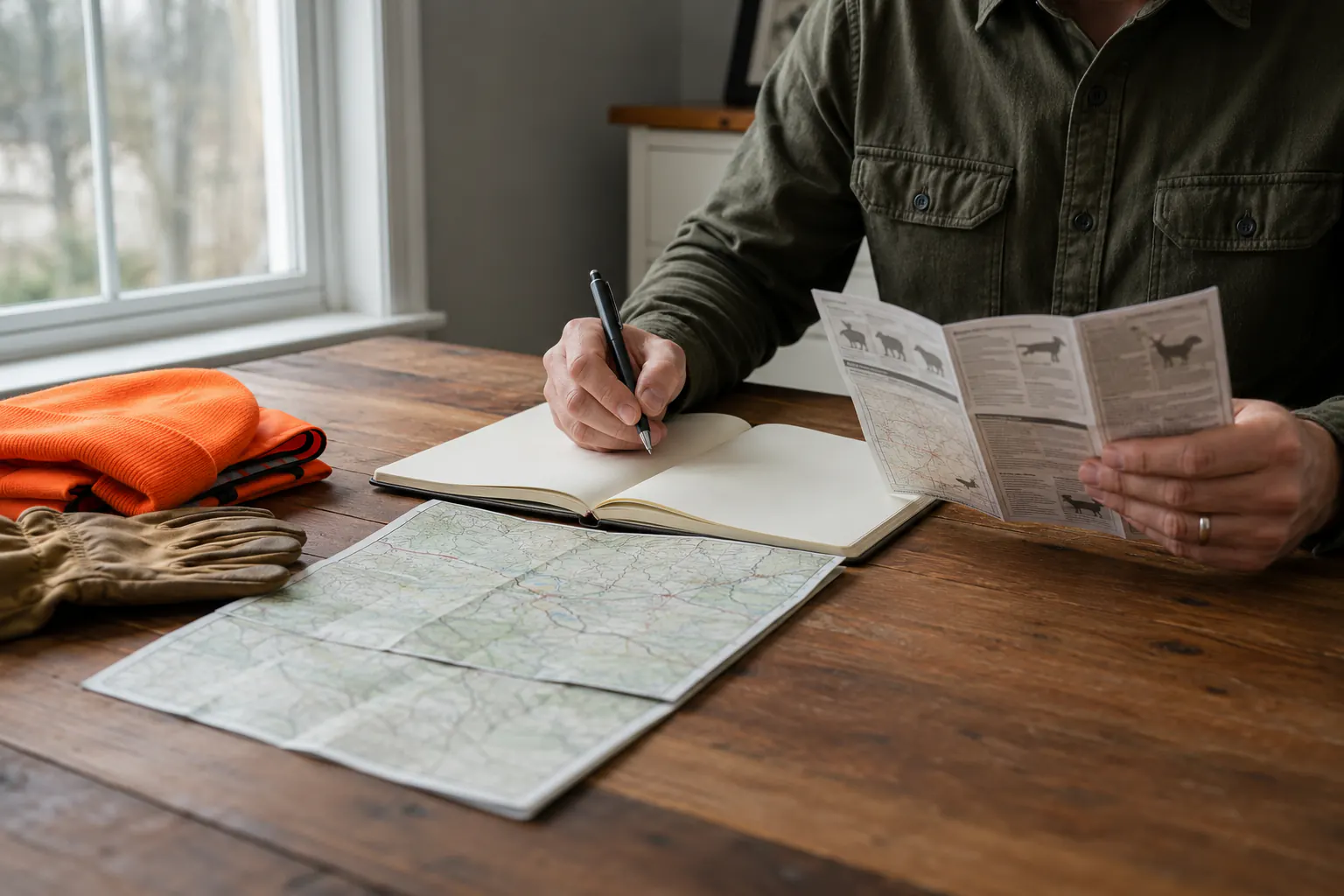
Start with a six-part identity
Write one sentence that names:
- Person: exact hunter, age, residency status, education record, and any applicable eligibility detail.
- Animal: exact species and any legally relevant sex, age, antler, zone, population, or tag category.
- Place: state, management unit, property, access point, land status, and boundary source.
- Time: date, legal hours, season segment, and time zone where relevant.
- Method: only the category named in the official materials; ReadyLience does not advise selection or use.
- Disposition: tagging, validation, reporting, testing, carcass movement, transfer, processing, storage, and donation plan.
If the sentence says only “deer in Colorado this fall,” it is not specific enough to research. If any element changes, create a new file or re-verify every dependent requirement.
Find the responsible state agency
The Fish and Wildlife Service hunting-license page provides links by state and U.S. territory. Use it as a directory to reach the responsible agency, then verify that the destination is an official government or agency-controlled service. Save the agency name and contact channel.
From the agency, locate the current materials for:
- hunter-education and prior-card recognition;
- license, endorsement, permit, stamp, lottery, draw, tag, and validation requirements;
- residency, age, youth, apprentice, disability, military, landowner, and other classifications that actually apply;
- species definitions and identification resources;
- season dates, legal hours, zones, units, quotas, and bag or possession limits;
- legal methods and method-specific restrictions;
- tagging, reporting, check-station, biological-sample, or harvest-record duties;
- chronic wasting disease or other wildlife-health notices;
- carcass, high-risk tissue, meat, hide, head, antler, and waste movement or disposal rules;
- transfer, donation, processor, storage, and transport documentation;
- current emergency orders, closures, and contact details.
Do not use the checkout page as the only source. A successful purchase does not prove that the selected combination is correct or that all location and land rules have been met.
Add every land layer
State permission does not grant entry to land. Record the parcel or managed area and identify who controls access. Depending on the trip, verify:
- private owner permission and any written conditions;
- state wildlife area or forest rules;
- national wildlife refuge hunt permit and refuge-specific conditions;
- national forest, Bureau of Land Management, National Park Service, military, municipal, utility, or other federal/local land status;
- tribal jurisdiction, access, licensing, and cultural-resource requirements;
- road, gate, parking, camping, fire, off-highway vehicle, dog, temporary structure, and retrieval restrictions;
- adjacent no-entry, residential, roadway, trail, school, work, or safety zones;
- whether digital maps are informational rather than surveyed legal boundaries.
Use the land manager’s current map and written rule together. A mapping app, visible fence, old sign, trail, road, GPS track, or another person’s memory may not establish the legal boundary. When the property line or access route is uncertain, stop and contact the owner or manager.
The map and compass guide supports orientation practice. It does not determine land ownership or a hunting unit.
Read definitions before dates
Tables are easy to copy and easy to misunderstand. Read the definitions, general provisions, species chapter, unit notes, method chapter, and emergency updates that control the table.
Terms that may require exact agency definitions include:
- resident and nonresident;
- youth, apprentice, mentor, supervisor, and accompanying adult;
- possession and daily limit;
- bag, take, pursue, hunt, retrieve, and wounded animal;
- legal shooting or hunting hours;
- loaded, cased, transported, and vehicle;
- public road, right-of-way, occupied structure, and safety zone;
- bait, lure, call, electronic device, light, drone, and trail camera;
- antlered, antlerless, sex, age, species, and protected look-alike;
- evidence of sex or species;
- carcass, edible portion, high-risk tissue, and processed meat.
ReadyLience does not define these terms for a jurisdiction. Copy the authority’s exact title and section into the private research record, then ask the authority when the application is unclear.
Build a source ledger
For every answer, record:
| Field | Entry |
|---|---|
| Question | One narrow issue the source answers |
| Issuer | Responsible agency, land manager, owner, or health authority |
| Publication | Exact page, proclamation, digest, order, permit, or map title |
| Effective period | Season, year, order dates, or revision period |
| Section | Heading, page, table, unit note, or numbered rule |
| Accessed | Date and local time checked |
| Answer | Plain-language note without deleting exceptions |
| Open issue | What still requires confirmation |
| Contact result | Office, date, channel, and factual response summary |
| Recheck trigger | Date, emergency order, disease update, weather, access, or plan change |
Keep the original file or printout available offline where the agency permits. A personal summary is for navigation, not a replacement for the source.
Verify wildlife-health overlays
Regulations and food safety meet at wildlife-disease instructions. Before the trip, check the state wildlife and health departments for the exact species and area. Determine whether there is surveillance, mandatory or recommended testing, a sample station, a special tag or check, carcass-movement restriction, disposal rule, processor instruction, or “do not consume” direction.
CDC chronic wasting disease guidance tells hunters to check state recommendations, consider testing deer or elk from affected areas, and not eat meat from an animal that tests positive. CDC also publishes distinct precautions for hunters handling wild birds and animals that may carry brucellosis. A generic game-meat plan cannot merge those hazards into one glove-and-cooler rule.
Link each disease instruction to the field-dressing education guide and game-meat cold-chain plan. Testing identity and temperature identity must remain attached to the correct animal through processing and storage.
Recheck at four moments
The file is not finished when a license is purchased. Recheck:
- Before committing money or travel: eligibility, education, draw, permit, property, and season structure.
- Before packing: final proclamation, unit, land access, weather, fire, disease, testing, processor, and communication details.
- Immediately before departure: closures, emergency orders, road/gate status, legal hours, check-station or processor hours, and group changes.
- Before acting in the field: exact location, time, species identity, surrounding people/property, current conditions, and all permit conditions.
An official rule can be current while a road is closed. A valid tag can exist while weather, fire, medical capacity, refrigeration, or disease instructions make the trip a no-go.
Keep the directory maintainable
Do not copy fifty state rule summaries into a static ReadyLience article. They would age at different rates and invite readers to treat a stale sentence as permission. The maintainable directory is the Fish and Wildlife Service state/territory page plus the original agency pages selected for the exact hunt.
In your private file, save a contact card for the relevant agency, land manager, public-health office, testing location, and processor. Date each entry. Rebuild the card for another state or species rather than assuming the same offices or processes apply.
Use a final unresolved-issue gate
Create a table with every open question and one owner. “Ask someone” is not an owner.
| Open question | Responsible authority | Answer due | Status |
|---|---|---|---|
| Education record accepted | Licensing agency | Before application | Open/confirmed |
| Unit and property boundary | Agency plus owner/manager | Before travel | Open/confirmed |
| Current species and method rule | Wildlife agency | Before packing | Open/confirmed |
| Disease test and carcass movement | Wildlife/health agencies | Before travel | Open/confirmed |
| Refuge or special-use permit | Site manager | Before entry | Open/confirmed |
| Processor and cold handoff | Processor plus food-safety plan | Before departure | Open/confirmed |
If any critical row remains open, the hunt does not proceed. Observation at a lawful public viewing location may remain an alternative if its own rules and conditions are clear.
Return to the Hunting for Food hub with a dated file, not a collection of browser tabs. The useful outcome is not knowing every hunting rule in America. It is knowing which authority controls each decision in one exact plan and being willing to stop when the answer is incomplete.