
Contact the intended processor or qualified receiving person before the trip. Confirm what they can accept, when they are open, and the identity, testing, handling, and temperature requirements. If the receiving route or cooling capacity is unresolved, do not proceed with a food-harvest plan.
Build one measured chain from trained field care to a confirmed receiving destination. Keep legal identity, disease-testing identity, temperature history, and physical custody attached to the same animal and packages. Do not use appearance, touch, odor, outside air, shade, snow, or a marketing claim as proof that the food remained safe.
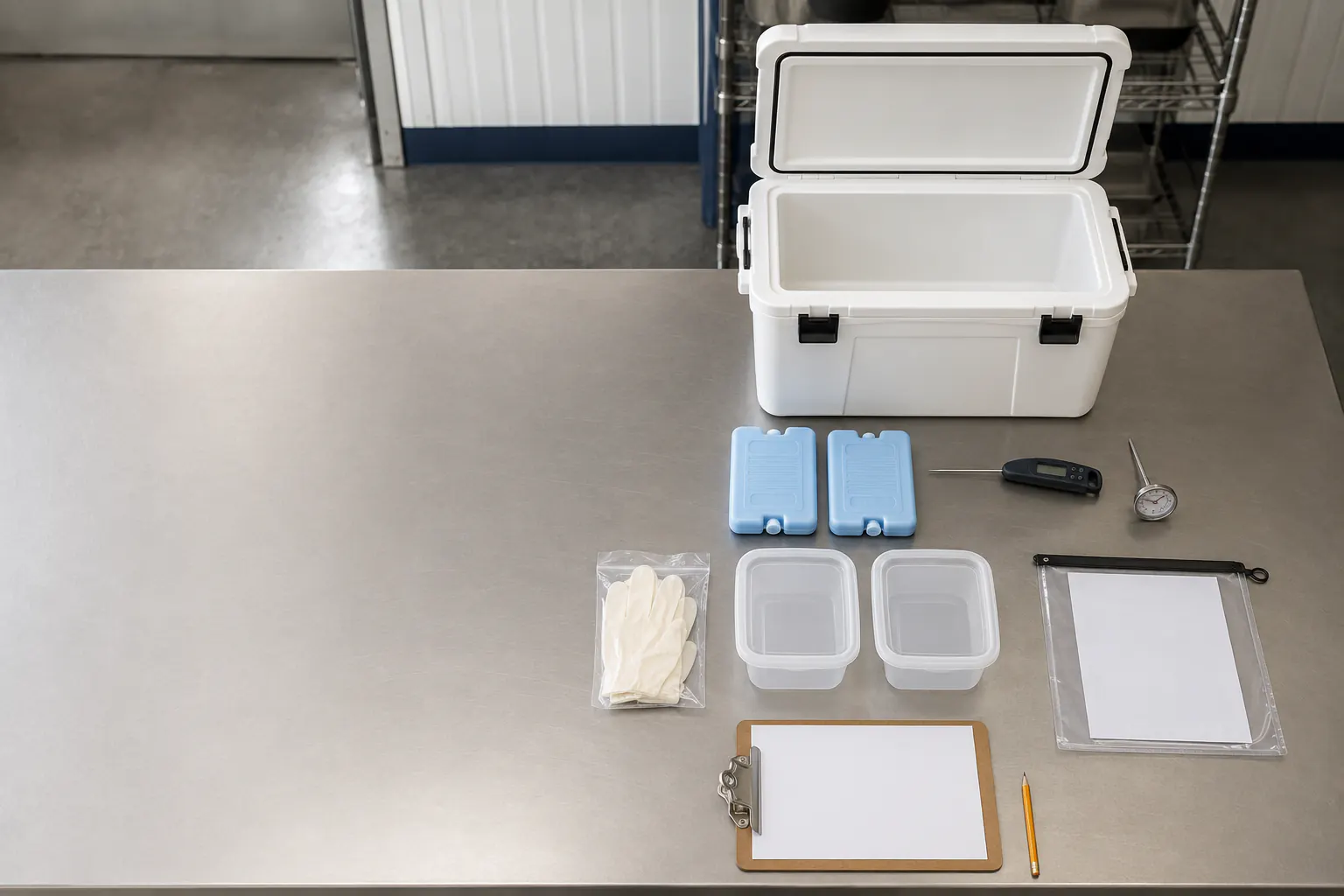
Confirm the receiving end first
Before the trip, contact the processor or identify the qualified home-processing plan. Record:
- business or responsible person and direct contact channel;
- address, receiving hours, after-hours policy, and seasonal capacity;
- species and carcass form accepted;
- tagging, evidence, reporting, testing, and identification requirements;
- cleanliness, packaging, temperature, and transport conditions;
- whether animals are processed individually or combined;
- how a pending disease test is isolated and linked;
- rejected-load and disposal procedure;
- estimated handoff time and the fallback if receiving closes;
- final package identification, refrigeration, freezing, and pickup conditions.
Do not assume a processor is open because it appears in a search result. Do not arrive with a form, condition, species, or test status the business cannot legally or safely receive.
If processing at home is lawful, the plan still needs suitable dedicated space, potable water where required, drainage and waste compliance, cleanable surfaces, equipment, temperature control, separation from household food and animals, trained people, and research-based food-safety instructions. A garage, porch, shed, campsite, bathtub, or kitchen is not automatically suitable.
Map the handoff chain
Create one row for each transition:
| Stage | Responsible person | Time/temperature evidence | Clean/contaminated boundary | Stop rule |
|---|---|---|---|---|
| Qualified field care | Named trained person | Start time and measured observations required by plan | Dedicated work zone | Exposure, contamination, delay, abnormal animal, or missing test route |
| Initial cooling | Named cold-chain lead | Device, reading location, time, and target from authority/instructor | Clean cooling media and protected meat | Capacity or measurement failure |
| Retrieval | Group lead | Departure and arrival times | Meat protected from dirt, fluids, fuel, waste, and ready-to-eat food | Route, effort, weather, or time exceeds plan |
| Vehicle transport | Driver/cold-chain lead | Logged checks without unsafe handling | Secured clean zone away from passengers/pets where required | Temperature, leakage, restraint, or vehicle failure |
| Processor receiving | Named receiver | Time, condition, temperature, test/identity record | Custody transfer documented | Receiver rejects or identity is unclear |
| Home storage | Household food lead | Refrigerator/freezer readings and package record | Raw/cooked and test-pending separation | Unknown history, damaged package, outage, or authority discard instruction |
This table is a planning record, not a validated food-safety process. The exact measurement points and limits come from qualified, species-specific guidance.
Do not confuse weather with refrigeration
USDA FSIS tells consumers to keep game cold below 40°F until it can be cooked or frozen, and Penn State Extension emphasizes rapid temperature control and verified refrigeration. Those general principles do not create a universal field timeline. Animal size, starting temperature, hide, air movement, contamination, cuts, package, ambient conditions, retrieval, and local instructions matter.
Cold outdoor air does not ensure the interior cooled adequately. Warm daylight can follow a cold dawn. A vehicle interior or enclosed bed can heat in sun. Snow or natural water can introduce contamination. Loose ice can create dirty meltwater. Frozen containers may cool unevenly or lack capacity. A cooler’s advertised duration does not describe a warm field load opened repeatedly under actual conditions.
Use a functioning thermometer suitable for the trained plan. Check it before departure and record readings with times. Do not take unnecessary measurements that puncture, expose, or contaminate food; follow the instructor, processor, and device instructions for placement and cleaning.
Protect the transport zone
The vehicle plan must address both food protection and road safety:
- secure every container so it cannot shift, leak, block visibility, affect controls, or endanger occupants;
- keep raw game and contaminated equipment away from ready-to-eat food, drinking water, medication, child items, pet supplies, and clean clothing;
- keep fuel, chemicals, waste, soil, leaves, insects, and dirty water out of the food zone;
- use clean, food-appropriate barriers or containers as directed;
- maintain airflow or containment according to the exact cooling plan rather than improvising sealed plastic around warm material;
- protect tags, samples, test identifiers, and records from moisture and separation;
- never attach a carcass where engine heat, exhaust, road debris, sun, or unsafe vehicle loading creates a hazard;
- keep pets and hunting dogs away from raw meat and carcass parts.
The vehicle’s driver does not perform temperature or packaging tasks while moving. Stop only in a lawful safe place that does not expose the load or people to traffic.
Preserve identity through testing
For deer, elk, or other animals subject to chronic wasting disease guidance, determine the current state testing and carcass-movement process before travel. CDC advises hunters in affected contexts to consider testing before eating and not to eat meat from an animal that tests positive. It also suggests asking a commercial processor to process the animal individually.
Use an identifier that follows the agency and processor rules. Keep a private record connecting:
- harvest/tag or legal record;
- sample submission identifier;
- processor receipt and batch or package identifier;
- freezer location;
- test status and date checked;
- final authority instruction.
Do not combine unidentified packages from multiple animals while a result is pending. Do not rely on a name written on one outer cooler after custody changes. Do not consume, donate, feed to animals, preserve, or distribute test-pending meat contrary to current guidance.
Other wildlife diseases may require different handling, testing, reporting, or cooking. The field-dressing disease guide owns the current hazard file.
Receive at home deliberately
Before meat arrives, verify refrigerator and freezer temperatures with appliance thermometers and create physical capacity. Do not crowd a refrigerator or freezer in a way that blocks required airflow or prevents cooling. Keep raw packages contained and below or separate from ready-to-eat food so leakage cannot cross-contaminate it.
At handoff, record:
- receiving date and time;
- source animal/test identifier;
- processor or responsible handler;
- package condition and any leakage or damage;
- measured storage-unit temperature;
- test status and restrictions;
- intended qualified cooking or research-tested preservation route;
- use-by, freeze, inspection, or authority-directed date where supplied.
If identity, temperature history, contamination history, package condition, or test status is unknown, isolate the question and contact the processor or responsible food-safety/wildlife authority. Do not taste the food to evaluate safety.
Plan for power loss
Game meat in a home refrigerator or freezer follows the same outage evidence rules as other perishable food, plus any wildlife test and identity restrictions. The Power Outage Food Safety guide owns time/temperature and discard decisions after power loss. The refrigerator backup-power guide owns electrical continuity planning.
Do not open the freezer repeatedly to inspect packages. Keep a current appliance thermometer, outage log, package map, and contact route. Backup power does not guarantee food safety if the equipment, transfer, fuel, ventilation, load, runtime, or temperature record fails.
Never “save” uncertain thawed game by making jerky, canning, smoking, curing, pickling, grinding, cooking for pets, or refreezing. Preservation cannot erase an unsafe history.
Keep cooking and preservation exact
Wild game is not one food. Species, cut, ground versus whole form, bird versus mammal, disease context, prior handling, and recipe affect safe preparation. Use the current responsible public-health, USDA, Extension, processor, or tested recipe for the exact food.
The Food Preservation hub explains method boundaries. The home-dehydrated food guide does not authorize wild-game jerky. USDA FSIS maintains separate jerky safety guidance and notes additional considerations for venison and other wild game.
Freezing does not sterilize food. Vacuum sealing is not preservation by itself. Smoke, salt, acid, dryness, color, a firm texture, or family tradition does not prove pathogen control.
Audit the chain after every handoff
Review facts, not success stories:
- Were all legal, testing, and receiving conditions confirmed before departure?
- Did a trained person perform only tasks within the approved plan?
- Are time and temperature entries complete and attributable?
- Did clean and contaminated zones remain separated?
- Did any cut, splash, leakage, damaged PPE, abnormal tissue, tool failure, or contamination occur?
- Did the same identity remain attached through sample, processor, and package?
- Did the receiving person accept the food without an unresolved condition?
- Is home storage verified and protected from outage risk?
- What instruction, equipment, route, or capacity must change next time?
Do not round missing times or recreate temperatures from memory. Mark them unknown. An honest unknown allows a qualified authority to make a conservative decision; invented precision conceals the hazard.
Return to the Hunting for Food hub with the completed chain. Food procurement is not complete at harvest. It is complete only when lawful identity, disease instructions, clean custody, measured cooling, receiving, and storage remain intact without improvisation.