
Before any live hunt, ask the responsible wildlife agency or a qualified local program about species-specific field-care education and current disease instructions. Do not begin handling an animal from a written checklist. A learner needs hands-on teaching, exposure precautions, and a confirmed testing, cooling, and receiving plan.
This page does not teach cuts, anatomy, tool technique, or carcass opening. It helps a learner prepare for instruction, identify disease and contamination questions, separate dedicated equipment, and establish the conditions that make “do not proceed” the correct decision.
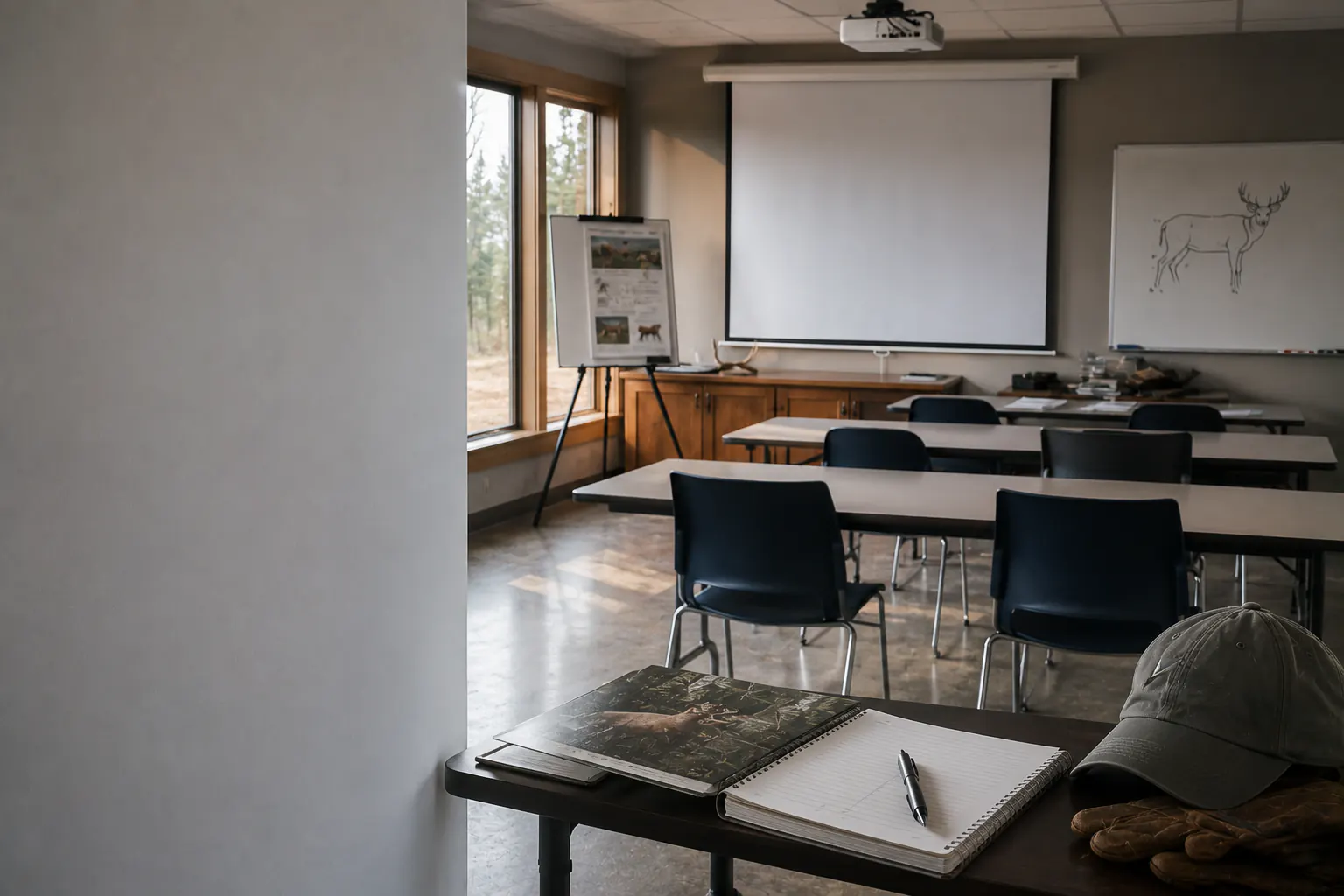
Start before any live hunt
Find a state wildlife agency, recognized hunter-education program, Cooperative Extension program, processor-led class, or other qualified local instructor whose scope includes the species and jurisdiction. Ask whether the session is demonstration-only, simulated, or hands-on; whether an animal is involved; and what licenses, permits, waivers, protective equipment, tools, age limits, accessibility arrangements, and prerequisite training apply.
Confirm that the instructor addresses:
- legal tagging, validation, evidence-of-species or sex, reporting, and transfer requirements;
- anatomy and species-specific technique through direct teaching;
- current local wildlife-disease notices and testing;
- handling of sick-looking, abnormal, or found-dead wildlife;
- personal protective equipment and exposure response;
- prevention of gastrointestinal, soil, hair, feather, dirt, water, and tool contamination;
- dedicated-tool cleaning and household separation;
- carcass-part, waste, and high-risk tissue disposal;
- cooling, transport, processor, and sample identity;
- when damage, contamination, delay, or uncertainty means stopping and contacting an authority.
Avoid a source that treats hygiene as optional, dismisses disease programs, uses household kitchen tools in the field, pressures learners to work beyond training, or substitutes tradition for current state and public-health guidance.
The hunter education guide helps locate the recognized learning pathway. Course completion alone does not establish field-dressing competence.
Review the current disease file
The state rules research guide should include wildlife and health pages for the exact species and area. Update it shortly before the trip.
Questions include:
- Is chronic wasting disease present or under surveillance for deer, elk, moose, or another cervid in the area?
- Is testing required or recommended, and where, when, and how is the sample or carcass presented?
- Must high-risk tissues or whole carcasses remain inside, or stay outside, a named zone?
- Are there avian influenza detections or game-bird handling instructions?
- Is brucellosis a concern for the species or area?
- Are there species-specific parasites, toxins, diseases, or public-health notices?
- Does the agency require reporting an animal that appears sick, behaves abnormally, or is found dead?
- What disposal method is legal for unwanted parts and used protective equipment?
- What record must remain attached to meat while a test is pending?
CDC chronic wasting disease guidance says not to shoot, handle, or eat animals that look sick or act strangely, and not to touch or eat meat from animals found dead. It tells hunters to check state recommendations, avoid internal organs especially brain and spinal tissue, use dedicated tools, and strongly consider testing deer or elk before eating in affected contexts. If a test is positive, CDC says not to eat the meat.
CDC’s bird-flu guidance and brucellosis guidance contain different protective details. Do not flatten them into one universal procedure. Follow the current source for the exact animal and exposure.
Separate equipment and household space
The qualified program and current health guidance decide the exact protective equipment. A planning system should nevertheless preserve clear separation:
- field/game tools are dedicated and never used as ordinary kitchen tools;
- intact protective equipment is stored clean, dry, and away from contaminated items;
- drinking water, ready-to-eat food, medication, phones, keys, and clean clothing have a protected zone;
- clean containers and contaminated containers are visibly distinct;
- pets and hunting dogs cannot access raw meat, organs, fluids, waste, tools, or protective equipment;
- children and untrained bystanders remain outside the work area;
- a testing identifier and harvest record stay attached to the correct animal and packages;
- the vehicle has a cleanable, separated transport plan;
- the destination has a documented receiving and refrigeration process.
Do not use a household sink, food-preparation counter, bathtub, shared utility item, or drinking-water container as an assumed cleanup station. Do not wash biological material into a drain, soil, waterway, campsite, road area, or trash system without authority guidance.
The non-offensive equipment checklist records the sealed module without turning it into a procedural kit recommendation.
Establish exposure stop rules
An instructor should explain the exact response before work begins. Stop immediately for:
- torn or missing gloves, eye protection, or other required PPE;
- a cut, puncture, splash to the eyes/mouth, contact with broken skin, or another exposure;
- a damaged, contaminated, or uncontrolled tool;
- contact between raw tissue and drinking, food, medication, phone, vehicle controls, or household items;
- gastrointestinal contents, dirt, standing water, fuel, chemical, or other contamination that the trained plan does not address;
- unusual odor, color, swelling, lesion, discharge, behavior, tissue, or body condition;
- an animal found dead or one that appeared sick or acted strangely;
- uncertainty about identity, testing, sample, disposal, or carcass movement;
- unsafe footing, darkness, weather, fatigue, impairment, bystander, child, animal, or traffic intrusion;
- failure of the cooling and processor handoff.
Do not hide an exposure to save a harvest. Secure the area without creating another exposure, contact the relevant wildlife or public-health authority, and obtain medical guidance. For severe bleeding, breathing difficulty, loss of consciousness, serious allergic reaction, or immediate danger, call 911 and follow dispatcher instructions.
Understand disease-specific examples
Examples show why one generic checklist is insufficient:
| Hazard context | Planning distinction |
|---|---|
| Chronic wasting disease | State testing and carcass-movement rules, organ/tissue avoidance, dedicated tools, individual processing, and test-linked consumption decisions may apply |
| Avian influenza | Current CDC guidance for game birds includes dedicated tools, separation from poultry/pet birds, protective equipment, cleaning, and cooking instructions |
| Brucellosis | CDC describes risk from animal fluids/tissues and undercooked meat, with protective equipment, bare-skin avoidance, dog precautions, cleaning, and thorough cooking |
| General bacterial contamination | Wound, gastrointestinal contents, hands, tools, surfaces, delay, and temperature can create contamination or growth risks |
| Parasites and species-specific hazards | Freezing, smoking, drying, pickling, visual inspection, or a familiar recipe may not control the hazard |
The current authority may change instructions as surveillance changes. A printed card should show its review date and tell the user where to obtain the live update.
Connect field work to the cold chain
Field care and temperature control are one handoff, not separate projects. The learner should know before departure:
- who is trained to act;
- the legal and hygienic sequence taught for that species;
- the maximum conservative trip and retrieval plan;
- how temperature will be measured rather than guessed;
- where and how cooling begins under the trained process;
- which testing identity stays with which meat;
- processor destination, hours, acceptance conditions, and fallback;
- what happens when contamination, delay, temperature, or testing makes the food unsuitable.
The game-meat cold-chain guide owns cooling, transport, receiving, refrigeration, and storage records. It cannot repair unsafe field handling.
Keep preservation downstream
Smoking, drying, pickling, freezing, vacuum sealing, and canning do not turn questionable game into safe food. CDC notes that freezing, smoking, drying, and pickling do not kill the bacteria that cause brucellosis. USDA FSIS notes that hunter-killed wild game is not federally or state inspected and requires careful handling.
The Food Preservation hub requires an exact research-tested process and starts only with suitable food. Do not create an improvised jerky, sausage, canned-meat, smoked-meat, pet-food, or raw-feeding process. Do not feed dogs raw game meat or carcass parts.
Document the instruction accurately
After training, record:
- provider, instructor, date, location, species scope, and format;
- official materials and revision dates;
- tasks demonstrated versus tasks personally practiced;
- protective equipment actually used;
- disease and testing instructions reviewed;
- contamination and exposure scenarios discussed;
- disposal and cleaning boundaries;
- cooling and processor handoff taught;
- instructor corrections and unresolved questions;
- next supervised step.
Never write “field dressing tested” after watching a demonstration. Never publish photographs of biological material, identifying records, unsafe handling, or another participant without proper basis and consent. A picture is not evidence of training or a completed procedure.
Return to the Hunting for Food hub only after the current disease file, qualified instruction, exposure plan, and cold-chain route agree. The responsible beginner is prepared not only to perform a taught task, but to recognize when the task must not begin.