
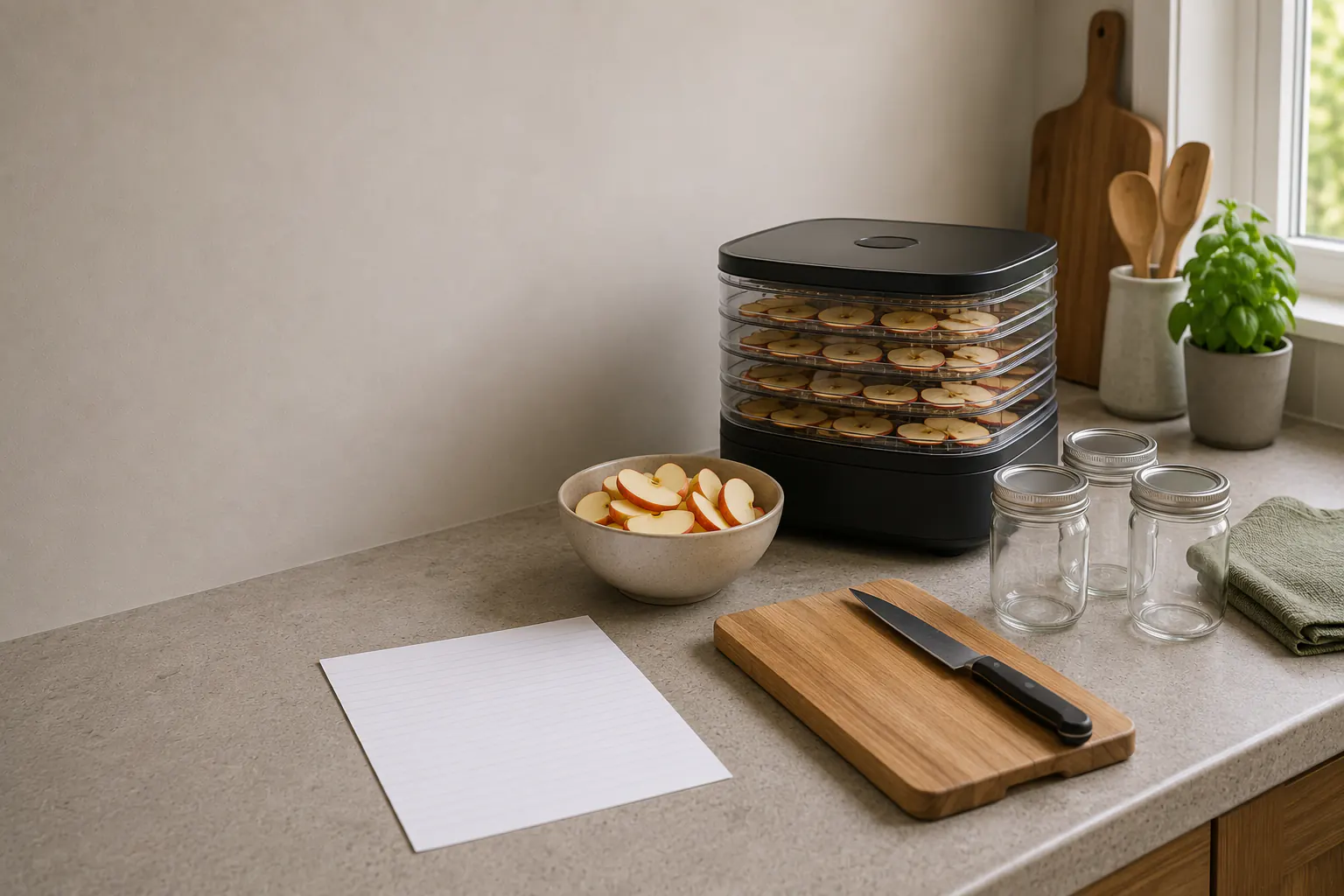
Choose one familiar food, then find a current research-tested preservation method for that exact food before buying equipment or starting a batch. Read the complete process, including storage requirements. Drying, freezing, vacuum sealing, and canning solve different jobs; they are not interchangeable ways to rescue questionable food.
The resilient approach is simple: choose the method that has a current research-tested process for the exact food, follow it without improvising, and preserve a record another person can audit.
Use this preservation family
- Food Dehydration Basics for Beginners explains equipment, method selection, preparation, airflow, monitoring, and the boundary around meat and unfamiliar foods.
- How to Store Home-Dehydrated Food Safely covers cooling, conditioning fruit, moisture checks, packaging, inspection, and discard rules.
- What to Preserve Before a Freezer Power Outage creates a pre-event plan without relabeling questionable thawed food as preservation material.
- Dehydration Batch Log and Yield Calculator records the exact method, equipment, weights, costs, package, and inspection date without declaring a batch safe.
- Home Canning Safety explains tested-recipe, acidity, pressure-canner, boiling-water, altitude, and equipment boundaries without publishing an improvised recipe.
- Vacuum Sealing, Jars, and Moisture Control explains why packaging does not itself preserve an unsafe or moist food.
The Emergency Food Storage hub owns three-day and two-week household reserves. The FIFO pantry guide owns ordinary rotation. Power Outage Food Safety owns every decision about refrigerated, frozen, thawed, or temperature-abused food after power loss.
Start with the food, not the machine
Buying equipment before selecting foods and tested processes reverses the useful order. Begin with a small amount of a familiar food the household already eats. Find a current NCHFP, USDA, or appropriate Cooperative Extension process for that exact food and form. Read the entire method before shopping or preparing.
Record:
- food and variety where relevant;
- fresh, frozen, canned, or previously prepared starting state;
- washing, peeling, cutting, blanching, pretreatment, or cooking steps;
- required equipment and its operating range;
- exact container, tray, jar, closure, or package;
- temperature, time, pressure, altitude, or endpoint instructions supplied by the tested process;
- cooling, conditioning, storage, inspection, and discard instructions;
- publication title, issuing organization, revision date, and date accessed.
If the method does not match the food, do not “adjust” it using intuition. A successful-looking batch is not evidence that a changed process controls the same hazard.
Know what each method actually does
| Method | Practical role | Boundary to preserve |
|---|---|---|
| Refrigeration | Slows microbial growth for food that requires cold holding | A refrigerator does not make previously unsafe food safe. |
| Freezing | Slows growth and quality changes while food stays frozen | Freezing does not sterilize food or erase prior temperature abuse. |
| Dehydration | Removes enough moisture under a validated process for the named food | Weight loss or a leathery appearance alone does not prove safe water activity. |
| Boiling-water canning | Processes properly acid or acidified foods using a tested recipe | It is not a substitute for pressure canning low-acid food. |
| Pressure canning | Reaches temperatures required by tested low-acid-food processes | Pressure, time, jar size, packing, altitude, and equipment cannot be guessed. |
| Pickling or fermentation | Uses a controlled formulation and process | Changing salt, acid, food ratio, temperature, or vessel can change safety. |
| Vacuum packaging | Reduces air exposure and can protect quality in an appropriate preserved food | It is not cooking, sterilization, refrigeration, freezing, curing, canning, or drying. |
| Freeze-drying | Removes frozen water under vacuum using specialized equipment | Home equipment and attractive texture do not independently prove a validated safe process. |
This family emphasizes dehydration because it is practical and space-efficient, but it does not turn every surplus food into a dehydration candidate.
Keep meat, seafood, dairy, eggs, and complete meals separate
Animal foods and mixed meals introduce hazards and process variables that a fruit or vegetable guide cannot answer. USDA FSIS documents why pathogens can survive ordinary low-temperature meat drying and gives specific controls for jerky. Wild game adds harvest, contamination, chilling, and handling variables.
ReadyLience does not generalize a jerky method to poultry, fish, game, ground meat, pet treats, or complete meals. Use the exact USDA or Extension method and qualified instruction for the specific product. Do not dry raw milk, eggs, leftovers, or an improvised mixed meal based on a generic time and temperature table.
The hunting and fishing guides cover harvest, field hygiene, cold chain, transport, and species-specific legal planning. Food Preservation begins only with food that is still suitable under the applicable safety rules.
Build a small controlled practice loop
Use one tray or modest batch before scaling:
- Read and print the exact tested method.
- Inspect and clean the equipment as its manufacturer directs.
- Check that the thermostat, fan, trays, cords, plugs, and controls are intact.
- Prepare uniform pieces exactly as the method describes.
- Record starting weight only as a yield and cost input, not a safety threshold.
- Operate at the validated setting and monitor the actual batch.
- Apply the method’s endpoint, cooling, conditioning, and packaging instructions.
- Label the food, method, date, batch, package, and next inspection.
- Use the food in an ordinary meal while quality and preparation requirements are known.
Repeatability matters more than volume. A batch log can reveal tray differences, overloaded equipment, changing costs, packaging failures, and foods the household never uses.
Plan the full dependency chain
Dehydrated food reduces weight and storage volume, but often adds water, time, and heat at use. Record whether it will be eaten dry, rehydrated, or cooked. Connect it to the Emergency Water Storage hub and safe cooking plan. Do not assume stream, rain, tap, or stored nonpotable water is suitable for rehydration.
Electric dehydrators can run for many hours. Check the exact appliance rating, sound outlet, cord condition, ventilation clearance, stable surface, and manufacturer supervision instructions. Do not run a high-draw or heat-producing appliance from backup power merely because a runtime calculator produces a number. The Backup Power hub can document a measured load, but product instructions and electrical safety control use.
Preserve quality without claiming impossible certainty
Home-preserved food changes over time. Heat, moisture, oxygen, light, pests, packaging, opening frequency, and starting quality affect it. A date is not permission to keep moldy, leaking, swollen, unsealed, odorous, wet, or otherwise suspect food. Conversely, an attractive package does not prove the process was safe.
Use original labels and records. Inspect storage routinely. Follow the tested method’s storage guidance and the current authority for recalls or contamination events. Do not taste a questionable home-canned or preserved product to test it.
Keep emergency planning from creating rushed preservation
A forecast can motivate a sensible pantry and freezer review. It should not trigger first-time pressure canning, a new jerky process, an improvised outdoor dryer, or an attempt to convert a warming freezer into shelf-stable food during unsafe conditions.
Preservation is work for normal utilities, clean water, sound equipment, adequate time, and full attention. During an outage, protect cold food and use the federal decision rules in Power Outage Food Safety. If time or temperature is uncertain, preservation does not reset the history.
What ReadyLience will not claim yet
This family does not rank dehydrators, vacuum sealers, jars, accessories, or freeze-dryers. When considering equipment, check compatibility with the exact method, documented operating limits, usable capacity, cleaning, maintenance, and manufacturer instructions. Food-specific safety still comes from the validated process, not a product rating.
An illustration never counts as test evidence. Affiliate links remain inactive until products and claims meet the documented evidence standard.
Sources reviewed
ReadyLience reviewed the National Center for Home Food Preservation method library, drying guidance, canning-safety principles, and the USDA Complete Guide to Home Canning source on July 15, 2026. Current research-tested methods, exact product instructions, food-safety authorities, and qualified Extension review control every batch. This hub helps you choose the right route; it does not replace those sources.