
Start with one familiar food and read the complete research-based drying instructions before preparing it. Check that the appliance, preparation, endpoint, and storage plan match that method. A dry-looking piece or a timer alone does not establish that the batch is suitable to keep.
Begin with a familiar fruit or vegetable that has a current National Center for Home Food Preservation or Cooperative Extension method. Read the preparation, pretreatment, loading, drying, cooling, conditioning, packaging, and storage sections before starting.
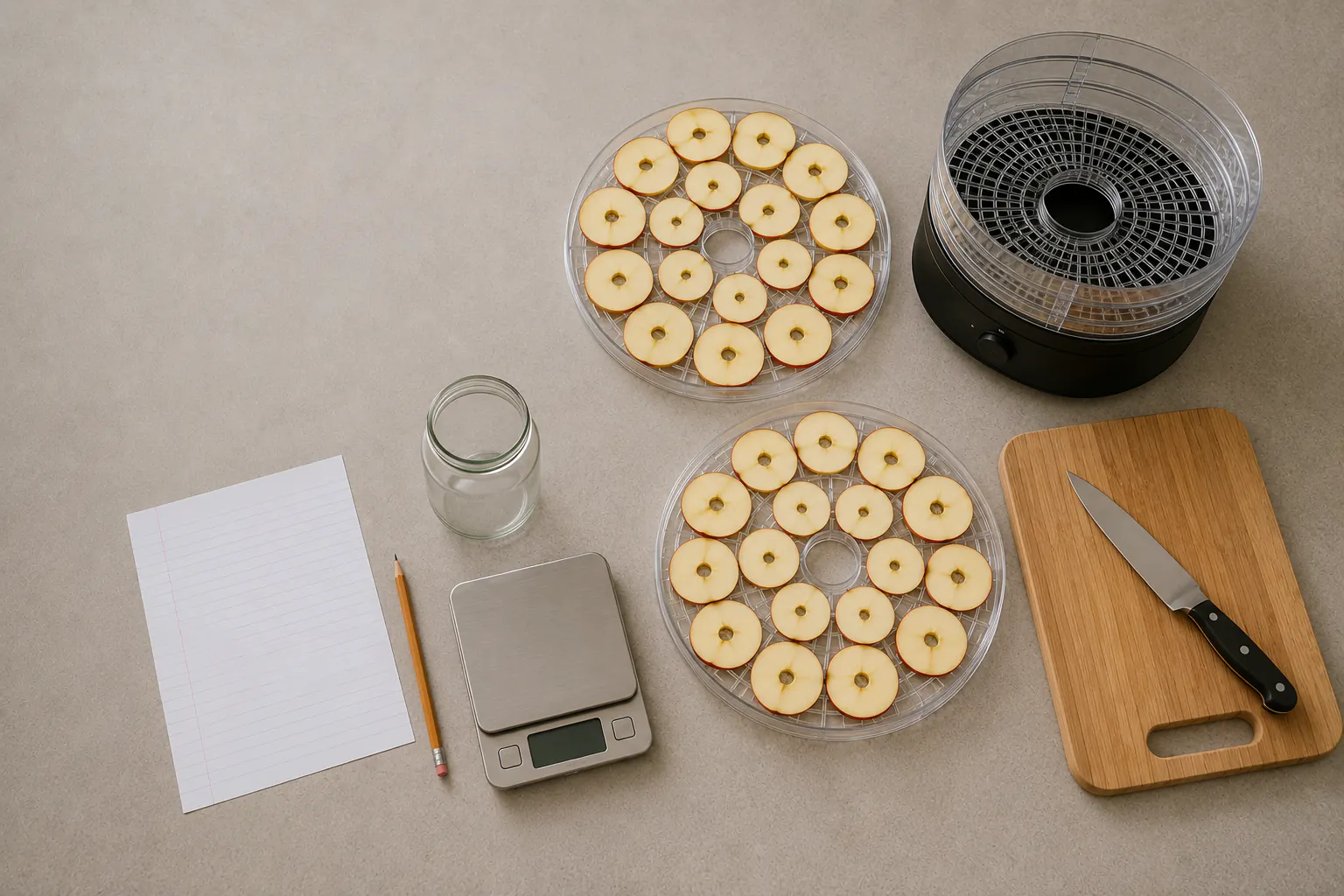
Choose a manageable first food
A good first batch has an established process, is easy to cut uniformly, fits on one or two trays, and will be used in a normal meal. Avoid beginning with meat, poultry, fish, wild game, dairy, eggs, leftovers, complete meals, pet treats, or a social-media recipe with no identifiable research source.
Record the exact food and form. Apple slices, fruit leather, herbs, and blanched vegetables are different products. Fresh, frozen, canned, cooked, and raw starting states are not automatically interchangeable. Variety, ripeness, thickness, and pretreatment can change drying behavior and quality.
Do not use dehydration to rescue food that has an uncertain cold-chain history. Power Outage Food Safety retains every discard, time, temperature, thawing, and refreezing decision.
Use an appliance designed for controlled drying
NCHFP describes a food dehydrator as an electrical appliance with a heat source, fan, vents, and trays. Its recommended feature list includes double-wall construction, enclosed heating elements, an enclosed thermostat covering the needed range, a fan or blower, washable open-mesh trays, a temperature control, and useful service support.
Before use, check:
- model instructions and permitted foods;
- intact cord, plug, housing, fan, trays, thermostat, and controls;
- stable, dry, heat-resistant counter with required clearance;
- an outlet and circuit suitable for the appliance;
- no extension cord, adapter, damaged receptacle, wet area, combustible clutter, or blocked exit;
- enough supervision for the manufacturer’s operating instructions;
- a plan for the batch to finish without unattended improvisation.
Do not assume the dial equals food temperature or that every tray experiences the same conditions. Follow the exact appliance and research-tested method; ask Extension or the manufacturer about a mismatch rather than recalibrating safety from an internet shortcut.
Understand horizontal and vertical airflow
NCHFP distinguishes horizontal-flow and vertical-flow dehydrators. Horizontal designs place the fan and heating element at the side, while vertical designs commonly place them at the base. The layout can affect flavor mixing, tray exposure, dripping, and whether trays need rotation under the product instructions.
Air must move around food. Do not cover vents, line a tray with an unapproved solid material, press pieces together, or overload beyond the method and appliance instructions. More food can slow drying and create uneven results; a longer run does not automatically correct a poorly loaded tray.
Prepare food uniformly
Wash hands, food-contact surfaces, tools, trays, and produce as the method directs. Use sound food at suitable ripeness and remove damaged material. Cut pieces to the exact form and thickness in the research-tested process. Uniform pieces reduce the gap between the fastest and slowest drying sections.
Some fruits use an antioxidant or other pretreatment for color and quality. Many vegetables require blanching under a tested method. These steps are food-specific. Do not transfer a dip, blanching time, sulfite treatment, sugar, salt, acid, or preservative from one recipe to another.
Food allergies and sensitivities still apply. Sulfites can be a concern for some people and must be handled and labeled accurately. Keep cross-contact controls and original ingredient records with the batch.
Load one layer and preserve airflow
Arrange pieces as the tested method and appliance direct, usually in a single layer without overlap. Keep wet drips away from heating elements and controls. If different foods are allowed in one run, consider flavor transfer, allergens, drying rates, and whether one finished tray can be removed without disrupting another.
Record tray position, load, piece thickness, set temperature, start time, room conditions if relevant, and every tray change. These observations help compare batches; they do not replace the tested endpoint.
Use the Dehydration Batch Log to keep measured yield and entered cost separate from safety claims.
Follow the food-specific temperature and endpoint
NCHFP materials provide directions for specific fruits, vegetables, herbs, leathers, seeds, and other products. Use the temperature, pretreatment, estimated time range, and dryness description for the exact food. Time is an estimate because load, thickness, humidity, airflow, food, and appliance vary.
Do not end a batch solely because a timer stopped. Do not keep heating indefinitely because a piece “looks wet” without checking the method and equipment. Record what the validated method says to observe and inspect pieces from different trays or positions as directed.
Weight yield is useful for purchasing and cost records, but a percentage of weight removed is not a water-activity test. Two foods can lose the same percentage and still have different compositions and safety characteristics.
Keep sun drying inside its narrow boundary
Outdoor drying is not a universal off-grid substitute. NCHFP says meats and vegetables are best dried indoors under controlled conditions and limits sun drying to appropriate fruits when temperature, humidity, breeze, protection, and other conditions are favorable. Weather is variable; night air can add moisture; birds, insects, dust, animals, surfaces, and screen materials can contaminate food.
ReadyLience does not publish a generic solar-dryer plan or advise sun drying after a disaster. Smoke, ash, flood residue, pesticide drift, dust, insects, wildlife, humidity, temperature changes, and unsafe outdoor work can make the setting unsuitable.
Treat jerky as its own safety process
USDA FSIS explains that pathogenic bacteria can survive ordinary warm-air drying of raw meat and poultry. Its jerky guidance includes safe handling and a specific heat step before dehydration, along with controlled dehydrator operation. Wild game has additional contamination and chilling concerns.
Do not infer a meat process from fruit or vegetable temperatures. Do not treat marinade, salt, smoke, spice, color, texture, or long drying as proof of safety. Ground meat, poultry, game, and fish are not interchangeable. Use the exact current USDA or Extension method and a food thermometer as directed.
This beginner guide contains no jerky recipe. The hunting and fishing guides address legal harvest, field hygiene, chilling, and transport; any preservation still requires the exact specialist method for suitable food.
Cool and package without adding moisture back
Drying is not finished at the moment heat stops. Follow the method for cooling, conditioning, and packaging. NCHFP warns that packaging warm food can cause sweating and enough moisture for mold growth. Food can also reabsorb moisture from air each time a container opens.
Move from this page to Safe Storage for Home-Dehydrated Food before sealing a batch. Fruit conditioning, vegetable dryness, package size, inspection, and condensation response are different parts of the process.
Run a useful first-batch review
After the food is packaged and inspected under the tested method, use it in an ordinary meal. Record:
- whether the household likes it;
- whether pieces rehydrate evenly;
- how much safe water and fuel preparation requires;
- whether the package is too large for one use;
- whether labels and dates remain readable;
- whether the location is cool, dry, dark, and pest-resistant;
- whether another household member can identify the method and next inspection.
The FIFO pantry guide owns routine use and rotation. A preserved food that is never used is not a resilience asset.
Do not improvise through equipment trouble
Stop the batch for smoke, sparking, burning odor, damaged wiring, abnormal fan noise, failed control, liquid reaching the heating area, or other unsafe behavior. Disconnect through a safe normal control only when it is safe to do so. Call emergency services for fire or immediate danger and use qualified electrical or appliance service for defects.
Do not move a hot malfunctioning appliance through the home or continue on a different unvalidated heat source. The Basic Electrical Safety hub owns damaged outlet, plug, circuit, and appliance boundaries.
Sources reviewed
Return to the Food Preservation and Dehydration hub to connect this first-batch workflow to storage, outage planning, canning boundaries, packaging, and ordinary rotation.
ReadyLience reviewed current NCHFP drying, food-dehydrator, sun-drying, and USDA FSIS jerky guidance on July 15, 2026. The exact research-tested method, appliance instructions, food-safety authority, and qualified Extension guidance control each product. This guide stays within those evidence and safety boundaries.