
How much dried food did this batch produce, and what did it cost? Enter the prepared starting weight, the cooled final weight, and the costs you recorded. You will get a yield and cost log to compare with another batch made using the same research-tested method.
Record that exact method first. If the publication and food do not match, stop before entering a weight. These numbers cannot measure water activity, identify pathogens, validate dryness, or authorize room-temperature storage.
Private in-browser worksheet
Dehydration batch yield and cost log
How much did your batch weigh after drying, and what did it cost? Record the measurements here. Less weight does not prove the food is safely dried or shelf stable. Nothing entered here is saved.
Measurement log only. Weight loss is not a water-activity measurement and cannot prove that a food is safely dried or shelf stable. Follow the exact current research-tested method, product instructions, and qualified Extension guidance; discard moldy or otherwise suspect food rather than using this result to justify keeping it.
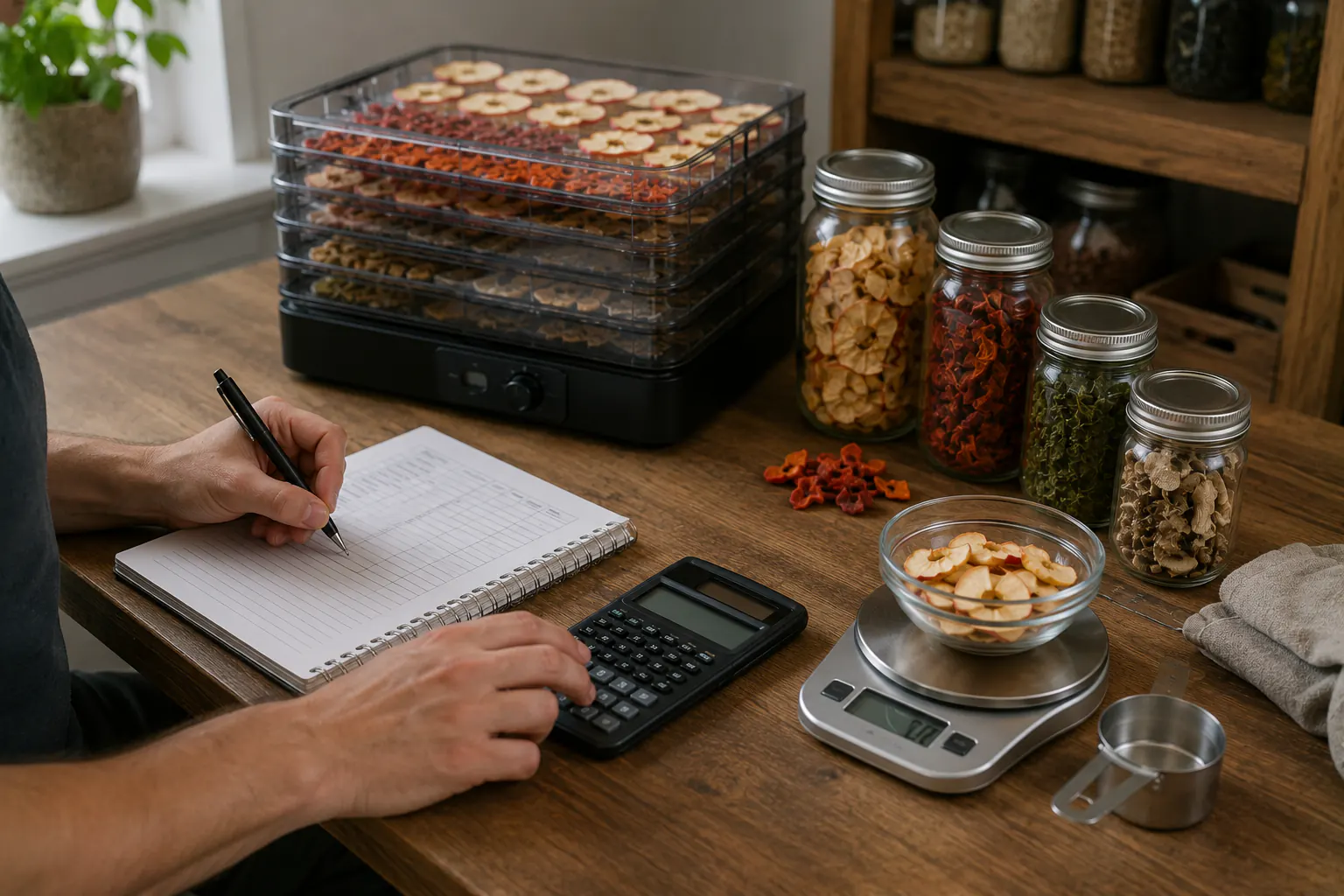
What the calculator reports
The tool uses four transparent calculations:
final cooled weight / prepared starting weight x 100 = measured weight yield
starting weight - final weight = weight removed
food cost + electricity entered + packaging cost = entered batch cost
entered batch cost / final weight = cost per final ounce
These outputs are useful for purchasing, recipe planning, package size, energy awareness, and comparing repeated batches of the same food under the same validated method. They are not safety thresholds.
“Weight removed” is not equal to verified water removed because trimming, peel, pits, stems, drips, sampling, and residue can change weight. Even when weight change mostly reflects water, food composition and remaining water availability matter. A kitchen scale does not measure water activity.
Record the method before the measurements
Every batch needs an identifiable source:
- issuing organization;
- publication and exact recipe or food title;
- revision or publication date when available;
- date accessed;
- exact food and starting state;
- preparation, thickness, pretreatment, and blanching instructions;
- equipment and required temperature range;
- endpoint, cooling, conditioning, packaging, and storage instructions.
“Internet recipe,” “usual method,” or a copied table with no source is not enough. If a family note is used, trace it to current NCHFP, USDA, or Cooperative Extension guidance before treating it as a validated process.
Do not edit a method because the first batch takes longer, tastes different, or has a lower yield. Diagnose equipment, piece size, loading, humidity, and method fit with qualified guidance.
Define the weighing points consistently
Choose and document what each weight includes. A useful starting weight is the food after the preparation stage specified in the method: for example, after washing, trimming, peeling, pitting, slicing, or blanching, but before tray loading. The final weight should be measured after the required drying endpoint and cooling step, before samples are eaten or pieces are lost.
Use the same scale, units, container-tare method, and weighing point for repeat batches. Record whether a bowl, tray liner, or package was included accidentally. If the method requires conditioning fruit, keep pre-conditioning and post-conditioning records distinct.
Do not repeatedly expose a finished batch to humid air just to obtain more readings. The process and package remain more important than a perfectly tidy spreadsheet.
Track cost without overstating precision
Food cost can include the purchased quantity actually used, not the retail price of a package left mostly unused. Packaging cost can include the bag, lid, jar allocation, label, or liner used for that batch. Electricity cost uses entered kilowatt-hours multiplied by the household’s entered rate.
The tool does not estimate electricity automatically. Use a suitable energy monitor only when the appliance, outlet, environment, and manufacturer instructions allow it. The plug-in watt-meter guide explains measurement boundaries. Do not place a meter where liquid, heat, damaged wiring, or an overloaded receptacle creates risk.
Cost still excludes labor, equipment wear, travel, water, cleaning, failed batches, storage space, and future preparation. A lower cost per ounce is not evidence of better quality or safety.
Log equipment and tray conditions
Record the exact dehydrator model, tray count, tray positions, liner or mesh type, set temperature, start and stop times, and every tray rotation permitted by the instructions. Note unusual fan cycling, room humidity, overloaded trays, inconsistent piece thickness, or a door opened for inspection.
Do not use the record to normalize equipment failure. Smoke, sparks, burning odor, liquid reaching electrical parts, a failed fan, damaged cord, or a control that cannot hold its required setting is a stop condition. A batch exposed to an uncontrolled process needs guidance; simply adding hours does not validate it.
The beginner dehydration guide covers appliance and airflow selection. The batch log should make deviations visible, not excuse them.
Record the endpoint exactly as the method describes it
Different foods use different endpoint descriptions and follow-up steps. Write the source wording in the private record rather than reducing everything to “dry.” Note which tray and pieces were checked, whether the method requires conditioning, and whether any condensation or unevenness appeared later.
Do not create a household percentage such as “20 percent yield means safe.” Yield varies with starting water, variety, ripeness, trimming, piece size, and preparation. The same yield across two foods says nothing about equivalent microbial control.
If objective water-activity testing or process validation is required for a commercial, regulated, novel, or high-risk product, a household calculator is not the instrument. Use the appropriate laboratory, process authority, regulator, or Extension specialist.
Keep the package and storage record attached
Once the tested cooling and conditioning steps are complete, record:
- package type and size;
- closure or seal observation;
- batch and package date;
- storage location;
- first inspection date;
- every opening date when useful;
- condensation, moisture, pest, damage, or quality observation;
- final use or discard date and reason.
Use How to Store Home-Dehydrated Food Safely for packaging and inspection. Vacuum sealing is a packaging step, not a safety validation; use the vacuum and moisture-control guide before relying on it.
Compare batches only when the comparison is fair
Yield and cost become useful over time when the method, food, preparation, load, and weighing points are comparable. A different apple variety, slice thickness, pretreatment, tray load, or final endpoint can change results. Keep a short note about those changes.
Useful questions include:
- Did a smaller batch dry more evenly?
- Did the household use the package before repeated opening affected quality?
- Did one tray position consistently finish later?
- Did the process require more safe water or fuel at meal time than expected?
- Was the final cost reasonable for a food the household actually eats?
- Did any condensation or package failure appear at inspection?
The answer may be “do not repeat this food.” That is a successful record, not a failed resilience plan.
Print without exposing unnecessary information
The component stores and sends nothing. Print the result or transcribe it to a paper or local file if desired. Do not put private medical, household-security, account, or supplier information on a label visible to visitors. A batch ID can connect a small package label to a fuller private record.
Keep at least the validated method reference and package identity with the food. Another household member should be able to determine what it is, how it was processed, whether it requires rehydration or cooking, and when it should be inspected.
Do not use cost pressure to keep suspect food
A batch can represent time and money, but sunk cost never changes the safety decision. Discard moldy food and food that the applicable authority or tested process says to discard. Do not taste a questionable batch, repackage it, add an oxygen absorber, redry it without an applicable instruction, or mix it into another food to avoid waste.
If a power outage or contamination event affects the batch, use Power Outage Food Safety and current public-health instructions. The calculator’s result does not survive a broken process or unsafe exposure as a permission slip.
Sources reviewed
Return to the Food Preservation and Dehydration hub before using a log as part of a larger household preservation routine.
ReadyLience reviewed NCHFP drying, dehydrator, packaging, conditioning, and storage guidance on July 15, 2026. The exact tested method and qualified food-preservation guidance control the process.