
Decide how the exact food will be safely preserved and stored before choosing a bag or jar. Vacuum sealing changes packaging, not the food-safety requirements. Perishable food still needs its applicable cold storage or validated process, even when the seal looks good.
For suitable, properly dehydrated food, vacuum packaging can protect quality from air and moisture. For moist or perishable food, a low-oxygen package can make casual room-temperature storage more dangerous, not less.
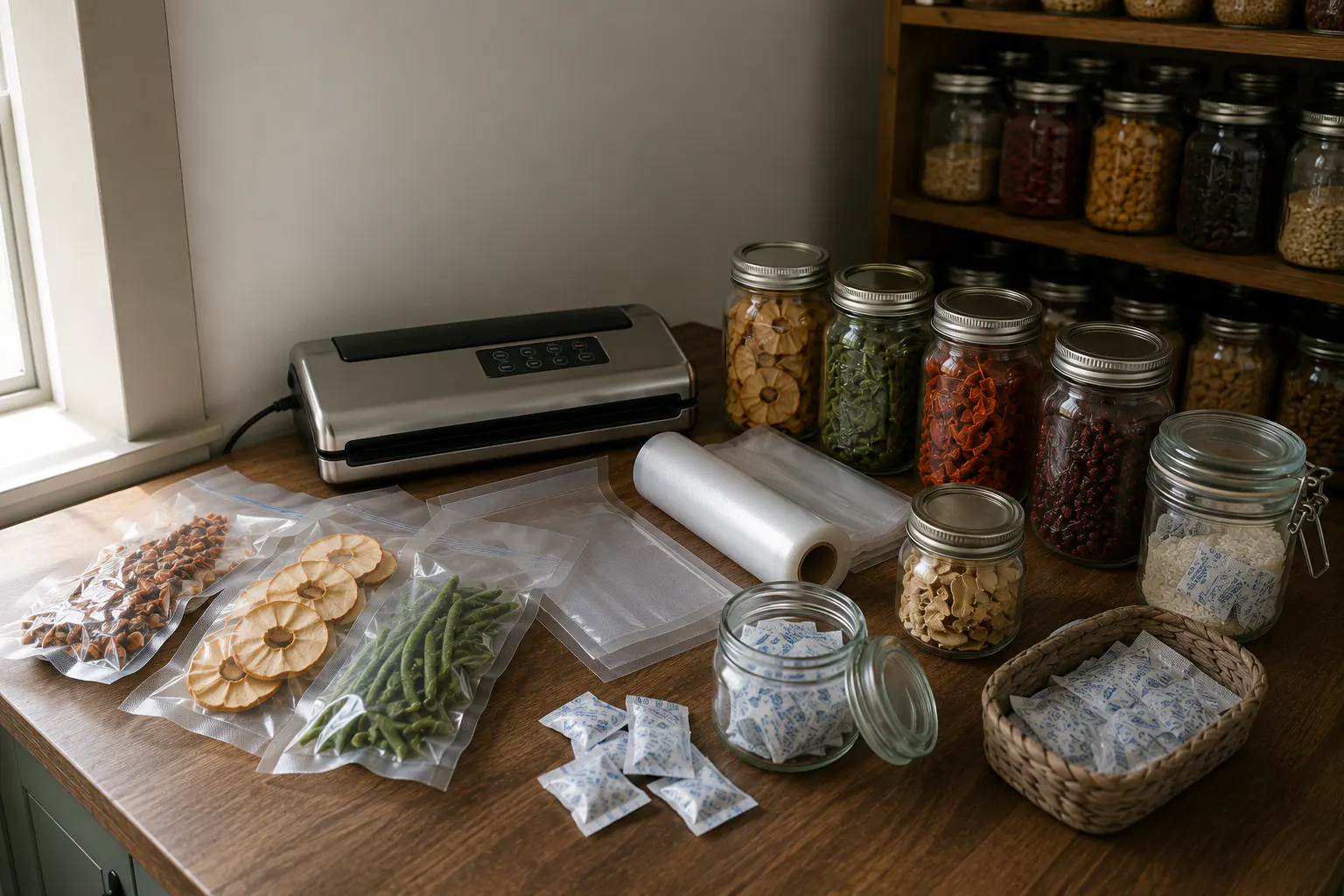
Keep preservation and packaging as separate decisions
Ask two questions in order:
- What validated process makes this exact food suitable for the intended storage condition?
- Which package does that process permit or recommend?
Possible answers to the first question include refrigeration, freezing, a food-specific dehydration process, a tested canning recipe, or another validated method. “Vacuum sealed” is not an answer.
NCHFP guidance explicitly states that in-home vacuum packaging is not a substitute for cooking or preservation such as refrigeration, freezing, or curing. The National Center also notes that Clostridium botulinum grows under low-oxygen conditions when other conditions support it. Do not infer that less oxygen means fewer risks in every food.
Use vacuum packaging only after the drying process is complete
For home-dehydrated food, follow the exact method through endpoint, cooling, and conditioning before selecting final packaging. NCHFP says warm dried food can sweat inside a package and that dried food can spoil if it reabsorbs moisture. Pulling a vacuum around warm or incompletely dried pieces can conceal the moisture in a tight package.
Use How to Store Home-Dehydrated Food Safely for cooling, fruit conditioning, container choices, and inspection. The Batch Log can record package and seal observations, but weight yield does not prove readiness.
Do not vacuum-seal moldy, damp, condensed, underprocessed, or uncertain food to “stop it from getting worse.” Discard or handle it exactly as the applicable authority directs.
Do not confuse a jar vacuum with home canning
A vacuum-sealer jar attachment removes air and may hold a lid down. It does not heat-process the food and is not equivalent to boiling-water or pressure canning. A used canning lid that appears to seal under a vacuum attachment has not undergone a tested canning process.
Use Home Canning Safety for acidity, canner, jar size, pack, time, pressure, altitude, and cooling. Never attach a vacuum device to an unprocessed jar of moist low-acid food and put it on a shelf.
Likewise, a tight lid on a commercial jar does not convert it into approved home-canning equipment. Follow the food and packaging method, not the visible strength of the seal.
Refrigerated food remains refrigerated
Raw or cooked meat, poultry, seafood, dairy, cut produce, leftovers, and other perishable foods do not become room-temperature foods because air is removed. Keep them at the required refrigeration or freezing temperature and follow the food-specific storage guidance.
Vacuum packaging can change spoilage signs and does not pause the Power Outage Food Safety clock. During an outage, a sealed bag follows the same applicable time, temperature, food-category, flood, and contamination rules. Do not use an intact vacuum as evidence that warming food remained safe.
If time or temperature is unknown, do not cook, can, dry, smoke, ferment, or reseal the food to avoid the official discard decision.
Handle low-oxygen storage as a real control
Botulism risk depends on several conditions, including moisture, acidity, oxygen, temperature, and time. Removing air changes one part of that system. A household cannot evaluate the full hazard from bag tightness, smell, color, a date, or a generic chart.
This is why ReadyLience does not publish blanket oxygen-absorber instructions. An absorber, barrier bag, desiccant, vacuum, and sealed bucket are different tools. Their suitability depends on the exact food, moisture, validated process, package, storage, and authority. A packet does not repair an uncertain batch.
Never add oxygen absorbers or desiccants directly to a food unless the validated method and food-contact instructions explicitly support that exact use. Keep packets away from children and anyone who could mistake them for food.
Choose bags for the actual food and sealer
Use only material intended by the manufacturer for the exact appliance, food, temperature, and storage use. Inspect bags and rolls for punctures, channel damage, contamination, folds, incomplete seams, or melted areas. Sharp dried pieces can puncture a bag; powder can contaminate the sealing zone.
Record:
- bag or roll type and lot where useful;
- food and batch ID;
- seal width, number, and visible condition;
- date sealed and intended storage condition;
- whether the food needs refrigeration or freezing;
- first inspection and opening date;
- resealing or transfer history.
Do not use a household sealer on liquids, hot food, dusty powders, or other products the manufacturer excludes. Do not hold or defeat a safety switch, add an incompatible hose, or continue when the appliance overheats or behaves abnormally.
Use jars where condition remains visible
NCHFP identifies clean, dry home-canning jars among suitable containers for properly dried food. Glass can make condensation and insect activity easier to see. It is also breakable and heavier than bags.
Inspect the jar rim, body, lid, closure, cleanliness, and complete dryness. Keep it on a stable shelf where it cannot fall and where heat, light, humidity, plumbing leaks, and pests are controlled. Do not stack in a way that hides a failed closure or places excess load on glass.
A screw-on lid can be a practical closure for dry food under the tested storage guidance. Do not imply it is a home-canned seal. Label the process accurately: “dehydrated,” batch, method, date, and storage instructions.
Control package size and opening frequency
NCHFP advises packaging dried food in amounts that can be used at one time because each opening exposes it to air and moisture. Match the package to a normal recipe or snack use. Large bags may look efficient but can be opened repeatedly in a humid kitchen.
If a package must be reopened, use clean dry tools and close it promptly according to the package instructions. Record the opening when storage time or moisture exposure matters. Do not reach into a bulk package with wet hands or a used cup.
The FIFO pantry guide owns visible rotation. Vacuum packaging should not turn food into an unlabeled object at the back of a shelf.
Inspect the package without trusting the vacuum alone
A lost vacuum can reveal a puncture, contaminated seal, closure failure, or food change. An intact vacuum, however, cannot rule out an unsafe process. Inspect for:
- condensation, moisture, clumping, unexpected softness, or liquid;
- mold, insects, webbing, package holes, or jar damage;
- swelling, leakage, foam, gas, or unexpected pressure;
- broken or contaminated seals;
- heat, flood, smoke, chemical, pest, or power-outage exposure;
- missing batch, method, or storage records.
Do not taste questionable food. Keep people and pets from a leaking or suspect package and follow current food-safety and disposal guidance.
Use the sealer as an electrical appliance
Place the sealer on a stable, dry surface with the ventilation and duty cycle required by the manufacturer. Inspect cord, plug, heating strip, lid, controls, hose, and attachments. Keep liquid away from electrical parts and hot sealing surfaces away from children and combustible clutter.
Stop for smoke, sparks, burning odor, melted housing, liquid ingress, damaged wiring, failed controls, or repeated overheating. Do not open the appliance, bypass a latch, tape a damaged cord, or touch a hot sealing bar. Use qualified service and the Basic Electrical Safety hub for equipment boundaries.
Do not buy a promise the package cannot make
Claims such as “five-year,” “long-term,” “airtight,” “commercial grade,” or “oxygen free” need exact conditions and evidence. Household food, seal quality, barrier performance, temperature, moisture, opening, and process vary. A marketing claim cannot override the tested food method.
This guide does not rank vacuum sealers or accessories. Compare documented bag and attachment compatibility, wet-food limitations, duty cycle, cleaning, maintenance, and inspection instructions for the actual task. Even a well-made seal cannot declare an unvalidated food safe.
Sources reviewed
Return to the Food Preservation and Dehydration hub to keep packaging downstream of the correct food-specific process.
ReadyLience reviewed NCHFP dried-food packaging, canning-safety, and home vacuum-packaging context plus USDA FSIS shelf-stable-food guidance on July 15, 2026. The exact preservation process, cold-storage requirement, package instructions, and qualified food-safety guidance control use. This guide supports packaging questions; it does not replace those requirements.