
Home-dehydrated food can reabsorb moisture after it leaves the appliance. Warm packaging can create condensation. A large package can be exposed repeatedly to humid air. Heat and light can shorten quality. A tight lid can hide, rather than fix, an incomplete process.
Storage begins only after the exact food-specific drying endpoint is met. It cannot make an underprocessed or questionable batch safe.
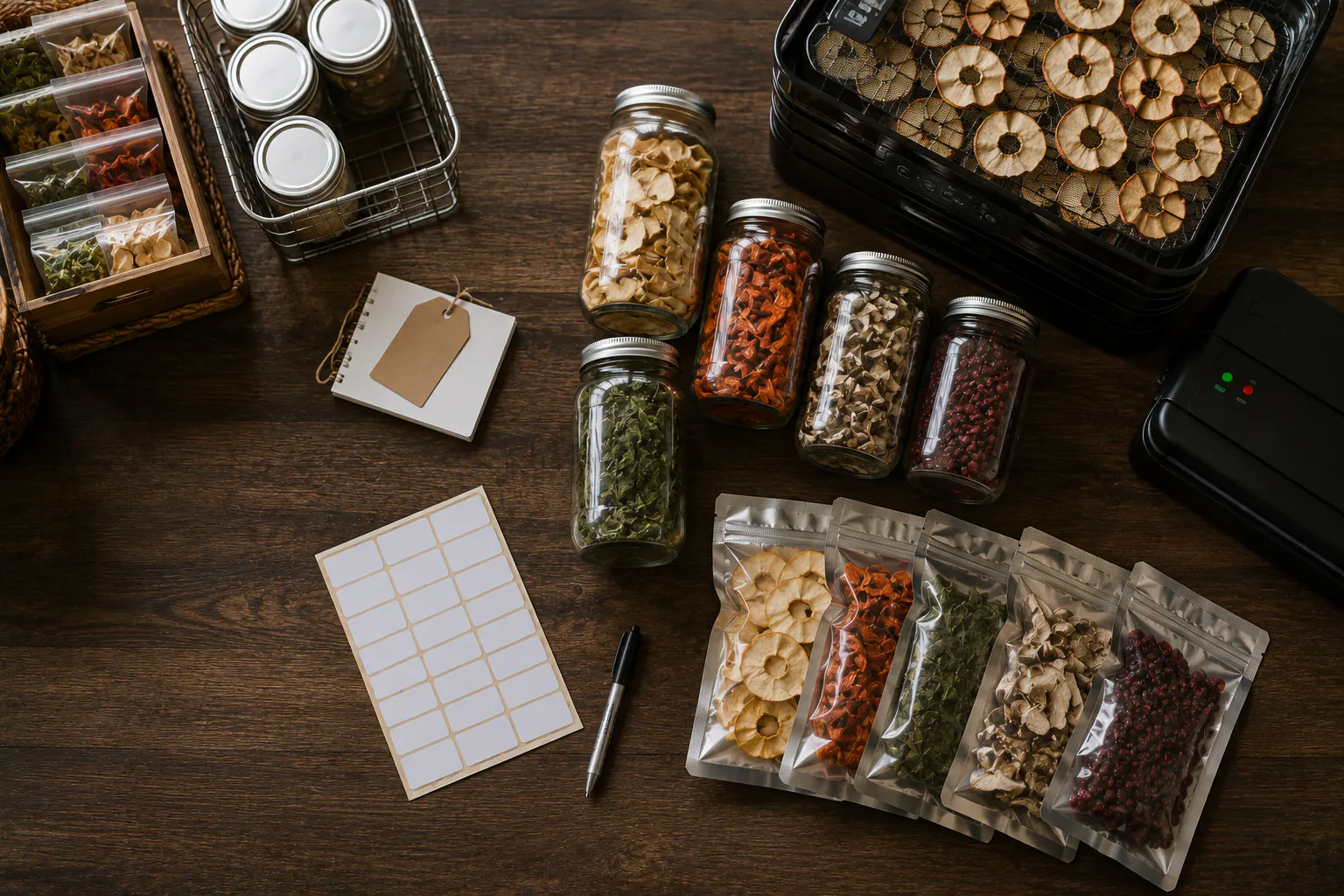
Cool completely before final packaging
National Center for Home Food Preservation guidance says dried food should cool completely before packaging. Warm food can sweat inside a closed container, adding enough moisture for mold growth. Cooling should occur in a clean, protected environment without leaving food exposed indefinitely to humidity, dust, pests, pets, hands, or kitchen splashes.
Follow the tested method for the exact food. Do not pile warm pieces into a deep container, seal them “to keep them clean,” then assume later cooling will remove the trapped moisture. Record cooling start and package time in the Dehydration Batch Log.
If food is still warm, soft in an unexpected way, or showing moisture, stop and review the method. Time alone does not establish readiness.
Condition dried fruit when the method requires it
Pieces of fruit can leave the dehydrator with uneven moisture. NCHFP describes conditioning as a way to equalize that moisture and reduce mold risk. Its general dried-food storage guidance directs users to cool the fruit, pack it loosely in plastic or glass jars, seal it for seven to ten days, shake the jars daily to separate pieces, and check for condensation. If condensation appears, the fruit returns to the dehydrator for more drying before final packaging.
Use that instruction only for the fruit products to which the validated method applies. Conditioning is not fermentation, a shelf-life test, or permission to keep moldy food. Do not generalize the conditioning period to meat, vegetables, complete meals, or an unfamiliar recipe.
Label the conditioning jar with batch, food, start date, tested source, and responsible person. Keep it where daily checks will actually happen.
Keep vegetable and fruit endpoints distinct
NCHFP general guidance describes properly dried vegetables as brittle or crisp and notes that they do not require the same conditioning as fruit because they are much drier. That description belongs within the food-specific process; it is not a universal “snap test” for any plant food.
Fruit may remain pliable depending on the product. Herbs, leathers, seeds, and other items have different endpoints. A household should not compare one batch with a commercial snack that may be fried, sweetened, treated, freeze-dried, or produced under industrial controls.
Use the exact process description and inspect pieces from different tray positions as directed. Weight yield can document consistency, but it does not measure water activity.
Choose a clean, dry, insect-resistant package
NCHFP lists clean, dry home-canning jars, plastic freezer containers with tight-fitting lids, plastic freezer bags, and appropriate vacuum packaging as options for properly dried foods. The package should fit the method and remain intact through normal storage.
Before filling, inspect for:
- moisture, residue, odor, cracks, chips, punctures, failed zippers, or damaged closures;
- a shape that can be cleaned and dried fully;
- enough barrier for the food and expected storage period;
- a size that can be used in one recipe or a few openings;
- space for an external label without hiding the contents or condition;
- compatibility with any pretreatment; NCHFP notes that sulfured fruit should not contact metal.
Do not reuse packaging that held chemicals or cannot be verified as suitable for food. Do not transfer commercial packaging claims to a different bag, lid, jar, or sealer combination.
Package in amounts that limit reopening
Every opening exposes dried food to air and moisture. NCHFP recommends package sizes that can be used at one time. That does not require dozens of tiny bags; it requires matching the package to household use.
Record the amount needed for a soup, snack, bread, sauce, or other familiar use. Keep diet-protected food separate and identify allergens. A large “bulk reserve” that opens weekly in a humid kitchen may lose quality and create more uncertainty than several practical packages.
The FIFO pantry guide owns shelf order and ordinary rotation. The small-apartment food guide owns egress, heat, pests, leaks, and limited-space decisions.
Understand what vacuum sealing does not do
Vacuum packaging can reduce air exposure and protect the quality of a properly dried food. It does not cook, sterilize, refrigerate, freeze, cure, can, dry, or correct excess moisture. Removing oxygen can create a low-oxygen environment; that makes it especially dangerous to treat vacuum as a universal preservation process for moist or perishable food.
Use Vacuum Sealing, Jars, and Moisture Control before selecting a package. This guide does not provide oxygen-absorber instructions because food moisture, composition, process, package barrier, and validated method control whether such a system is appropriate.
Label the process, not just the product
A useful label includes:
- food and preparation form;
- batch ID and processing date;
- exact validated publication or recipe reference;
- pretreatment or allergen note where relevant;
- package date and storage location;
- planned first inspection and quality-use date;
- preparation or rehydration instruction;
- “refrigerate after opening” or another requirement from the validated method.
Do not claim “shelf stable” merely because the package is sealed. Do not put an invented multi-year expiration date on home-dried food. Keep the complete record separately if the package is too small.
Store cool, dry, dark, and visible enough to inspect
NCHFP advises cool, dry, dark storage. Higher temperature shortens quality life. Dried food also needs protection from insects and moisture. Choose a stable interior location away from direct sun, ovens, ranges, water heaters, laundry humidity, exterior heat, plumbing leaks, chemicals, and pest access.
Keep packages off the floor where flooding, cleaning water, and pests are concerns. Do not block exits, panels, shutoffs, ventilation, or appliance service. In a garage, attic, shed, vehicle, or outdoor structure, temperature and humidity may be far less controlled than the kitchen.
Glass makes condensation easier to see, but it can break. Keep jars where they cannot fall during ordinary access or local hazards. Do not stack beyond the container, shelf, or property limit.
Inspect on a real schedule
NCHFP recommends frequent checks to confirm dried food remains dry. Set a schedule that reflects climate, package, location, opening frequency, and tested method. Inspect without unnecessary opening:
- condensation or fogging;
- clumping, unexpected softness, color change, swelling, leakage, or damaged seals;
- mold, insects, webbing, droppings, holes, or other pest evidence;
- package damage, broken glass, rust, odor, or contamination;
- heat, water, smoke, chemical, or flood exposure;
- missing or unreadable records.
Do not taste questionable food. Moldy dried food should be discarded. NCHFP distinguishes moisture-affected but unspoiled food, which may be used immediately or redried under its guidance, from moldy food, which is discarded. If you cannot confidently place a batch in the first category, do not experiment.
Keep shelf-life language conditional
NCHFP general guidance gives a broad four-month-to-one-year quality range for dried foods and explains that heat shortens storage, with vegetables generally having less storage life than fruits. Those figures are not a guarantee for every food, process, climate, package, or home.
Use the exact tested method and aim for rotation before quality becomes uncertain. A date never overrides mold, moisture, damage, contamination, recall, or a missing process record. The best resilience supply is a food the household uses and replaces through ordinary meals.
Rehydration reintroduces perishability
Once water is added, a dried food no longer has the same storage condition. Use safe water, clean utensils, and the tested preparation method. Refrigerate or cook as directed and manage leftovers under ordinary food-safety rules. Do not leave rehydrating food at room temperature merely because it began dry.
The Emergency Water Storage hub owns safe reserve water and advisories. The low-water meal guide helps determine whether dehydrated food is practical during a disruption.
Sources reviewed
Return to the Food Preservation and Dehydration hub for the full method map and the boundary between preservation, packaging, emergency food, and outage safety.
ReadyLience reviewed NCHFP packaging, storage, fruit conditioning, and vegetable dryness guidance and USDA FSIS shelf-stable-food context on July 15, 2026. The exact tested method, observed package condition, food authority, and qualified Extension guidance control use. This guide supports storage planning, not a determination that a food is safe.