
Preservation can reduce future freezer dependence when it happens before an outage, with safe food, normal utilities, clean water, sound equipment, and enough time to follow a tested process. It is not an emergency reset button for food that has warmed, thawed, flooded, leaked, or developed an unknown history.
The first outage actions remain simple: keep appliance doors closed, record the outage start, monitor temperature, use coolers or backup power appropriately, and follow Power Outage Food Safety. Do not begin a new preservation process while the food-safety clock is uncertain.
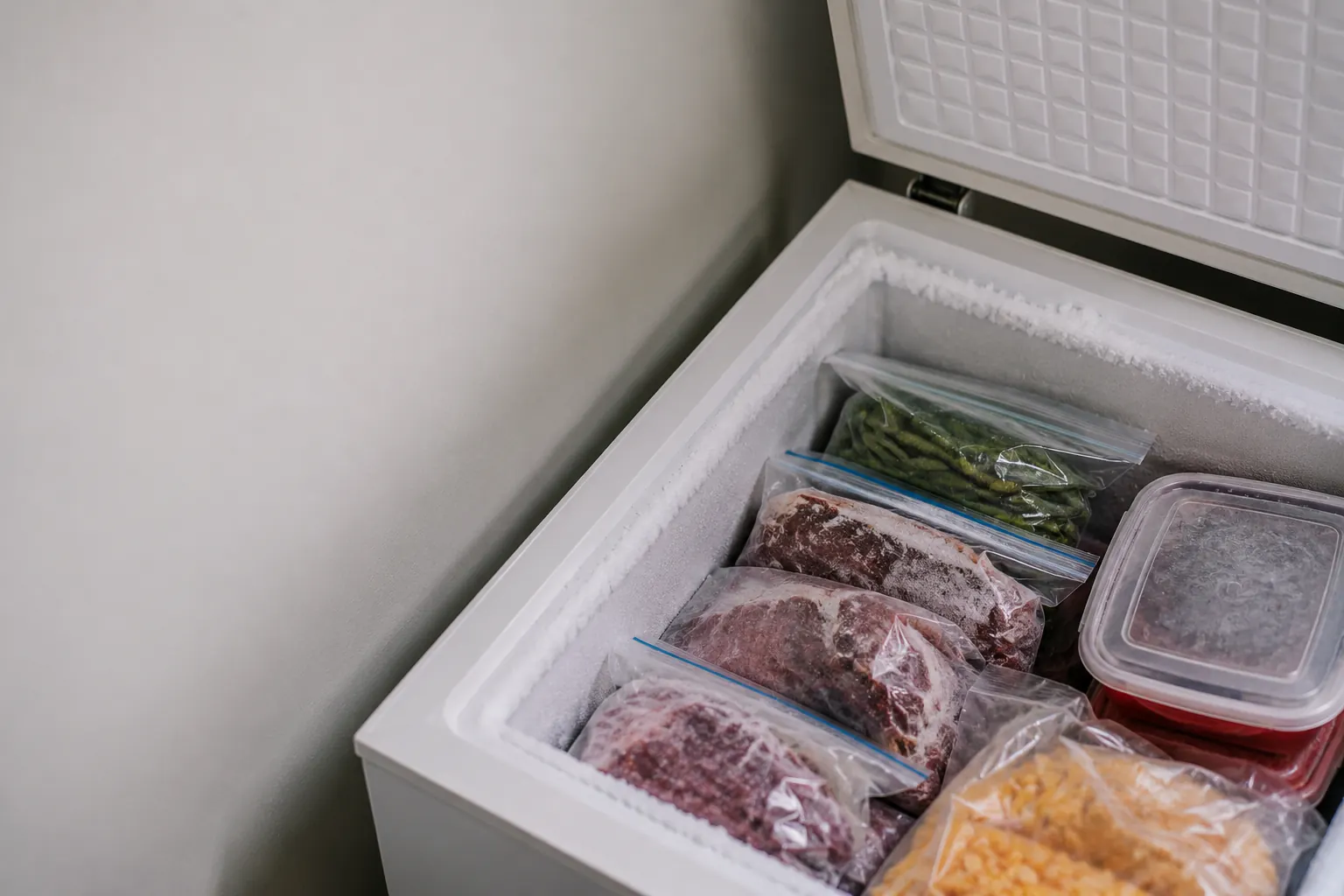
Build the plan during ordinary conditions
Inventory the freezer before storm season or a period of grid instability. Record:
- food, package size, and quantity;
- date frozen and normal meal use;
- whether it has a current research-tested canning, drying, or other preservation process;
- equipment, jars, trays, ingredients, clean-water, and time required;
- who is trained to complete that process;
- whether the household actually uses the preserved form;
- priority for eating, moving, cooling, powering, or preserving.
Do not assign a preservation route just because one exists for a vaguely similar ingredient. A tested process for sliced apples does not establish a process for pie filling. A process for one vegetable, jar size, acidity, or pack does not authorize another.
Separate four goals
Reduce the freezer gradually
The safest and easiest approach is normal meal use. Rotate older food into the weekly plan, avoid refilling the freezer immediately before a high-risk season, and shift selected foods into an approved shelf-stable form while all conditions are controlled.
Protect cold food during an outage
Use appliance thermometers, closed doors, coolers, ice, and correctly sized backup-power planning. The refrigerator backup guide owns measured load, surge, runtime, temperature logging, and fuel or battery limits.
Preserve suitable food before power loss
Schedule tested dehydration or canning batches days or weeks before the event. One batch at a time allows full attention, cooling, labeling, inspection, and cleanup.
Decide food after power loss
This belongs solely to federal time, temperature, ice-crystal, damage, and contamination guidance. Preservation does not override it.
Rank foods by practical loss, not panic
Create a priority table:
| Priority | Pre-outage action |
|---|---|
| Familiar food with a tested preservation method and regular household use | Schedule a normal batch while food is unquestionably safe. |
| High-value food with no suitable home process | Improve cold backup, move it to a reliable freezer if safe and arranged, or use it in planned meals. |
| Food needed for a medical or protected diet | Coordinate with the relevant clinician or dietitian; do not substitute a preservation method. |
| Unfamiliar, unlabeled, damaged, or old food | Resolve it before storm season; do not preserve uncertainty. |
| Food the household does not use | Avoid spending energy and packaging to preserve it; adjust future purchasing. |
Financial value matters, but safety, method fit, time, and actual use come first. Do not prioritize an expensive item by forcing it into an untested process.
Preserve produce before it enters the freezer when practical
Garden and market surplus can often be directed to freezing, dehydration, or a tested canning process at harvest rather than frozen first and reconsidered during an emergency. Starting quality matters. Preserve sound food promptly according to the method.
The future gardening cluster will own growing, harvest timing, soil and contamination context. Food Preservation owns only the research-tested processing step. Do not use flood-exposed, smoke- or chemical-contaminated, diseased, moldy, or spoiled produce because the final container will be sealed.
Do not start pressure canning during a failing outage
Pressure canning requires stable equipment, full process control, clean water, heat, attention, altitude adjustment, cooling, and no interruption. A storm or outage can remove lighting, ventilation, water, time, and safe heat while increasing distraction. An interrupted process must be handled under the exact tested authority guidance; it cannot be repaired by adding random minutes.
Boiling-water canning is also method-specific and energy intensive. Do not move a hot canner to a grill, camp stove, generator area, improvised burner, or unstable outdoor surface. Do not use indoor combustion equipment that creates carbon monoxide or fire risk.
Use Home Canning Safety for tested-recipe, acidity, canner, jar, altitude, and interruption boundaries. A first canning project belongs in ordinary conditions, preferably with qualified Extension instruction.
Do not dehydrate warming meat or mixed meals
Dehydration can take many hours at conditions that require a validated process. Ordinary warm-air drying does not automatically destroy pathogens. USDA FSIS treats jerky as a specific process with safe handling, heat, and controlled drying steps.
Do not put warming freezer meat, poultry, seafood, game, leftovers, casseroles, dairy, eggs, or mixed meals into a dehydrator to avoid discard. Do not assume cooking first solves every later drying and storage requirement. Food Dehydration Basics intentionally routes these products to exact specialist methods.
Use backup power to protect food, not feed a new processing load
A refrigerator or freezer is already a priority load. Adding a dehydrator, hot plate, pressure canner, or other long-duration heat load can exceed the electrical system, shorten battery runtime, consume fuel, and create heat or ventilation problems. Do not power a preservation appliance from an uncertain extension-cord, inverter, generator, or battery configuration.
The Backup Power hub can document measured loads and priorities. It cannot approve cooking equipment, canning heat, or an appliance prohibited by the manufacturer or property.
Protect the freezer before the forecast arrives
Under normal conditions:
- keep the freezer at 0°F or below and use an appliance thermometer;
- organize food so the door can stay closed and a priority package can be found quickly;
- freeze water containers with expansion space to fill unused space;
- know the capacity and safe use of coolers and cold sources;
- identify a verified alternative freezer or cold-storage route without assuming a neighbor has capacity;
- measure the freezer’s electrical behavior if backup power is planned;
- keep an inventory and photographs for household and insurance use;
- test alerts and assign one person to log outage time and temperature.
Never place food outdoors or in snow as a substitute for controlled refrigeration. Animals, sunlight, fluctuating temperature, contamination, and packaging damage make outdoor storage unreliable.
Decide after the outage with the federal chart
FoodSafety.gov and CDC guidance use time, temperature, freezer fullness, ice crystals, food category, and contamination. An unopened refrigerator generally keeps food cold for about four hours; a full freezer about 48 hours and a half-full freezer about 24 hours. Those windows are planning references, not proof for a particular item.
If frozen food still has ice crystals or is at 40°F or below, federal guidance may allow refreezing or cooking, though quality can decline. If history is unknown, use the conservative official decision. Never taste food to decide.
Do not can, dry, pickle, smoke, ferment, or vacuum-seal an item that the federal chart says to discard. Heat processing is not a retrospective correction for toxins, contamination, or an unknown history.
Build a seasonal reduction calendar
Eight to twelve weeks before the local high-risk season, choose one freezer category per week. Use older suitable food in normal meals. Preserve only foods with a tested process and a real household use. Replace freezer stock selectively rather than automatically.
Track the resulting shelf-stable food through the FIFO pantry system. Record water and fuel required at use. A smaller freezer and a familiar shelf-stable reserve can reduce outage losses without creating a rushed preservation event.
Sources reviewed
Return to the Food Preservation and Dehydration hub for the complete family and to the Emergency Food Storage hub for the shelf-stable reserve that reduces freezer dependence.
ReadyLience reviewed FoodSafety.gov and CDC outage food guidance plus NCHFP freezer and power-outage planning resources on July 15, 2026. Federal food-safety decisions, the exact tested preservation process, appliance instructions, and qualified Extension guidance control each action. This guide cannot determine whether a food is safe; current food-safety guidance controls that decision.