
A useful hunting equipment checklist begins with the person, rule, terrain, forecast, communication limits, and food handoff. It does not begin with a catalog. For ReadyLience, “non-offensive” means this page covers clothing, visibility, navigation, communication, first aid, hydration, weather protection, disease-control supplies, and clean cold-chain logistics. It does not select, compare, monetize, store, transport, or teach a weapon, ammunition, bow, arrow, trap, or tactical system.
Build the kit only after completing the state rules file and trip card in the wildlife observation guide. A required item, prohibited item, color, material, radio, electronic device, knife, container, or transport method can depend on the jurisdiction and activity.
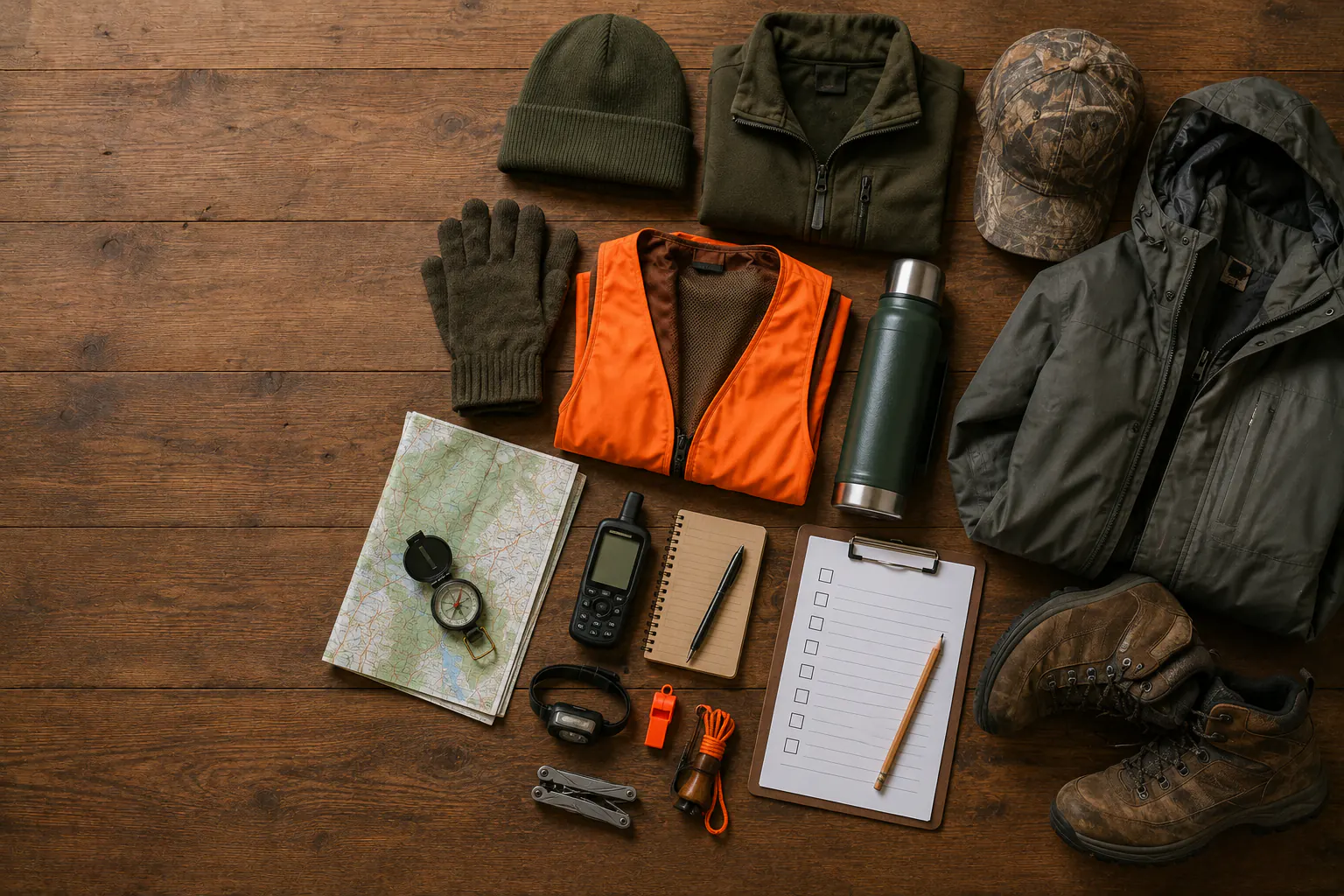
Pack by function
Use a table that names the job, responsible person, storage location, current condition, and stop rule.
| Function | Questions before packing |
|---|---|
| Legal visibility | What garment/color/area requirements apply to each participant and activity? |
| Weather | What handles the forecast range without becoming the severe-weather plan? |
| Navigation | Which official map, offline backup, compass, and route card are current? |
| Communication | What primary and backup channels work, and where do they fail? |
| Medical | What personal medication, accessibility support, and first-aid scope are required? |
| Water and food | What quantity, access, allergy, and safe-use plan applies? |
| Wildlife hygiene | What dedicated protective and containment supplies match current disease guidance? |
| Cold chain | How will temperature be measured and maintained to the confirmed handoff? |
| Retrieval | What conservative human capacity and legal transport plan exists? |
| Return | What lighting, spare power, keys, documents, and check-in support protect the trip home? |
Do not let one object silently own several critical roles. A phone is not the only map, alert receiver, light, license record, camera, and emergency channel. A vehicle is not guaranteed shelter, refrigeration, communication, or access if it is parked beyond a closed gate or cannot be reached in time.
Build the clothing system
Choose clothing for the official visibility requirements, forecast, terrain, vegetation, expected movement, and participant. Record the actual rule rather than assuming a familiar “blaze orange” convention applies everywhere or to every season.
A practical non-offensive system may include:
- agency-required high-visibility garment in the correct area and condition;
- moisture-managing base layer suitable for the temperature and person;
- insulating layer that remains available before the person becomes cold;
- wind/rain layer that does not restrict hearing, vision, movement, or required visibility;
- footwear already fitted and appropriate to the maintained route and conditions;
- dry spare socks and a protected spare layer;
- gloves selected for weather and benign handling tasks, separate from disposable game-care gloves;
- sun protection, insect/tick precautions, and headwear as conditions require;
- a plain spare visibility item for an unexpected companion or roadside problem where lawful.
Do not use camouflage as a default resilience purchase. Visibility to companions, other land users, vehicles, and responders may be the more important function. Never test whether clothing successfully conceals a person from another person.
Try the full clothing system on a short lawful observation walk. Check reach, balance, hearing, peripheral vision, overheating, pressure points, mobility aids, bathroom access, medication access, and whether every required visible area remains visible with the pack and rain layer in place.
Protect navigation and communication
Carry the current official map or area document needed for the plan, an offline route card, and a compass the user has practiced with in a familiar location. Protect paper from weather. Mark no private details on a publicly visible map image.
The map and compass guide supports orientation, but no tool proves ownership, unit boundaries, closures, safe terrain, or legal access. Stop when the map, sign, fence, GPS, or observed landscape conflict.
For communication, document:
- primary device and coverage expectation;
- backup method and its legal/technical limits;
- scheduled check-ins and exact overdue trigger;
- emergency contact and location-sharing choice;
- spare power stored against temperature and moisture;
- local alert channels and the responsible person monitoring them;
- what the group does when a device fails.
The emergency charging plan can size benign device energy. It does not make a remote route acceptable.
Carry bounded medical support
The home first-aid kit guide and qualified training own first-aid scope. For the trip, add personal medications, clinician-approved emergency items, identification where appropriate, allergy information, mobility support, hearing/vision aids, and the return trigger for each participant.
Do not pack a treatment capability nobody is trained or authorized to use. Do not extend the trip because a kit is present. Call 911 or local emergency services for immediate danger, severe injury, breathing difficulty, loss of consciousness, uncontrolled bleeding, serious allergic reaction, or another emergency, and follow dispatcher instructions.
Record the nearest appropriate care route only as planning information; road, weather, service, and facility status can change.
Separate wildlife-care supplies
Wildlife handling requires a dedicated system selected through current species and disease guidance plus hands-on instruction. It should remain sealed and separate from household kitchen tools, ready-to-eat food, drinking surfaces, clean clothing, and pet supplies.
Depending on the authoritative instructions, the plan may identify:
- intact disposable gloves in multiple pairs and sizes;
- eye protection;
- species/hazard-specific respiratory protection where the authority calls for it and the user can wear it correctly;
- dedicated, clean, maintained tools approved by the instructor;
- hand-cleaning supplies for the setting;
- clean barriers and leak-resistant containment;
- waste/disposal bags used only as rules allow;
- cleanable outer protection and closed footwear;
- separate clean and contaminated transport zones;
- labels or identifiers that keep testing and meat attached to the correct animal;
- thermometer and verified cooling capacity.
This is not a field-dressing procedure. The field-dressing education guide explains why live instruction and stop rules are required. Do not improvise disinfectant concentrations, carcass disposal, high-risk tissue handling, or disease-specific PPE.
Verify the cold-chain module
Before departure, test that the temperature-measurement device works and that the cooling system has capacity for the realistic plan. Confirm the processor or refrigeration destination, hours, acceptance conditions, individual-animal identity requirements, test plan, and fallback if it is closed.
Weather, a vehicle bed, shade, snow, frozen bottles, or a cooler label does not prove food temperature. Do not place loose ice, dirty water, fuel, chemicals, game-care waste, or personal food where it can contaminate meat. Do not promise a cooler duration from marketing claims.
The game-meat cold-chain guide owns cooling, separation, measurement, handoff, and storage records. If the plan cannot protect the chain from the field to verified refrigeration, the trip is a no-go.
Use a pack audit
Lay out only non-restricted equipment and ask another group member to retrieve each critical item. Check:
- Required visibility remains visible with every layer and pack configuration.
- Map, route card, check-in times, keys, and identification are protected and reachable.
- Primary and backup communication work in the planned configuration.
- Medication, first aid, water, and weather layers are accessible without unpacking contaminated supplies.
- Wildlife-care supplies are sealed, dedicated, intact, and matched to current guidance.
- Clean and contaminated zones are visibly distinct.
- Temperature measurement and cooling equipment operate before departure.
- Nothing blocks vehicle controls, exits, restraints, visibility, or required access.
- Pack weight and fit work for the actual person on a short benign walk.
- Every participant knows the return and stop triggers.
Record failure, correction, and retest date. Do not claim a product was tested beyond what was actually observed.
Avoid premature product comparisons
ReadyLience does not rank hunting clothing, packs, optics, radios, GPS devices, knives, coolers, PPE, or processors without documented access, fit, weather, durability, cleaning, accessibility, failure-mode, and field-use tests. This checklist is therefore not monetized and contains no affiliate links.
Future non-offensive product coverage must remain separate from weapons, avoid invented field experience, disclose the exact test, and preserve current legal and public-health requirements. A highly rated item cannot repair a missing course, illegal plan, uncertain boundary, failed communication route, or insufficient refrigeration.
Return to the Hunting for Food hub after the audit. A complete pack is not a reason to go. It is one gate in a plan that must still remain lawful, observable, weather-appropriate, medically realistic, and easy to cancel.