
An emergency charging plan is not a drawer full of cables. It is a short decision about which communication devices must work first, how they will be charged safely, when they will be checked, and what the household does when the available power is no longer enough.
Ready.gov recommends alternative ways to charge phones and other mobile devices before a power outage. The practical part is prioritization. A household that drains every battery on entertainment, repeated refreshes, and duplicate charging can lose the phone, radio, accessibility device, or contact method it needs for the next official instruction.
List the communication jobs before the batteries
Write the device beside the job it must perform. Do not start with a shopping list or advertised battery capacity.
| Job | Primary device | Backup | Owner | What happens if it fails? |
|---|---|---|---|---|
| Receive official alerts | Phone, radio, or accessible alert device | Printed local source list | Named adult | Use the next official channel |
| Contact household | Phone or relay device | Paper card and out-of-area contact | Each person | Use planned retry time |
| Call emergency services | Working phone | Another available phone | Named adult | Follow local instructions; call 911 when possible |
| Receive accessibility information | Caption, relay, large-print, tactile, or alert device | Agreed accessible backup | Person who uses it | Use the tested accessible format |
The Family Communication Plan owns names, message format, meeting places, and out-of-area contact. The communication-channel limits guide explains why no phone, radio, or satellite feature is guaranteed, and the NOAA radio comparison covers choosing the receiver itself. This checklist owns only the power needed to keep those paths available.
Separate communication from high-load power
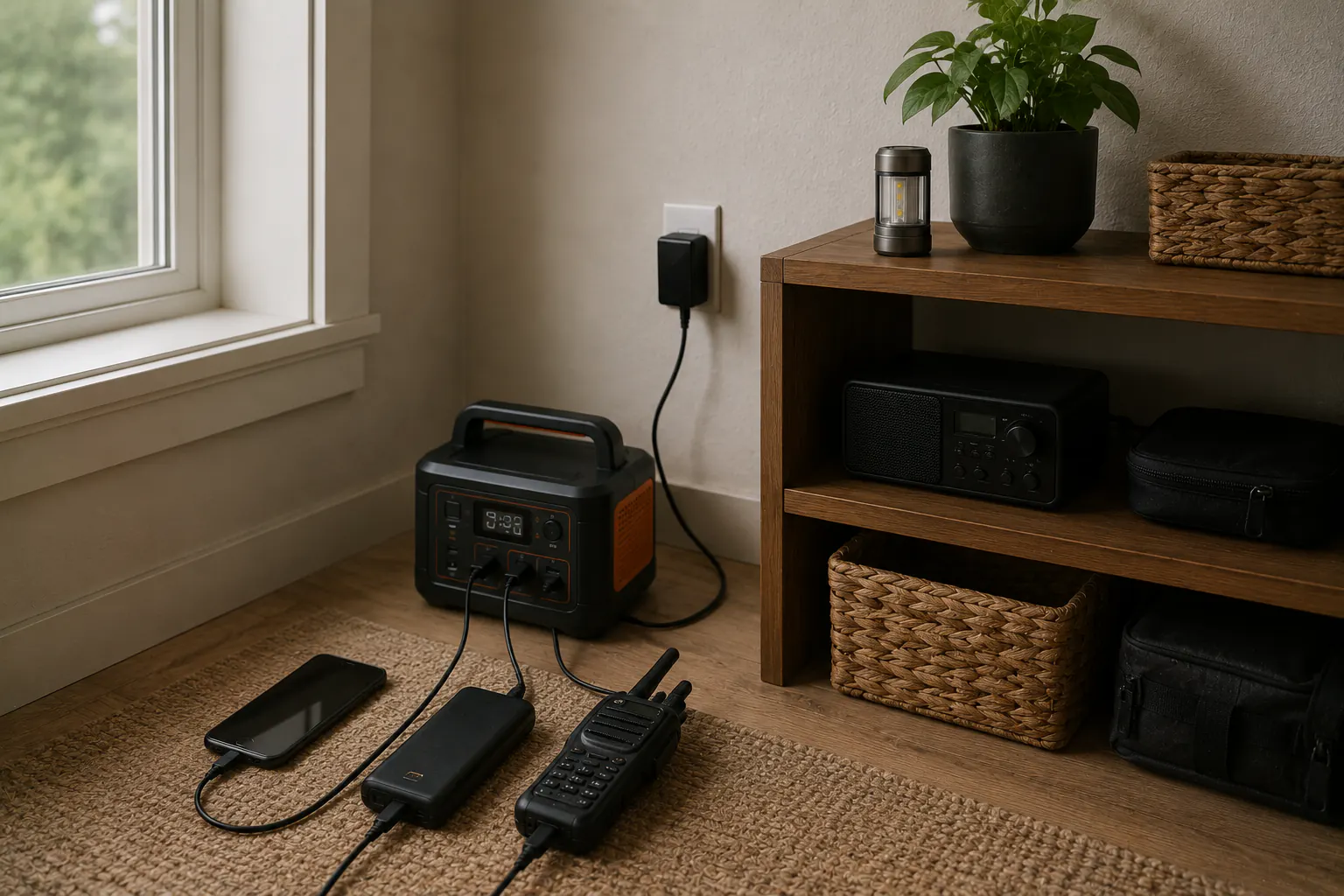
Phones, radios, small alert devices, and power banks have different needs from refrigerators, heaters, medical equipment, tools, or whole-home backup. Put the communication kit in its own labeled location with compatible cables, wall adapter if used, instructions, and a paper charge record.
Do not assign a communication power bank to an appliance or a speculative project. A compact device can be the difference between receiving an evacuation message and having no charged contact method. Conversely, a power station that is reserved for a refrigerator or other essential load may not be available for every phone.
Use the Backup Power for Home guide to understand system categories and the backup-power worksheet to record measured loads. Use the runtime calculator only as a planning estimate. None of those tools guarantee that a battery, outlet, cable, device, or network will be available during an event.
Build a simple charge order
Decide the order before the power fails. A common household order is:
- the device receiving official alerts and emergency calls;
- the device used by the person with the greatest communication or access need;
- the out-of-area contact and household coordination device;
- the radio or accessible alert device that provides an independent path;
- secondary phones and convenience devices.
This is not a universal ranking. A person who uses a communication device for disability access may need a different priority. A medical device is not a communication accessory; its planning remains with the Medical Device and Medication Continuity plan and the relevant clinician, manufacturer, and supplier.
Record the reason for each priority. That prevents a household argument in the dark and makes a gap visible while there is time to add a safe backup.
Check the physical system
At the beginning of severe-weather season, before a forecast event, and after any household or device change, inspect:
- phone, radio, alert-device, and power-bank operation;
- cable ends, ports, adapters, and connector fit;
- manufacturer charging instructions and storage limits;
- date and status of any recall check;
- paper contact card and local alert sources;
- accessible settings, relay contacts, captions, or alert features;
- whether the device can be charged from the planned source without rearranging the room or blocking an exit.
The CPSC identifies hazards involving batteries and battery chargers, including overheating, fire, electrical shock, and burns. Do not keep a damaged cable because it is the only one that fits. Do not cover a charging device, charge it on a bed or other soft surface, force a connector, combine unknown parts, open a power bank, or improvise a battery repair.
Stop using equipment that is swollen, leaking, hot without an ordinary explanation, damaged, smoking, sparking, or has an unusual odor. Check current recall information for the exact model. Follow manufacturer and local hazardous-waste instructions rather than putting a recalled or damaged lithium-ion product in ordinary trash or recycling.
Use a low-drama outage routine
When the power fails, first make the home safe and check current official information. Then preserve communication power:
- Put the primary phone in battery-saving mode and lower nonessential use.
- Turn off unnecessary background activity, video, hotspot sharing, and repeated automatic refreshes.
- Choose check-in times rather than charging and checking continuously.
- Charge the highest-priority device only when the household can supervise and use the planned compatible equipment.
- Keep a paper note of device level, power source, next check, and any failed cable or device.
- Keep an independent lighting source; do not use a phone screen as the only room light. See the Emergency Lighting plan.
If a vehicle charger is part of the backup, use it only according to the vehicle and charger instructions, in a safe location. A vehicle is not a portable indoor generator. Never idle a vehicle in a garage or other enclosed or partly enclosed space to charge devices.
Make a charge schedule that can change
Use a small table on paper. It should describe decisions, not promise hours of runtime.
| Time or trigger | Device | Power source | Goal | Next check | | — | — | — | — | | Outage confirmed | Primary alert phone | Existing battery | Read official instruction | After household safety check | | Scheduled check | Radio or alert device | Its approved battery path | Receive official update | At next planned interval | | Battery low | Coordination phone | Labeled compatible power bank | Send status and preserve contact | At agreed check-in | | Source unavailable | Paper plan | None | Use contact and meeting fallback | Follow official conditions |
Change the schedule when an official order, accessibility need, medical plan, temperature risk, transportation decision, or household separation changes the priority. Do not keep charging a secondary device because it was next on a written list when a current emergency changes what matters.
Test calm failures, not emergencies
Once or twice a year, simulate only ordinary conditions. Turn off a power strip, set aside Wi-Fi, use the paper plan, confirm the right cable, start the radio, and charge one device from its intended approved source. Do not create a false emergency call, false satellite distress message, or hazardous battery test.
Record the failure: connector mismatch, inaccessible charger, depleted power bank, missing instructions, no reception, unclear priority, or an item that should be replaced through its manufacturer or recall process. The best result is a small correction before the next outage.
Use forecast time well
When a credible forecast gives the household time, charge the listed communication devices and inspect the planned cables while normal power is still available. Update the paper charge record, confirm the next official-alert source, and move the kit to its known dry, accessible location. Do not postpone ordinary safety tasks, food planning, medication continuity, evacuation preparation, or official instructions merely to top up every secondary device. The charge plan supports those decisions; it does not outrank them.
Sources reviewed
- Ready.gov: Power Outages; Get Tech Ready; Family Emergency Communication Planning
- U.S. Consumer Product Safety Commission: Batteries and battery-charger safety information
Sources reviewed July 15, 2026. This page is household planning guidance, not electrical, fire, battery-repair, medical-device, or product-selection advice. Current equipment instructions and emergency guidance control actual use.