
Decide whether you need a radio to alert you while you are asleep, provide information while you are awake, or travel in a bag. Then check reception, alert features, power, and accessibility for that job. NOAA Weather Radio uses a broadcast path separate from home internet and cellular service, but neither the broadcast nor an individual receiver is a guarantee that an alert will reach you.
This is a research-based comparison of categories with documented desktop and pocket examples, not a hands-on review or product ranking. ReadyLience has not tested these radios. Manufacturer features describe the intended job, not reception, alert perception or runtime in your home. Any later controlled test will be identified by its actual method and results.
Where a radio fits among your alert channels is the job of the multiple-channel alert plan — read it first, because a radio is one redundant layer, never the whole system. This page only helps you choose the layer.
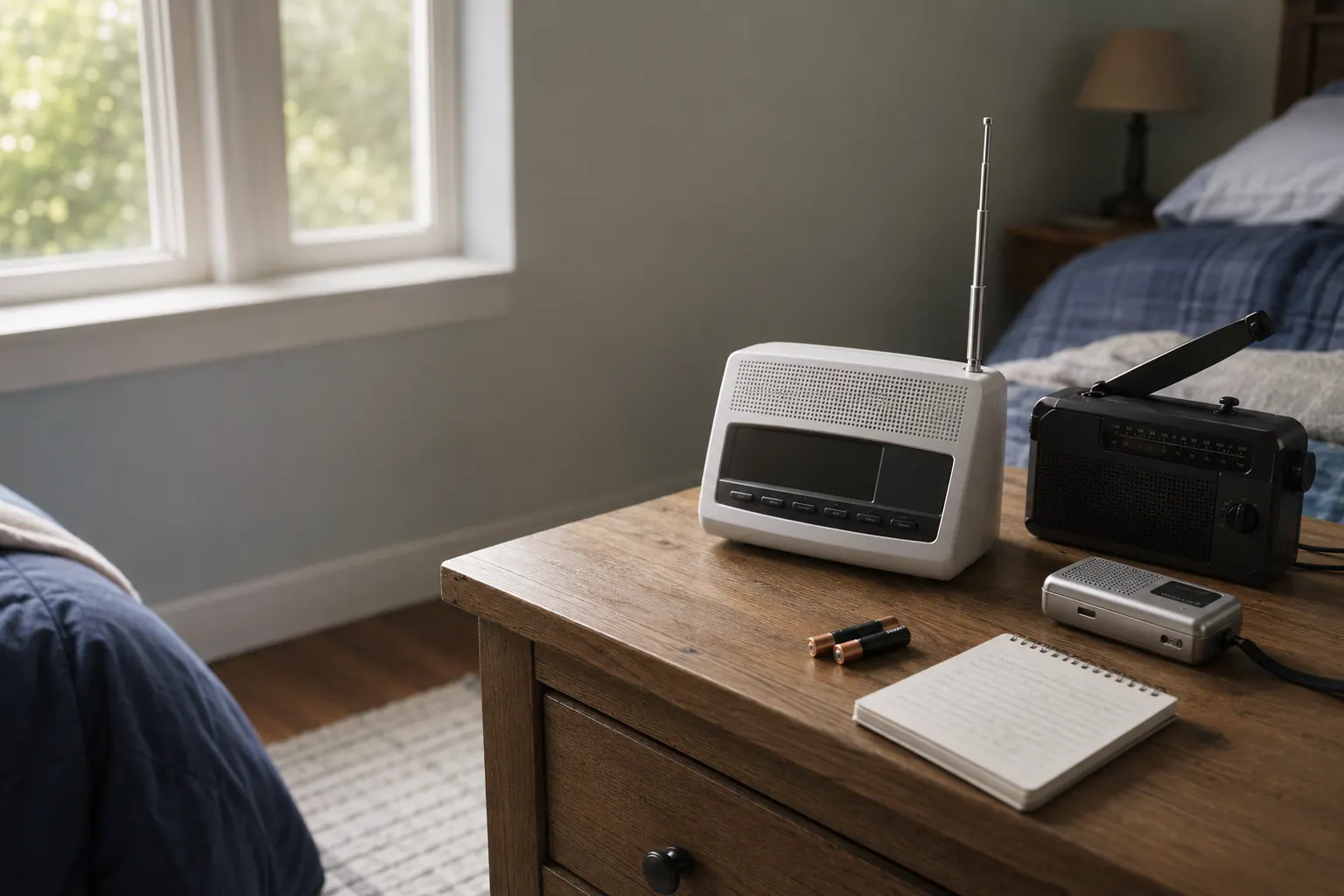
What the network actually is
NOAA Weather Radio All Hazards is a nationwide network of transmitters broadcasting continuous weather information from the nearest National Weather Service office, 24 hours a day. During an emergency, the broadcast carries watches, warnings, and post-event information — and it does not depend on your internet provider, cell carrier, or the power at your house. (Source: National Weather Service, NOAA Weather Radio.)
Two features decide whether a receiver is an alerting device or just a radio:
- Tone alert / alert standby. A compatible, properly configured receiver can announce a matching alert it receives without continuous listening. Power, settings, reception and the person’s ability to perceive it still matter; standby is not a guarantee of waking someone.
- SAME programming. Specific Area Message Encoding can filter alerts by programmed county or counties. It does not guarantee reception or awakening. Use current National Weather Service instructions for your area; the alert-channel guide explains why a copied code from a social post is the wrong source.
The three categories
| Category | The job it does | Main limit |
|---|---|---|
| Desktop SAME alert radio | Monitors a selected broadcast for matching alerts; documented backup power supports an outage plan | Stationary; settings, reception, battery condition and actual alert perception need checking |
| Multi-band crank/solar portable | Portable listening with the exact model’s documented power sources | Charging output, alert modes and county filtering need model-specific checks; the category name establishes none of them |
| Pocket battery receiver | Portable listening when a stationary receiver cannot travel with you | Check the exact alert mode; pocket size does not tell you whether standby or county filtering is supported |
The pattern is alert me, accompany me, travel with me. Choose the missing job from the household alert plan; you do not need to buy all three categories.
Desktop alert radios: the wake-up job
A desktop unit with SAME and alert standby may fit a household that needs an independent alert receiver. Confirm usable reception and whether the actual alert is perceptible to the people who need it. Keep another official-alert channel in the plan.
Documented functions to compare: alert standby, county filtering, backup power and selectable alert modes. None establishes alarm loudness or perception in your home.
Limits and honest cautions:
- Check how the exact model switches to backup power and how long it can remain in alert standby. Follow its battery inspection and replacement instructions rather than assuming another appliance’s schedule applies.
- The alarm has to wake the actual household, through the actual bedroom doors. That is testable in advance.
- Reception indoors varies with terrain, construction, and distance to the transmitter. Placement near a window, away from interference, can matter more than the model.
What to look for in research: SAME support, alert-standby behavior, alarm loudness, battery-backup runtime figures, external-antenna jack for weak-signal areas, and accessibility features (visual or vibration alerting) where hearing is a factor.
Crank and solar portables: the outage companion
The multi-band portable is what most people picture as an “emergency radio”: NOAA bands plus AM/FM broadcast, powered by replaceable or internal batteries with crank and solar as fallbacks, often with a flashlight and a USB port bolted on.
Potential use: portable listening to weather broadcasts and available local AM/FM information. Whether that works through your outage depends on reception, maintained power and the exact receiver, not its category.
Limits and honest cautions:
- Crank output needs a model-specific check. Do not budget listening time from a generic crank ratio. Treat the crank as a supplement to a dependable battery or charging plan.
- A solar panel is not proof of useful recharging. Check the model’s documented charging conditions and time; do not assume the built-in panel will replenish the radio during the outage weather.
- A USB port is not a phone-charging plan. Verify the actual output and energy available before depending on it. The charging plan for phones, radios, and power banks separates those needs so phone charging does not silently use up the radio reserve.
- Check the portable’s actual alert modes and county-filtering functions rather than assuming they match a desktop receiver.
What to look for: battery format shared with the rest of your kit, honest runtime figures at listening volume, whether NOAA alert standby exists at all, and controls usable in the dark.
Pocket receivers: the layer that travels
A pocket receiver may fill a portable-listening gap when your stationary radio cannot travel with you. Check the actual bag space, battery instructions and local reception; a compact label does not establish fit or reliable reception. Vehicle storage also needs to match the exact product’s permitted conditions.
Useful distinction: a replaceable-battery receiver can use a compatible spare-battery plan rather than a charging cable. That is a documented power arrangement, not an autonomy measurement.
Check the alert mode rather than assuming it is absent. Midland’s ER10 manual describes an enabled WX alert mode, including while the radio is powered off. That is not the same as programmable SAME county filtering: compare the actual received version and manual with your alert plan. Neither the documented siren nor the flashing light proves you will notice it. Follow battery and storage instructions, keep compatible spares accessible, and do not remove batteries from a receiver you depend on for continuous alert standby. (Source: Midland, ER10 owner’s manual.)
For portable listening, saved stations and the controls you prefer may matter more than another advertised band. Sangean’s DT-400W manual documents AM/FM presets, a volume wheel and speaker/earphone selection. FM uses the earphones or wire antenna; confirm the actual accessories rather than assuming a telescopic antenna. Keep a suitable receiver you already own if its controls work for you.
Its weather standby is a separate limitation: the selected 4-, 8- or 16-hour period expires, a weak-battery indication disables the alert, and replacing batteries clears its alert setup. Those settings are not continuous SAME monitoring or a guarantee of waking someone. This example is for planned listening while awake, with independent official alert channels still in place. (Source: Sangean, DT-400W Revision 3 manual.)
Power is the real specification
Power is one possible failure point alongside reception, setup and alert perception. Ready.gov includes a battery-powered or hand-crank radio among outage supplies; that does not establish any particular model’s runtime. (Source: Ready.gov, Power Outages.)
Use only the battery format and storage conditions the receiver requires. Keep compatible spares accessible, and follow its own check instructions rather than borrowing a replacement interval from a lamp. The backup power hub helps compare documented household loads without treating a radio’s energy use as measured here.
What the marketing numbers do not tell you
- Check what a certification or endorsement label actually covers. Receiving NOAA weather bands does not by itself establish a model’s alert features, reception in your home, or a ReadyLience product test.
- Band count is not capability. Seven bands you never use matter less than one alert feature that works.
- Advertised crank ratios and solar wattages are best-case. Real output depends on effort, sun, and battery condition — assume less.
- Range claims ignore your terrain. Reception at your actual home, in the room where the radio will live, is the only figure that matters, and no box quotes it.
- A flashlight bolted onto a radio is a convenience, not a lighting plan. The lighting system has its own owner.
A decision path
- Start from the alert plan. The multiple-channel guide decides what the radio must add; usually the answer is “wake us when phones will not.”
- For an alerting gap, compare alert-standby receivers. Confirm reception, current NWS programming, backup power, and an alert the household can perceive before relying on it.
- For portable listening, check what you already have. Compare a multi-band portable only if the home or departure plan needs that function.
- For a travel kit, check weight and duplication. A separate pocket receiver is useful only if it adds an information path the kit otherwise lacks.
- Connect it to the household plan. A warning is only useful if the household knows what it does next — that is the family communication plan, and the radio is one input to it.
What a credible review would record
Before a radio is presented as personally tested or a measured winner, a credible review would document:
- reception at defined indoor locations against a known transmitter, not open-sky best case;
- whether the alert alarm wakes a sleeping adult through a closed door, at measured volume;
- SAME programming usability by someone who has not read the manual;
- measured runtime at listening volume on each power source, including how many minutes of listening one minute of cranking buys;
- battery-backup behavior on a desktop unit through a simulated outage;
- solar charging results in stated, repeatable conditions;
- exact test conditions, instruments, and sample count.
None of the linked examples satisfies that testing protocol. They are disclosed research-based options under the criteria above, not tested recommendations. The National Weather Service does not endorse this or any other receiver brand.
Sources reviewed
ReadyLience reviewed National Weather Service NOAA Weather Radio information, Ready.gov alert and power-outage guidance, and the FEMA “Know Your Alerts and Warnings” reference. Statements about transmitter coverage, SAME filtering, and alert types describe the public network as those sources document it. Manufacturer range, crank, and solar figures are not household measurements. ReadyLience has tested no radio or identified a measured winner; current official instructions control every real event.
Midland’s WR120B product page, current WR120 documentation and the exact Amazon listing were checked October 12, 2026 for model identity and documented SAME/desktop power role. NWS receiver guidance was checked for its non-endorsement boundary. No radio was operated or tested, and no reception, alert-perception, accessibility or runtime result is established. Check the exact received version and manual rather than borrowing revision-specific settings from another unit.
Midland’s ER10VP page, currently linked ER10 manual and exact single-receiver Amazon listing were checked October 12, 2026 for the portable AA power arrangement and WX alert mode. The manual does not document programmable SAME county filtering. Retailer dimensions were inconsistent and are not used as a fit claim. No receiver, battery runtime or alert delivery was tested.
Sangean’s current US DT-400W page, its linked Revision 3 manual and the exact Yellow single-receiver listing were checked October 12, 2026. The manual documents 19 AM/FM memories, not weather presets, and the timed standby, battery and antenna limitations above. The listing names earbuds and a manual; confirm any separate wire antenna and current supplied labeling before use. Its small-parts and California chemical warnings remain relevant. No radio, accessory, reception, controls, cleaning or alert perception was physically tested; manufacturer reception and loudness marketing is not household evidence.