
Choose one short practice task that fits the people taking part, with normal safety systems available and an immediate way to stop. You can start with retrieving a map or reviewing a no-fire decision. The calendar below is an optional sequence, not a test of endurance or a required family schedule.
Use any applicable session below at a pace the household can support; there is no required twice-yearly cycle. Repeat to address a specific question, not to make the exercise harder. A useful change might be a clearer label, a more accessible route, another willing participant, or equipment retrieved from its normal storage place.
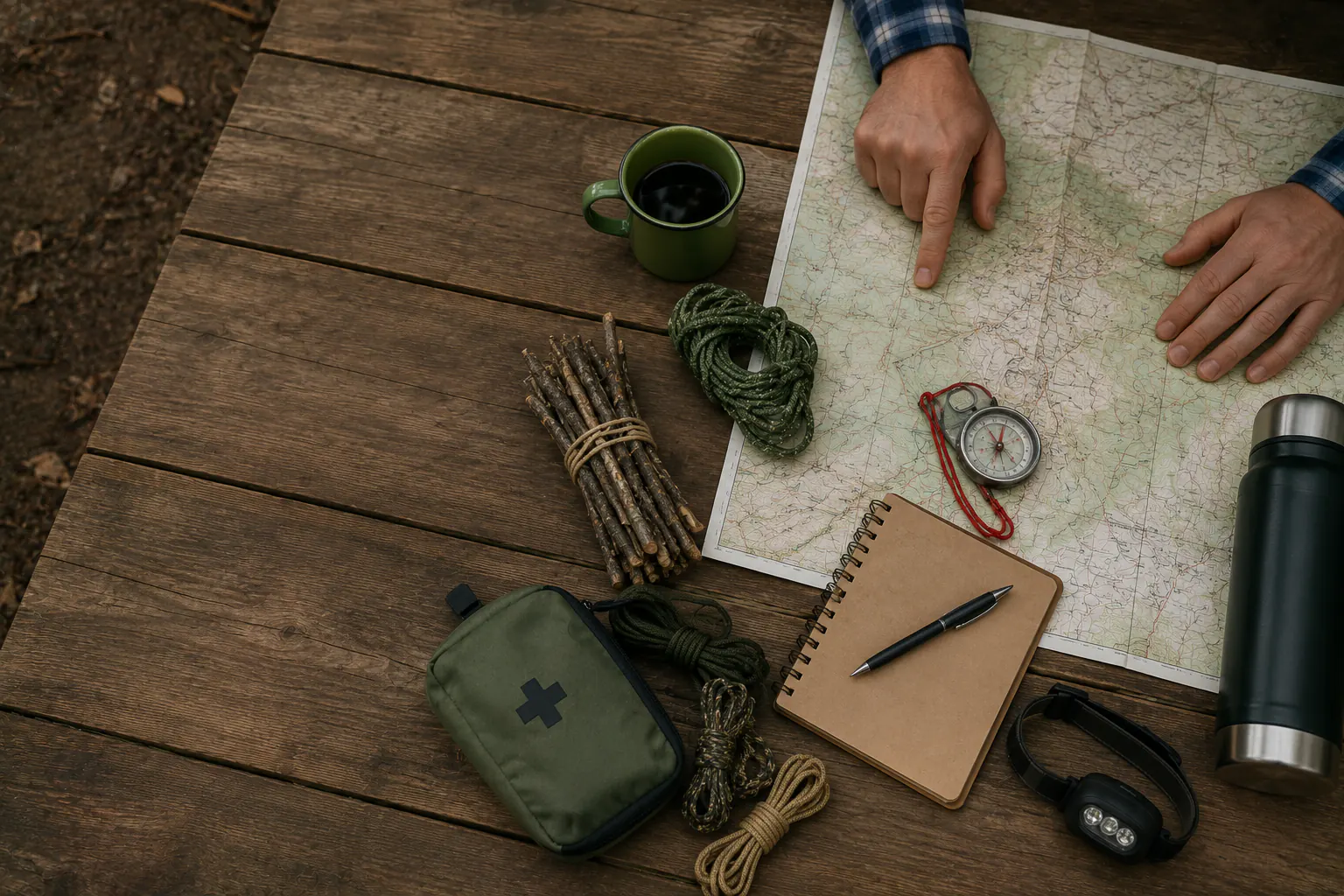
Establish household practice rules
Write and read these rules before the first session:
- Participation is voluntary, and any person can say “stop” without debate.
- Practice occurs with permission, benign conditions, daylight unless lighting is the planned topic, working communication, and an immediate safe fallback.
- Life-safety systems remain active. Do not disable alarms, utilities needed for safety, medical equipment, refrigeration for medication, locks required for egress, or essential animal support.
- No person, animal, vehicle cargo, heavy object, overhead object, occupied hammock, tow, lift, or fall depends on a practice knot.
- A tarp or tent is ordinary weather cover, not lightning, tornado, wildfire, flood, falling-tree, or extreme-temperature shelter.
- Fire practice is dry by default. Any live flame requires current explicit permission, suitable conditions, competent adult supervision, and the complete approved extinguishing route.
- The session ends for a warning, thunder, smoke, rising water, unsafe temperature, darkness, injury, distress, equipment damage, blocked path, lost communication, or unclear authority instruction.
Post the rules with the practice bin. They are more important than finishing the calendar.
Assign four rotating roles
One person may hold more than one role in a small household, but name each responsibility:
- Session lead: states the goal, exclusions, and stop conditions.
- Skill lead: demonstrates from a trusted source or follows a qualified instructor.
- Observer: watches paths, weather, people, animals, and deviations from the plan.
- Communication and access lead: keeps the phone or radio, route, medication, mobility support, and safe fallback available.
Rotate roles during the second six-month cycle. A child can observe landmarks, find a checklist, or announce “path clear,” while an adult retains safety and route decisions. A person who cannot manipulate small cord may lead inspection or communication. Practice should reveal ways to adapt the system, not exclude the participant.
The family emergency communication plan owns contacts, meeting places, and check-ins. Reuse those exact names and callouts.
Use one session card
Complete this card before each practice:
| Field | Entry |
|---|---|
| One observable outcome | What one person will retrieve, identify, assemble, or explain |
| Setting and permission | Familiar location, owner or manager, approved activity |
| Time box | A duration that fits actual support needs, including reset; stop earlier when needed |
| Participants and roles | Names, adult lead, observer, communication/access lead |
| Current conditions | Forecast, alerts, closures, fire rules, daylight, surface |
| Safe fallback | Substantial building, hard-topped vehicle, or cancellation |
| Exclusions | What will not be attempted or loaded |
| Stop triggers | Exact words, conditions, and person who acts |
| Reset | Dry, inspect, count, return, and update |
If any field remains unclear, convert the session to a tabletop discussion or cancel it.
Month 1: Find and orient the physical map
Outcome: Another household member can retrieve the correct local map, identify its date, scale, legend, and north diagram, orient it at one known location, and state what information it cannot provide.
Use a familiar yard, block, or maintained park. Mark two durable visible features on the route card but do not draw a live emergency route. Confirm that the map covers home, a household meeting place, and enough surrounding area to recognize a wrong turn.
Practice one orientation and one reset. Compare the result with a second source after the exercise. Record outdated roads, missing accessibility information, or map storage that was hard to reach.
Use Basic Navigation With a Map, Compass, and Landmarks as the skill owner. The session ends if traffic, weather, visibility, separation, or location uncertainty creates consequence.
Month 2: Tie and inspect one low-risk fastening
Outcome: A learner can inspect bright practice cord, state the prohibited uses, tie one approved pattern from a trusted diagram, load an empty practice task gently, recheck the tail, unload, untie, and inspect.
Use an empty tarp corner on the ground or a light bundle of folded blankets. Keep every line visible and every person outside the tension path. Do not practice around a tree, handrail, door, pipe, vehicle, animal, or occupied shelter.
Record whether the cord was easy to handle and whether another person could compare the finished shape with the reference. Retire damaged or unexplained cord.
The low-consequence knot guide controls the task. Success does not extend to another material or load.
Month 3: Build empty ordinary weather cover
Outcome: The household can select a permitted low-risk spot, identify the substantial weather fallback, pitch a small empty tarp according to instructions, preserve drainage and egress, then dismantle and dry it.
Practice beside home in calm dry daylight. Place no person, animal, medication, food, or critical equipment under the cover. Mark all guylines visibly and keep them outside the path. Time movement from the practice area to the real substantial shelter.
Use the weather-protection shelter guide. If thunder, warning, wind, smoke, heat, cold, or equipment movement appears, end the exercise and use the fallback.
Month 4: Complete a fire decision without flame
Outcome: A participant can identify the responsible land and fire authorities, find the current restriction, explain which devices it covers, inspect a cold designated fire area, stage the required extinguishing resources, and choose the no-fire plan.
Do not light anything. Use a cold, authorized site or photographs supplied by the responsible authority. Rehearse the exact location information needed for 911 and the path away from the area. Pack a meal, light, and clothing plan that requires no combustion.
The outdoor fire-safety warning owns this session. If a later live-fire lesson is desired, use qualified local instruction and repeat every same-day permission and weather check.
Month 5: Run a weather movement and communication drill
Outcome: Every participant receives a simulated weather message, stops the activity, accounts for people and animals, and moves along the clear route to the predetermined substantial shelter within the household plan.
Use calm weather. Do not wait for a real warning or create fear with sirens. The observer quietly introduces a written prompt such as “practice thunder reported.” The communication lead uses the same plain language the household will recognize, then everyone walks rather than runs.
Check path width, lighting, doors, shoes, medication access, mobility support, animal handling, and the all-clear owner. NWS campground guidance emphasizes planning, practice, multiple warning paths, shelter timing, and a defined release decision.
The multi-channel alert guide owns actual alert sources. The pet preparedness hub and medical continuity plan own animal and medical dependencies.
Month 6: Run a two-hour household systems trial
Outcome: The household operates a normal two-hour block using selected backup light, communication, water dispensing, simple food, and sanitation arrangements while normal safety systems remain available.
This is not an outage reenactment. Do not shut off household water, electricity, heat, cooling, refrigeration, alarms, medical devices, or required communication. Instead, place a visible “practice only” card on the normal controls and use the backup items for selected routine tasks.
Record quantities used, setup time, unclear labels, missing adapters, path conflicts, and caregiver load. Stop immediately if the practice affects a real need.
The 24-hour and 72-hour off-grid trial owns any longer progression. The daily dependency planner can expose arithmetic gaps but does not declare the system safe.
Repeat the cycle with a meaningful variation
For months 7 through 12, repeat each topic with one controlled change:
- another adult leads while the original lead observes;
- equipment is retrieved from its real shelf rather than staged on a table;
- a large-print, high-contrast, tactile, or simplified instruction is tested;
- a second familiar location is used with current permission;
- the household adds one service-animal, pet, caregiver, or mobility step;
- a failed component is simulated by removing it before the session begins;
- the reset is completed in the dark indoors using normal safe lighting, without creating outdoor night exposure.
Do not increase consequence by adding remote terrain, severe weather, live flame, heavier loads, faster movement, longer deprivation, or less supervision.
Debrief without grades
NPS camping guidance recommends assessing what went right and wrong after a trip. Use four plain categories:
- Worked as planned: observed directly and repeatable in the same low-risk context.
- Worked with friction: completed, but access, instructions, time, comfort, or coordination needs improvement.
- Did not work: stop using the assumption until corrected and retested.
- Not tested: remains unknown; do not count ownership or purchase as capability.
Avoid percentages, readiness scores, badges, or “survival capable” labels. Record the exact evidence: “Map was found in 40 seconds but the legend was too small for one reader” is actionable. “Navigation 8/10” is not.
Close every session completely
Account for every participant and animal. Tell the outside contact the practice is over if a check-in was used. Dry, clean, inspect, count, and store equipment. Replace only what has an identified purpose. Preserve a short note with date, conditions, participants, outcome, stop, and one next action.
Update the relevant owner page rather than creating a separate household rule. Communication changes go to the communication plan; water changes to the water plan; medical changes to clinician-led continuity; pet changes to the animal plan; and route changes to the evacuation or transportation plan.
Return to the Transferable Outdoor Skills hub after month six and choose the next cycle from observed friction. A mature practice program becomes calmer and more inclusive over time, not more theatrical.