
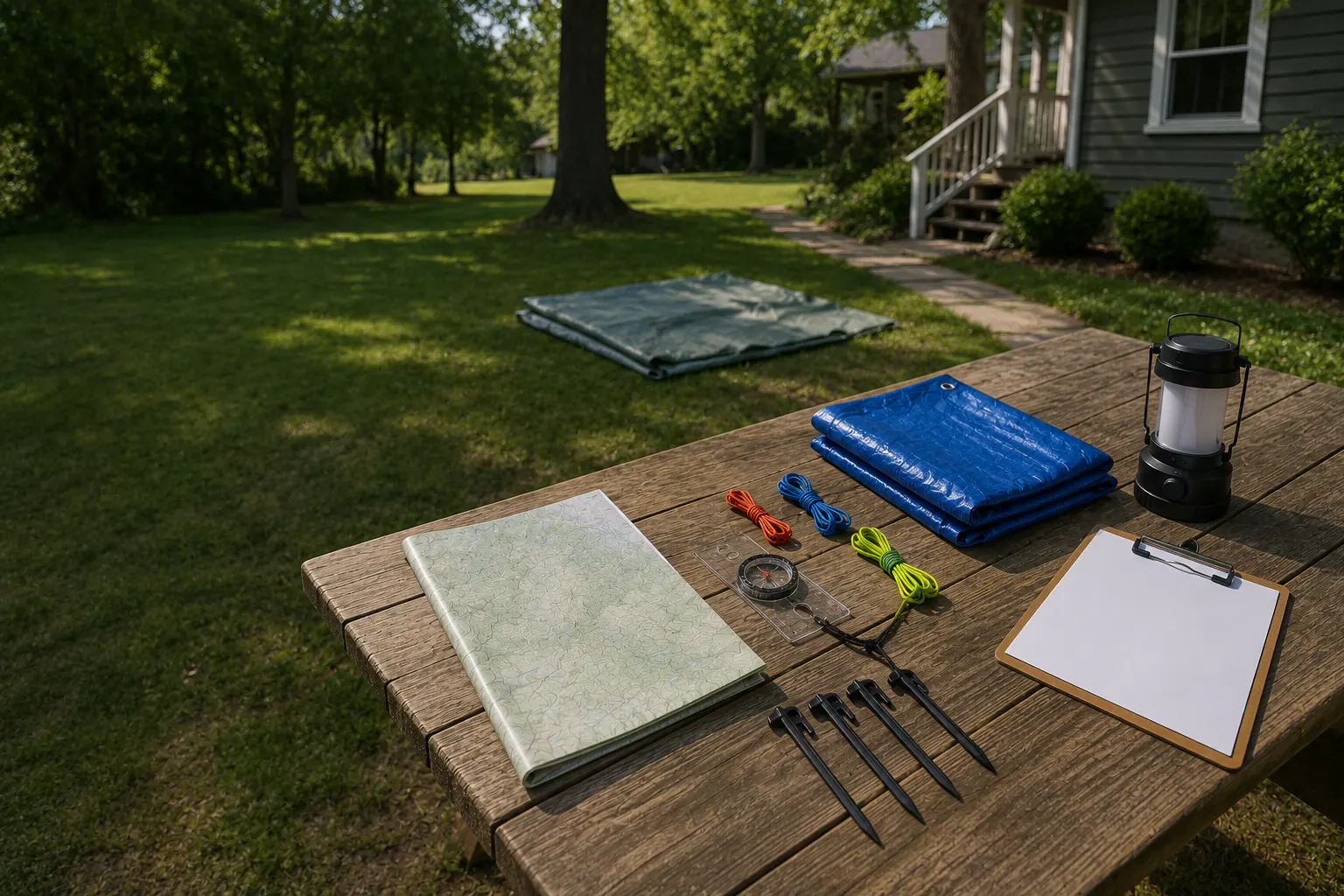
The outdoor skills that matter most in a household emergency are rarely dramatic. They are the ability to read a physical map when a phone is unavailable, make a temporary cover without blocking an exit, secure a light bundle without trusting a mystery knot, recognize when a fire is prohibited, and practice a small task until another household member can do it too.
That is a different goal from improvising a wilderness rescue or proving that a family can endure unnecessary exposure. A transferable skill should make an ordinary plan more reliable. It should also make its own limit obvious.
Use this outdoor-skills family
- Basic Navigation With a Map, Compass, and Landmarks covers physical-map orientation, simple bearings, landmark confirmation, route records, and a controlled neighborhood practice.
- Essential Knots for Tarps, Bundles, and Low-Risk Repairs teaches a deliberately small set for visible, low-consequence tasks and excludes every life-safety or road-cargo use.
- Emergency Shelter Principles for Weather Protection separates ordinary rain, wind, ground, and sleep protection from true severe-weather shelter.
- Outdoor Fire Safety: Site Selection, Restrictions, and Extinguishing starts with current permission and a no-fire option, then covers supervision and a cold-out check.
- A Monthly Outdoor Skills Practice Plan for Families turns these topics into short, reversible sessions with roles, stop rules, and a useful after-action note.
The short-term off-grid hub owns the complete operating plan for a cabin, campsite, or utility trial. This family owns only the learnable outdoor tasks inside that wider plan.
Define transfer before training
A skill transfers when the same underlying action helps in more than one setting without pretending the settings are identical.
| Outdoor practice | Household or emergency transfer | Limit that stays in place |
|---|---|---|
| Orient a map to visible streets and terrain | Keep a physical route picture during a phone or network outage | An old map does not override closures, orders, water, fire, or security conditions |
| Tie and inspect a low tarp guyline | Secure a temporary rain cover or organize a light bundle | Not for a person, fall, rescue, tow, hoist, overhead load, hammock, or moving vehicle |
| Pitch a small tarp beside a safe building | Learn drainage, wind, tension, visibility, and egress | A tarp is not lightning, tornado, wildfire, flood, falling-tree, or cold-weather certification |
| Check current fire restrictions and extinguish a permitted practice fire | Improve flame discipline and no-fire decision-making | Permission, weather, site rules, fuel, equipment, and fire authority always control |
| Debrief a 30-minute family session | Reveal unclear roles, inaccessible gear, and fragile assumptions | A successful drill is not proof that a live emergency will be safe |
This distinction keeps useful fieldcraft connected to normal life. It also prevents a familiar action from being stretched into a job it was never designed to do.
Build skill as a closed loop
Use the same six-part loop for every practice:
- Name one outcome. “Orient the neighborhood map and identify two verified meeting places” is measurable. “Learn navigation” is not.
- Choose a controlled setting. Use a familiar park, yard, room, or designated site with permission, benign weather, daylight, communication, and a quick exit.
- State exclusions aloud. Before cordage practice, say that no person or heavy object will depend on the line. Before shelter practice, identify the substantial building used if weather changes.
- Demonstrate slowly. The learner should be able to see each step, ask what could fail, and stop without consequence.
- Repeat from reset. Untie the cord, fold the map, or remove the tarp. A skill is more useful when it can be rebuilt from an ordinary stored state.
- Record one change. Move the compass, replace frayed practice cord, enlarge a label, shorten the route, or schedule qualified instruction. A drill without a change is only an activity.
The National Park Service trip-planning model similarly puts current conditions, permits, group limits, equipment, an outdoor emergency plan, and practice ahead of confidence. Equipment can support a trained process; it cannot create one.
Keep navigation tied to a current plan
A compass does not know that a bridge is closed, smoke has moved, floodwater covers a road, a property is private, or an evacuation order has changed. A physical map is valuable because it preserves context when batteries, networks, and apps fail. It still needs a date, area, legend, scale, north reference, and current authority information.
Practice in a familiar place before trying an unfamiliar one. Match a street, path, ridgeline, waterway, large building, or other durable feature on the map to what you can see. Compare map distance with a known walk. Learn how the exact compass and exact map handle magnetic declination. Keep the phone or GPS as a second system, not the only system.
Live get-home decisions belong with the realistic get-home plan, and evacuation movement belongs with the household evacuation hub. Outdoor navigation practice does not authorize a shortcut through floodwater, smoke, fire, unrest, a closed road, private land, or an unknown trail.
Treat cordage as a visible temporary system
The strongest-looking line can be the wrong material, damaged, poorly anchored, cut by an edge, degraded by sun or chemicals, or tied with a knot that slips in that application. A useful beginner habit is therefore not “memorize many knots.” It is choose one low-consequence job, inspect every component, select one appropriate fastening, load it gradually while everyone stays clear, and recheck it.
Bright practice cord makes lines and trip hazards easier to see. Keep guylines outside the walking route or mark them visibly. Protect cord from sharp edges. Retire practice material with cuts, melted areas, severe abrasion, unknown chemical exposure, or hidden damage. Untie and inspect after use rather than leaving an unexplained line for the next person.
The Essential Home Toolkit retains tool choice, maintenance, storage, and household repair boundaries. Cutting, drilling, powered equipment, and structural work do not become outdoor-skills topics because they happen beside a tarp.
Make shelter a location decision first
Shelter starts before fabric. Ask whether the activity is allowed, whether the location is exposed to floodwater, falling trees or branches, cliffs, traffic, fire, wildlife, unstable ground, wind, and changing weather, and whether every household member can reach the real emergency shelter in time.
For ordinary weather protection, think in layers: overhead rain and sun cover, wind reduction, ground moisture separation, insulation, dry clothing and bedding, ventilation, stable attachment, visibility, and an open exit. Practice setting up according to the product instructions in mild weather beside a substantial building. Time the reset and inspect every wet, abraded, or damaged part afterward.
Do not confuse that setup with a storm shelter. The National Weather Service says tents and open shelters are not safe lightning shelters. Tornadoes, wildfire, flash flooding, dangerous heat or cold, and falling-tree conditions require their own authority-led actions. If the forecast or location removes a timely safe option, postpone the practice.
Let the no-fire option win easily
Fire skill begins with deciding not to light one. A current restriction, missing permit, dry or windy conditions, questionable fuel, inadequate water, poor supervision, nearby combustibles, medical or accessibility concern, or uncertain extinguishing route is enough to use a no-flame meal and lighting plan.
When a fire is expressly permitted, the exact site rules control the device, location, size, fuel, attendance, tools, ash, and disposal. Keep children and animals outside a defined boundary. One unimpaired adult remains responsible without switching tasks. Extinguishing is complete only when the approved process has left all material cold and the authority’s requirements are met.
The generator carbon monoxide warning remains the owner for combustion around homes, cabins, vehicles, tents, garages, and outages. Never move a grill, charcoal device, camp stove, generator, or other fuel-burning equipment into or near an enclosure to continue a practice in poor weather.
Practice for the whole household
An efficient family session has one leader, one learner, one observer, and one communication or accessibility role. Rotate them. A child might point out landmarks while an adult retains navigation responsibility. A person with limited grip might select larger cord and demonstrate the inspection rather than tightening a knot. A caregiver may need to keep the session short enough that medication, temperature, food, animal, or mobility routines remain uninterrupted.
Use plain callouts: “stop,” “line under tension,” “path clear,” “weather change,” and “practice over.” Nobody should have to infer that a task has become unsafe. The family emergency communication plan owns contacts, meeting places, and household check-ins; reuse its language instead of inventing a second system.
Measure capability without pretending to certify it
Record observable facts:
- Could another person find the correct stored map and compass?
- Could the learner orient the map at a familiar location and explain what remained uncertain?
- Did the knot hold the intended light practice task, untie afterward, and leave the line undamaged?
- Did the tarp keep an empty groundsheet dry without blocking a path?
- Did the group identify the substantial weather shelter and reach it within the planned time?
- Was the fire decision made from current rules, and was the no-fire alternative ready?
- Did every participant know who could stop the drill?
Avoid scores such as “80% prepared” or labels such as “survival ready.” A skill log should expose the next useful practice, not award confidence.
Stop before practice becomes exposure
End or relocate for a warning, thunder, rising water, smoke, strong wind, dangerous temperature, darkness beyond the lighting plan, fire restriction, equipment damage, unclear permission, illness, injury, distress, lost communication, animal problem, blocked exit, or any participant who wants to stop. Contact the responsible authority or 911 for immediate danger.
The best transfer from outdoor practice is not endurance. It is noticing a limit early, communicating it clearly, and choosing the safer option while there is still time.