
The first outdoor fire skill is being comfortable with no fire. A cold meal, battery light, extra clothing, or cancellation is often the better plan. A permit from last month, an existing ring, a calm morning, or a stove marketed for camping does not override today’s restriction, weather, closure, equipment instructions, or site rule.
This guide provides a decision and supervision framework for an ordinary permitted practice fire. It does not teach fire by friction, accelerant use, debris burning, burn piles, wildfire defense, indoor combustion, technical cooking, or improvised heating.
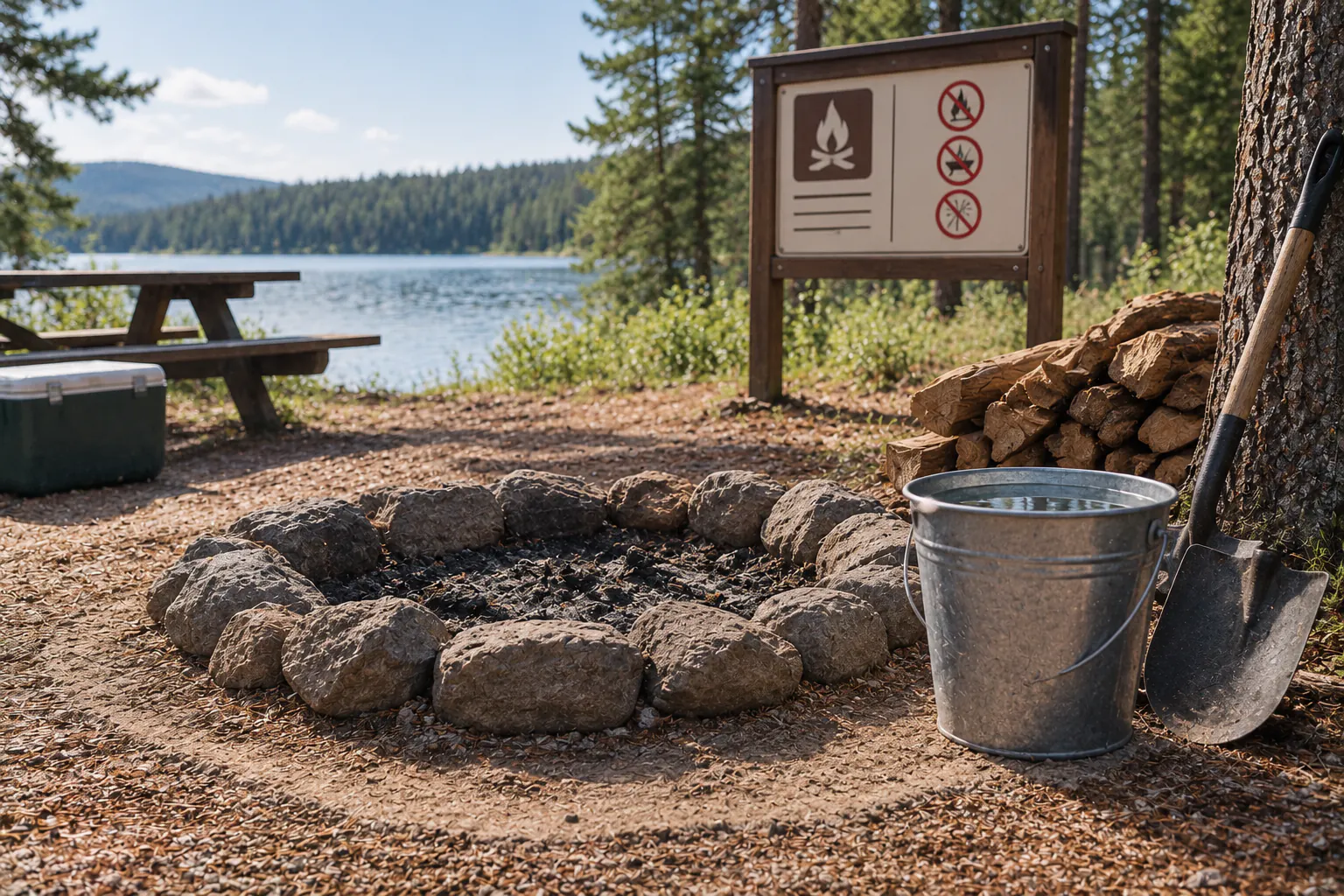
Make permission a same-day check
Identify the exact owner or land manager and the exact fire authority for the location. On the day of use, record:
- whether the site is open;
- whether any fire restriction, red-flag condition, burn ban, air-quality restriction, or temporary closure applies;
- whether a permit is required and remains valid;
- which devices are covered: wood fire, charcoal, liquid-fuel stove, propane appliance, grill, lantern, generator, spark-producing tool, or vehicle use;
- where the device may be used and whether an existing ring or designated unit is mandatory;
- allowed fuel, collection, transport, size, attendance, water, shovel, ash, and disposal requirements;
- who to contact and how to report an escaped fire.
BLM notes that regulations vary by area and can change with weather and season. Its regional restriction pages exist because a rule is not nationally portable. Ask the authority when wording is unclear. Do not infer that “no open fire” permits a stove, charcoal, or another flame.
Use the off-grid site checklist to keep the rule, date, source, weather, and exit in one record.
Choose no fire whenever a dependency is weak
Do not light a fire when:
- permission, permit, restrictions, or device coverage is unresolved;
- wind, drought, heat, low humidity, smoke, wildfire activity, or forecast makes conditions unsuitable;
- required water, shovel, fire pan, ring, clearance, supervision, communication, or disposal is missing;
- the site is near dry vegetation, roots, peat, duff, overhanging branches, structures, tents, vehicles, fuel, waste, or an escape route;
- a child, animal, impaired person, medical need, mobility limit, or group size cannot be supervised safely;
- alcohol, drugs, medication effects, fatigue, distraction, darkness, or competing tasks weaken continuous attention;
- the group would need the fire for survival, emergency heat, water safety, or essential food with no safe fallback;
- there is not enough time and water to extinguish and recheck it before leaving.
A fire should be optional. Prepare food that does not require heating, battery lighting, weather-appropriate layers, and an early departure. The short-term off-grid power guide owns the broader no-combustion energy context.
Inspect the exact fire area
When a fire is currently permitted, use the designated ring, grill, pan, or device required by the authority. Do not create a new scar merely because the ground appears bare.
Walk the area for:
- dry grass, leaves, needles, duff, roots, stumps, brush, low branches, or material that can carry heat underground or downwind;
- tents, tarps, clothing, chairs, vehicles, fuel, batteries, buildings, fences, utility equipment, and stored supplies;
- slopes where embers or burning material can roll;
- wind funnels and gusts around trees, terrain, or structures;
- trip hazards between the fire, water, exit, and communication point;
- wildlife, pets, children, and public traffic.
NPS gives general separation guidance for tents, gear, and other flammable objects, but the current local rule and device manual control the exact distance. More space is not permission to ignore wind or vegetation.
Place the required water and tool where the responsible adult can reach them without crossing the flame or a trip line. Keep the route to 911 communication and the site exit clear.
Assign one responsible adult
One unimpaired adult is the fire lead from ignition through the final cold check. That person does not cook a complex meal, supervise swimming, repair equipment, leave for more wood, manage a vehicle, or hand responsibility to a child.
State the boundary and callouts before ignition:
- who may approach;
- where children, animals, chairs, and loose clothing remain;
- who controls fuel and tools;
- “stop” for any participant;
- “wind change,” “spark out,” or “water now” for an immediate response;
- who calls 911 and provides the location if fire escapes.
Never leave a fire unattended, even briefly or while sleeping. An apparent bed of gray ash can retain heat and flare when wind changes.
Keep the fire small and ordinary
Follow the site and device instructions. Use only approved fuel obtained lawfully. Do not burn trash, treated or painted wood, plastics, batteries, aerosol containers, unknown debris, food packaging, or storm waste. Do not use gasoline or another unapproved accelerant.
Add only enough approved fuel to maintain the permitted small fire. Keep sleeves, hair, gloves, synthetic fabric, and tools controlled. Do not reach across flame or move hot material outside the approved area.
Stop adding fuel early enough to extinguish fully. If wind rises, sparks travel, smoke changes, the ring or device moves, a restriction changes, someone is injured, or supervision weakens, begin the approved extinguishing process and contact the authority as needed.
The post-storm debris warning owns debris contamination and utility hazards. Outdoor fire is not a cleanup shortcut.
Keep all combustion outside enclosures
Never move a fire, grill, charcoal device, camp stove, generator, or unapproved heater into a tent, tarp, cabin, garage, porch, vehicle, shed, doorway, or improvised enclosure because weather changes. Carbon monoxide is odorless and can become fatal before a person recognizes the problem.
The generator carbon monoxide guide owns placement and prevention. If a CO alarm sounds or symptoms may be present, move to fresh air and call 911. Do not search for the source or re-enter based on this page.
Extinguish with time to recheck
Begin well before departure or sleep. Follow the exact land-manager process. U.S. Forest Service guidance commonly uses a repeated water, stir, and recheck sequence:
- Stop adding fuel and allow manageable material to burn down while maintaining full attendance.
- Douse all embers and material with the required water, not merely the visible flame.
- Stir so hidden hot material is exposed and wet.
- Add more water and stir again.
- Check the entire bed for heat according to the authority’s method.
- Repeat until every part is cold and the local rule is satisfied.
- Wait and recheck before leaving.
Do not bury hot coals. Soil or sand can insulate heat rather than extinguish it. Do not carry hot ash through a campsite, place it in ordinary trash, pour it near roots or vegetation, or dispose of it without the site’s approved route.
If water is unavailable when the authority requires it, do not light the fire. Do not plan to substitute an extinguisher, dirt, sand, or another method unless the responsible authority and exact device instructions approve that plan.
Treat an escaped fire as an emergency
If fire leaves the ring or device, alert people, move them toward the safe route, call 911 or the responsible fire authority, and provide the exact location. Attempt only the action the authority directs and only if it does not delay escape or place anyone at risk. Wildland fire can spread through grass, roots, canopy, embers, and terrain faster than an untrained person expects.
For a burn injury, stop the activity and use trained first aid and emergency services. The First Aid hub owns kit access and training boundaries; this article does not provide remote treatment.
Record the complete fire decision
A useful log includes:
| Field | What to preserve |
|---|---|
| Authority | Land manager, fire authority, contact, and exact location |
| Permission | Rule, permit, restriction, device coverage, date, and check time |
| Conditions | Forecast, wind, fire weather, smoke, and closure status |
| Site | Approved ring/device, clearances, route, water, tools, and disposal |
| People | Responsible adult, children, animals, accessibility, medical needs |
| No-fire plan | Food, light, warmth, and cancellation alternative |
| Extinguishing | Start time, repeated process, cold check, wait, recheck, and disposal |
| Problems | Sparks, wind, smoke, damaged equipment, unclear rule, or near miss |
Do not record a successful practice as “safe fire certified.” Record what the authority allowed, what was observed, and what must change.
Practice the decision without flame
Most monthly sessions should be dry drills. Find the current restriction page, identify the responsible authority, inspect an unused cold ring, stage the required water and tools, define the boundary, rehearse the 911 location, and pack the no-fire meal. This exercises the highest-value decisions without creating heat or embers.
Return to the Transferable Outdoor Skills hub and use the family practice plan for the next dry run. Fire discipline is demonstrated most clearly when the household can walk away from lighting one.