
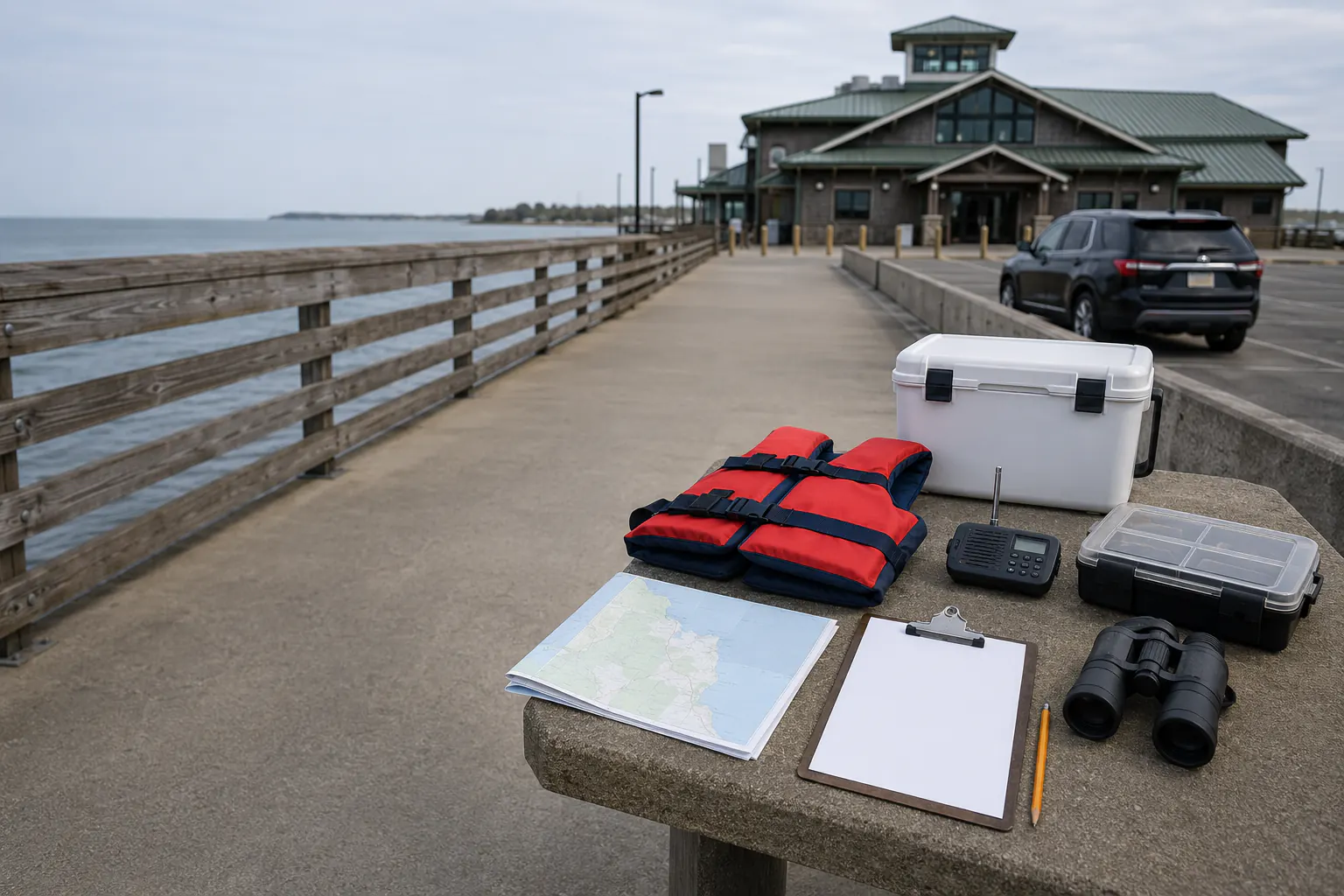
Fishing can provide recreation, skill, time outdoors, and some food. It cannot responsibly serve as a guaranteed emergency calorie source. A legal and usable catch depends on the person, license, waterbody, access point, date, legal method, species, size, limit, protected look-alikes, possession rule, water and weather conditions, consumption advisory, cleaning skill, temperature control, and household health needs.
For a beginner, the correct sequence is education, current rules, water safety, observation and supervised practice, then food handling. Buying a compact kit does not answer any of those questions. A license does not establish private access, safe conditions, correct identification, or permission to eat the catch without restriction.
Use this fishing family
- A Legal Fishing Setup for Adult Beginners starts with the responsible agency and qualified instruction instead of a generic tackle list.
- How to Research Fishing Licenses, Species, Seasons, and Limits builds a dated file for the exact person, waterbody, date, species, and method.
- Shore and Boat Fishing Water Safety Plan owns cold water, weather, lightning, edges, current, tide, ice, life jackets, float plans, and no-go decisions.
- How to Clean, Chill, and Transport Recreationally Caught Fish connects qualified cleaning instruction to measured cooling and protected household receiving.
- Realistic Fishing Yield for Supplemental Food Planning begins at zero and records actual lawful retained food without promising future catch.
- How to Inspect, Maintain, and Store Fishing Line, Hooks, Rods, and Reels limits maintenance to visible condition, safe storage, disposal, and manufacturer instructions.
- How to Check Local Fish Consumption Advisories keeps waterbody, species, size, population, contaminant, preparation, and meal limits attached to the current authority notice.
The Transferable Outdoor Skills hub owns benign navigation, weather-cover, and communication practice. The Food Preservation hub begins only with fish that remains suitable under the exact harvest, advisory, handling, temperature, preparation, and health instructions.
Treat fishing as supplemental
Emergency plans should assume zero catch. Fish may not be present, active, identifiable, legal to retain, safe to reach, within size limits, or advisable to eat. A storm, flood, wildfire, harmful algal bloom, sewage release, chemical spill, emergency closure, damaged access, cold water, high flow, rip current, unsafe ice, broken equipment, or absent refrigeration can remove the option entirely.
During a disaster, public safety, rescue capacity, and environmental conditions may be degraded. Traveling to water or operating a vessel to replace stored food can add drowning, injury, exposure, legal, and foodborne hazards. Do not interpret hardship as permission to ignore licenses, seasons, limits, closures, property rights, protected species, or consumption advice.
The Emergency Food Storage hub owns reliable household reserves. Fishing belongs in ordinary lawful practice, with a meal treated as an occasional result rather than a forecast.
Pass eight planning gates
| Gate | Required evidence | Stop condition |
|---|---|---|
| Agency pathway | Responsible license agency and accepted education resources identified | Jurisdiction or eligibility unclear |
| Access | Owner/manager permission, parking, hours, route, and boundaries confirmed | Trespass, closure, unstable or blocked access |
| Rules | Exact waterbody, date, species, method, size, limit, reporting, and possession file current | Any unresolved definition or conflicting source |
| Water safety | Forecast, water condition, edge, current/tide, cold-water, life-jacket, communication, and return plan documented | Conditions exceed the written plan |
| Qualified skill | Casting, hooks, identification, landing/release, cleaning, and vessel skills taught in person where relevant | Learner would improvise a safety-critical task |
| Consumption advisory | Current local/tribal/state advice matched to person, waterbody, species, size, preparation, and meal history | Advice missing, unclear, or prohibits consumption |
| Cold chain | Clean containers, measurement, cooling, transport, receiving, and outage plan verified | Temperature or contamination history cannot be protected |
| Review | Actual effort, lawful retention, edible weight, costs, conditions, and corrections recorded | Memory or optimistic estimate replaces evidence |
One gate never substitutes for another. A safe shoreline does not make a fish legal. A legal fish is not automatically appropriate to eat. Immediate chilling cannot repair unsafe water access or a prohibited catch.
Keep species uncertainty visible
Fish identification can depend on regional species, life stage, sex, season, coloration, fin and scale features, hybrids, protected look-alikes, and current rules. A photograph, app, online group, common name, or memory is not authority to retain an uncertain fish.
Use the responsible fisheries agency’s current materials and qualified local instruction. Learn what must be released immediately, what may not be removed from the water for identification, and how measurement or reporting works under the exact rule. ReadyLience does not provide remote species identification or a universal measurement technique.
When identity, size, condition, hook rule, protected-species interaction, or legal disposition is uncertain, follow the current authority’s conservative release/reporting instruction. Do not transport the question home.
Put water safety ahead of the catch
Warm air can coexist with dangerous cold water. Calm weather can change. A familiar bank can become slippery, undercut, flooded, icy, unstable, or cut off by tide. Waders, rocks, docks, piers, dams, surf, rivers, and vessels create different immersion and rescue problems.
The National Weather Service warns that sudden cold-water immersion can affect breathing, movement, and judgment, and advises preparing for water temperature rather than air temperature. The U.S. Coast Guard emphasizes an appropriate, serviceable, properly fitted, approved life jacket for the intended activity and user. Exact legal requirements vary and do not replace the decision to wear one.
Do not fish alone by default, near moving or flooded water, on uncertain ice, during thunder, beyond barriers, from a prohibited structure, or where a fall cannot be managed under the plan. Do not enter water to retrieve inexpensive gear. The water safety plan owns these decisions.
Make the food decision before casting
The EPA explains that states, territories, and Tribes issue advisories for fish and shellfish caught in local waters. Advice can name a waterbody or class of waters, species, size, contaminant, population, meal frequency, preparation method, and time period. FDA/EPA federal advice adds specific considerations for people who might become or are pregnant, breastfeeding, and young children.
Check the current advisory before deciding that retention is an objective. If no current answer can be found, contact the local or state health/environmental authority. A clear-looking lake, healthy-looking fish, legal stocking program, absence of a sign, or another angler’s habit does not prove unrestricted consumption.
Track meals from all relevant local catches across the period named in the advice. A household cannot evade a meal limit by changing who caught the fish, freezing it for later, or splitting one fish into packages.
Plan cleaning and chilling
Fish is perishable. The plan needs a qualified cleaning method for the exact species and legal evidence requirements, clean dedicated tools and surfaces, hand hygiene, separation from ready-to-eat food, prompt measured chilling, protected transport, and verified refrigerator/freezer capacity.
FDA advises keeping seafood on ice or in a refrigerator/freezer promptly, using a refrigerator at 40°F or below, and preventing cross-contamination. Those household principles do not create one universal field timeline or authorize cleaning at any site. The responsible fisheries, public-health, shellfish, processor, and land rules still apply.
Weather, lake water, a wet stringer, a livewell, a bucket, shade, or a cooler logo does not prove food safety. The fish cold-chain guide keeps measurement and handoff explicit.
Use real yield records
Count only legally retained fish that pass the advisory and cold-chain gates. Record whole retained weight only if actually measured, then final edible packaged weight after qualified cleaning. Keep bycatch, released fish, prohibited fish, spoiled food, test or advisory exclusions, and waste out of edible yield.
Include license, access, instruction, transport, bait or tackle where legal, ice, processing, storage energy, and time costs. Do not convert one good day into a weekly average. A zero-catch trip is valid data and often the most important planning correction.
Protect people and wildlife from gear
Hooks and line can injure people and entangle wildlife. Store hooks in a closed rigid organizer, control line ends, inspect gear before use, keep children and animals outside the work zone, and dispose or recycle damaged line and tackle through the appropriate route. Never leave line, hooks, bait, or fish parts at the water.
The Fish and Wildlife Service recommends Clean, Drain, Dry practices to reduce movement of aquatic invasive species, with current local rules controlling exact decontamination. NOAA emphasizes tracking gear, preventing hook/line interactions with protected wildlife, and contacting trained response networks rather than attempting hazardous rescue.
Use one conservative final rule
Do not depart or continue when any permission, rule, species, water, weather, edge, vessel, life-jacket, communication, hook-control, protected-wildlife, consumption-advisory, cleaning, cooling, or household-health question remains unresolved. Do not let travel cost, a purchased license, children waiting, a social promise, or hunger lower the standard.
Return to this hub after every class, observation visit, or lawful trip. Update the rule, safety, advisory, cold-chain, and yield records separately. Responsible fishing for food is demonstrated by being willing to return with none.