
The fish cold chain begins when retention becomes lawful, not when the trip ends. A fish can be legal to keep and still be unsuitable for a particular household or meal because of a consumption advisory, species-specific toxin or parasite, shellfish closure, contamination, delayed chilling, cross-contamination, damaged package, or power loss.
This page organizes the handoff. It does not teach dispatch, bleeding, gutting, scaling, skinning, filleting, deboning, or shellfish opening. Those procedures require qualified, species-specific instruction and must agree with legal evidence-of-species and disposal rules.
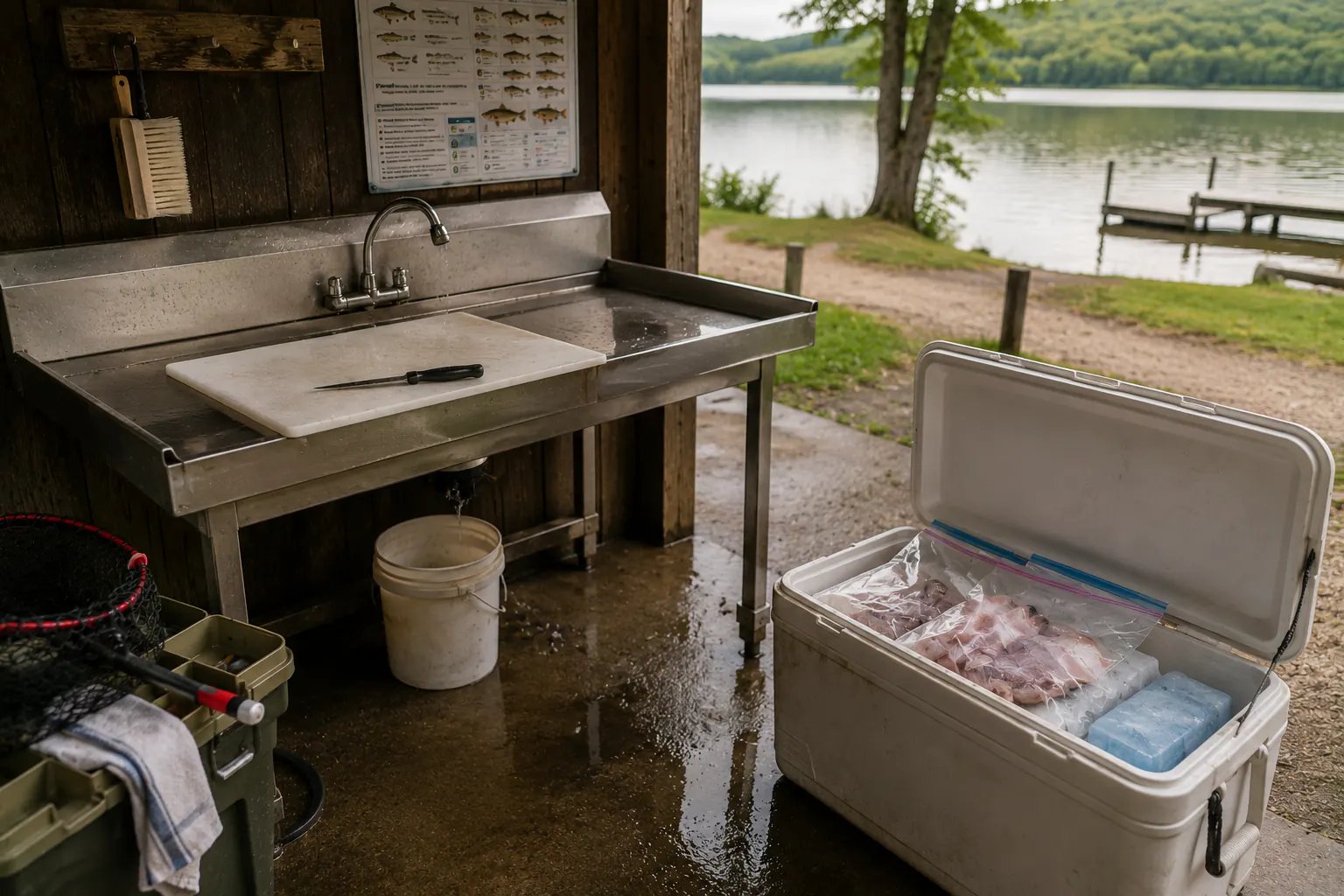
Decide whether retention belongs in the plan
Before fishing, confirm:
- exact species and legal retention/measurement process;
- current waterbody-specific consumption advisory;
- household member/life-stage restrictions and meal history;
- shellfish sanitation or harvest closure where relevant;
- trained person for fish handling and cleaning;
- site permission for cleaning and waste disposal;
- clean dedicated tools, surfaces, containers, hand hygiene, and potable water where required;
- measured cooling capacity for expected maximum lawful retention;
- transport time and protected vehicle zone;
- verified home refrigerator/freezer capacity and outage plan;
- exact cooking or research-tested preservation route.
If any row is missing, make the trip release-only or cancel. Do not retain first and solve the food system later.
The local advisory guide owns contaminant and meal decisions. The rules guide owns identity, size, limits, evidence, and cleaning/transport restrictions.
Keep legal identity attached
Some rules limit when or where a fish may be cleaned, filleted, headed, skinned, or otherwise altered before reaching shore, a check point, or home. Evidence of species, length, sex, tag, or whole form may be required. Possession limits may apply after the trip.
Record each retained fish or lawful batch according to the current authority. Keep identity linked through:
- harvest/retention record;
- species and waterbody;
- date/time;
- advisory category;
- cleaning person and location;
- package or container;
- final edible weight;
- household meal log.
Do not combine fish from different waters, species, advisories, dates, or uncertain histories into an unlabeled package.
Learn cleaning in person
Use an agency aquatic-education class, qualified local instructor, Cooperative Extension program, processor, or other appropriately scoped teacher. Ask the instructor to cover:
- legal form and evidence requirements;
- humane and lawful handling;
- species anatomy and tool control;
- contamination prevention;
- parasite/toxin/advisory boundaries;
- clean/dirty zones and hand hygiene;
- safe waste and organ disposal;
- prompt cooling and measurement;
- cleaning/disinfection of tools and surfaces;
- safe cooking and when not to consume.
Avoid instruction that uses household knives on an unstable surface, allows children or animals in the work zone, rinses waste into public water or a storm drain, treats smell as the only safety test, or claims freezing/pickling/smoking makes every species safe.
Create clean and contaminated zones
At the approved cleaning location, keep:
- raw fish and waste away from drinking water, ready-to-eat food, medication, phones, keys, clean clothing, and child/pet items;
- dedicated tools separate from household utensils until cleaned as directed;
- hands, gloves, cutting surfaces, and containers managed under the qualified process;
- fish off soil, dirty dock surfaces, boat floors, vehicle beds, untreated water, and meltwater;
- pets, birds, insects, children, and bystanders outside the work area;
- waste contained and disposed only through the legal route.
FDA emphasizes hand/surface cleaning and preventing raw seafood from contaminating cooked or ready-to-eat food. Do not wash raw fish in questionable water. Do not improvise bleach concentration or contact time; use product labels and authority instructions.
Stop for an uncontrolled knife/hook, cut, splash, broken glove, contaminated water, sewage/chemical exposure, damaged container, abnormal fish condition, or uncertain disposal route. Obtain medical advice for a possible exposure or significant cut.
Use measured cooling
FDA advises placing seafood on ice or in a refrigerator/freezer promptly and keeping a refrigerator at 40°F or below. Those are downstream principles, not permission to use one universal field timeline. Species, size, form, starting temperature, ambient conditions, container, ice, water, and handling matter.
Build a log:
| Stage | Time | Measured condition/temperature | Responsible person | Deviation/action |
|---|---|---|---|---|
| Lawful retention | ||||
| Initial cooling | ||||
| Cleaning complete | ||||
| Depart access | ||||
| Home/processor receipt | ||||
| Refrigerator/freezer |
Use a thermometer appropriate to the process and follow cleaning/placement instructions. Do not repeatedly puncture or expose food unnecessarily. A fish feeling cold, being wet, sitting in shade, remaining alive, or resting in a branded cooler does not prove a safe internal or storage history.
Keep drainage and containment aligned with the process so fish does not sit in contaminated meltwater. Never use fuel, chemical, bait, or catch containers interchangeably with food storage.
Protect transport
Secure clean containers so they cannot tip, leak, block controls, affect vehicle restraints, or expose passengers. Separate raw fish from ready-to-eat food, drinking water, medication, pet supplies, clean clothing, and contaminated gear.
The driver does not handle fish, ice, thermometers, phones, or packaging while moving. Stop only in a lawful safe location. Minimize unnecessary opening while preserving any required drainage/airflow and current processor instructions.
For vessel transport, fishing does not displace stability, capacity, navigation, life-jacket, lookout, or emergency equipment. The water safety plan remains controlling.
Receive fish at home
Before the trip, verify refrigerator/freezer temperatures and physical capacity. At receiving, record package condition, identity/advisory label, time, measured appliance temperature, and intended use.
FDA says seafood intended for use within two days after purchase should be stored in a clean refrigerator at 40°F or below; otherwise it should be appropriately wrapped and frozen. Recreational catch may have a different handling history, so use the exact qualified guidance and do not infer a longer storage life.
Prevent leakage onto other food. Keep advisory meal limits visible. If the history, identity, contamination, time/temperature, package, or appliance condition is unknown, isolate the question and contact the responsible food-safety authority. Never taste to decide.
Keep preparation exact
FDA says most seafood should be cooked to 145°F and identifies additional risk for people more likely to have severe foodborne illness, but species-specific toxins, parasites, advisories, shellfish rules, and household clinical guidance can require more. Use a food thermometer and the exact responsible instructions.
Freezing does not kill all harmful germs. Cooking does not necessarily remove chemical contaminants or marine toxins. Smoking, drying, pickling, ceviche-style acid, vacuum sealing, or a visual texture is not a universal safety control.
The Food Preservation hub begins only with suitable fish and an exact research-tested process. Do not improvise jerky, smoked fish, canned fish, fermented fish, pet food, or shelf-stable seafood.
Plan for power loss
Stored catch follows the Power Outage Food Safety guide. Keep appliance thermometers and an outage log. Do not open storage repeatedly. Backup power does not erase prior handling issues or guarantee temperature if the electrical plan fails.
Never preserve or refreeze uncertain warming fish merely to avoid discard. Follow the responsible time/temperature and advisory decision; when refrigeration was interrupted, the keep-or-discard rules in Power Outage Food Safety apply to fish like any other perishable.
Document any alarm, outage, open-door period, cooler leak, thermometer failure, or transfer between appliances. A later cold reading cannot prove that an earlier unknown interval was safe.
Audit the chain
Record legal identity, advisory status, cleaning instruction used, time/temperature log, cross-contamination events, receiving, edible packaged weight, and meals. Mark unknowns honestly. Do not reconstruct precise times or temperatures from memory.
Return to the Fishing for Food hub with the completed handoff. A catch becomes household food only when legality, advisory, trained cleaning, clean custody, measured cooling, storage, and preparation all remain intact.