
Fishing rules attach to an exact activity. A state license page is only the beginning: freshwater and saltwater authority may differ, tribal waters may have separate rules, federal refuges or parks may add permits, private access may be required, and a local health department may issue a consumption advisory that changes whether a legal catch belongs in a meal.
Use this page to build one dated research file. It exposes unanswered questions but cannot interpret law or identify a fish.
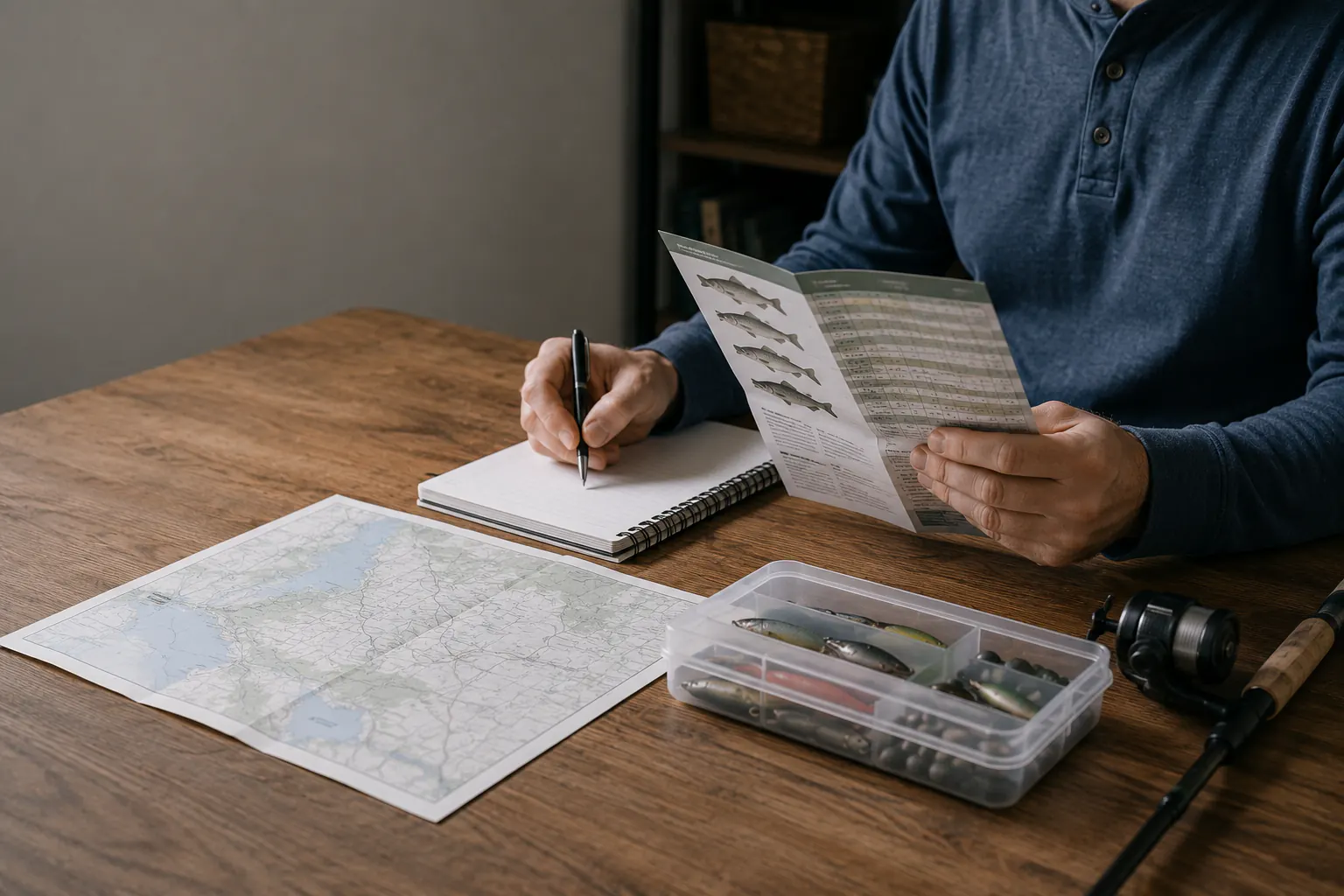
Name the exact activity
Write a sentence containing:
- Angler: name, age, residency, disability/youth/senior status where relevant, and education requirements.
- Water: named waterbody, segment, coordinates or managed access point, freshwater/saltwater context, and authority.
- Date and time: day, season, legal hours, tide or closure period where relevant.
- Species: target category plus protected and regulated look-alikes expected locally.
- Method: only the legal category named by the authority; this page does not select tackle.
- Disposition: release or possible retention, measurement, limit, tagging/reporting, transport, possession, advisory, and cold chain.
“Fishing at the lake this weekend” cannot support a compliance decision. A different bank, tributary, county line, management zone, boat route, species, or date may change the file.
Reach the responsible agency
The U.S. Fish and Wildlife Service fishing-license page links to state-specific requirements. Use it as a directory, then identify every authority that controls the exact trip:
- state or territorial fish and wildlife agency;
- tribal fisheries or land authority;
- saltwater/marine fisheries authority;
- national wildlife refuge, park, forest, BLM, Corps, municipal, utility, or other land/water manager;
- private owner or access operator;
- boating registration/education authority;
- local shellfish sanitation or harvest authority;
- state, tribal, territorial, or local fish-consumption advisory program;
- emergency, weather, harmful-algal-bloom, spill, sewage, flood, or public-health authority.
Save the exact page, proclamation, regulation digest, emergency order, map, permit, or contact response. A retailer license terminal or payment receipt does not contain every applicable rule.
Research the person and privilege
Confirm:
- whether a license is required for that person and water;
- residency definition and evidence;
- age, youth supervision, senior, disability, military, free-fishing-day, pier, landowner, guide, charter, or other rules only when they actually apply;
- separate freshwater, saltwater, species, gear, stamp, endorsement, harvest card, tag, permit, draw, or reporting requirements;
- education or boating credentials;
- start/end time of validity and whether the license must be signed, displayed, carried, or available offline;
- replacement process and profile-name match;
- whether accompanying or assisting another person requires a privilege.
Do not assume “license-free” means rule-free. Size, season, method, limit, access, safety, invasive-species, reporting, and advisory requirements can still apply.
Match the exact water
Use the agency’s current map and definitions. Record named tributaries, mouths, dams, bridges, tide lines, zones, marine boundaries, reservation boundaries, sanctuaries, refuges, special-regulation reaches, closed areas, and private parcels that matter.
Digital map pins, shoreline appearance, road signs, old paper maps, another angler’s location, or a social-media geotag may not establish the legal water or access point. If the boundary is unclear, contact the manager and do not fish the disputed area.
The map and compass guide supports orientation only. It does not determine jurisdiction, navigability, ownership, fishing rights, or safe access.
Read definitions with the table
Do not copy only season dates and limits. Read definitions and general provisions for:
- angling, take, attempt, possess, retain, release, snag, foul-hook, and harvest;
- daily, aggregate, annual, boat, trip, and possession limits;
- minimum, maximum, slot, fork, total, or other length definitions;
- legal hook, lure, bait, fly, line, rod, trap, net, spear, ice, or device categories;
- unattended gear and number of lines/hooks/devices;
- protected, threatened, endangered, invasive, stocked, native, game, nongame, and bait species;
- live bait possession, collection, transport, disposal, and water transfer;
- cleaning, filleting, evidence-of-species, head/tail attachment, and transport before reaching shore or home;
- party fishing, transfer, gifting, receipt, and household possession;
- reporting, tagging, check station, survey, or electronic harvest record.
ReadyLience does not supply universal definitions. Copy the authority’s source location and ask that authority when application is unclear.
Build an identification gate
For likely species, record current official identification resources and legally relevant traits. Include protected or regulated look-alikes. Ask a qualified local instructor to teach identification and measurement in person.
Do not rely on color alone, one fin, a common name, AI/image recognition, a distant photograph, or an online vote. Water, age, sex, spawning condition, handling, light, region, and hybrids can change appearance.
Before retention, the learner must know the authority’s rule for keeping the fish in water, handling, measuring, photographing, releasing, or reporting. If identity or legal size is uncertain, use the authority’s conservative release/reporting process. Do not retain first and research later.
Link legal retention to the advisory
A regulation determines whether a fish may be retained. A consumption advisory determines how or whether people should eat locally caught fish. These are separate decisions.
EPA says all 50 states and some territories and Tribes issue advisories, and directs readers to current local/state health or environmental programs. Advisories may depend on:
- exact waterbody or class of waters;
- fish or shellfish species;
- size or age;
- contaminant;
- person or life stage;
- meal size and frequency;
- preparation or parts to avoid;
- date, closure, bloom, spill, or sampling update.
Record the advisory before choosing retention as a goal. Use the local fish advisory guide to preserve meal history and household-specific instructions.
Add invasive-species and protected-wildlife rules
Confirm Clean, Drain, Dry, inspection, decontamination, felt-sole, bait-water, live-organism, boat, trailer, wader, net, and equipment rules for the exact water. The Fish and Wildlife Service provides general prevention guidance; local requirements can be stricter.
Record protected marine wildlife, bird, turtle, mammal, sturgeon, sawfish, or other interaction instructions where relevant. Know the official response number/channel before fishing. Do not attempt to disentangle or rescue protected wildlife without trained authority direction.
Use a source ledger
| Field | Entry |
|---|---|
| Narrow question | One legal, access, safety, advisory, or disposition issue |
| Issuer | Responsible authority/owner |
| Source | Exact title, year/season, section, map, or order |
| Effective period | Start/end or revision |
| Accessed | Date and time |
| Plain-language note | Summary preserving exceptions |
| Open issue | Missing or conflicting answer |
| Contact | Office, date, channel, factual response |
| Recheck trigger | Departure, order, weather, spill, bloom, closure, or plan change |
Keep official files offline where permitted. A private summary helps navigate them but never replaces them.
Archive the exact version used for a completed trip separately from the working file for the next trip. Mark superseded material clearly rather than silently overwriting it. This preserves why a past decision was made without encouraging anyone to reuse an expired season table, map, permit condition, closure notice, or agency response.
Recheck before and during the trip
Recheck at application, packing, departure, and immediately before fishing. Look for emergency closures, changed flows, harmful algal blooms, sewage or chemical releases, fire/weather restrictions, ramp/gate status, tide/current changes, protected-species presence, and updated consumption advice.
If signs or on-site instructions conflict with the file, stop. A current license does not override a closure. A legal method does not make unsafe water acceptable. A consumption advisory does not grant access or retention.
Return to the Fishing for Food hub with the dated file and unresolved-issue table. The goal is not a national list of rules. It is a defensible chain from one planned action to the exact authority that controls it.