
Name the missing convenience function before choosing a substitute: grouping dry nonfood supplies is different from replacing an alarm or food-safety process. Use only a known item within its ordinary limits for a reversible, low-consequence job. When failure could injure, contaminate, trap, or damage a critical system, do not improvise.
The best time to practice substitution is before stores close. Use ordinary owned items with known history, preserve exits and life-safety systems, and keep an obvious path back to the correct product or qualified service.
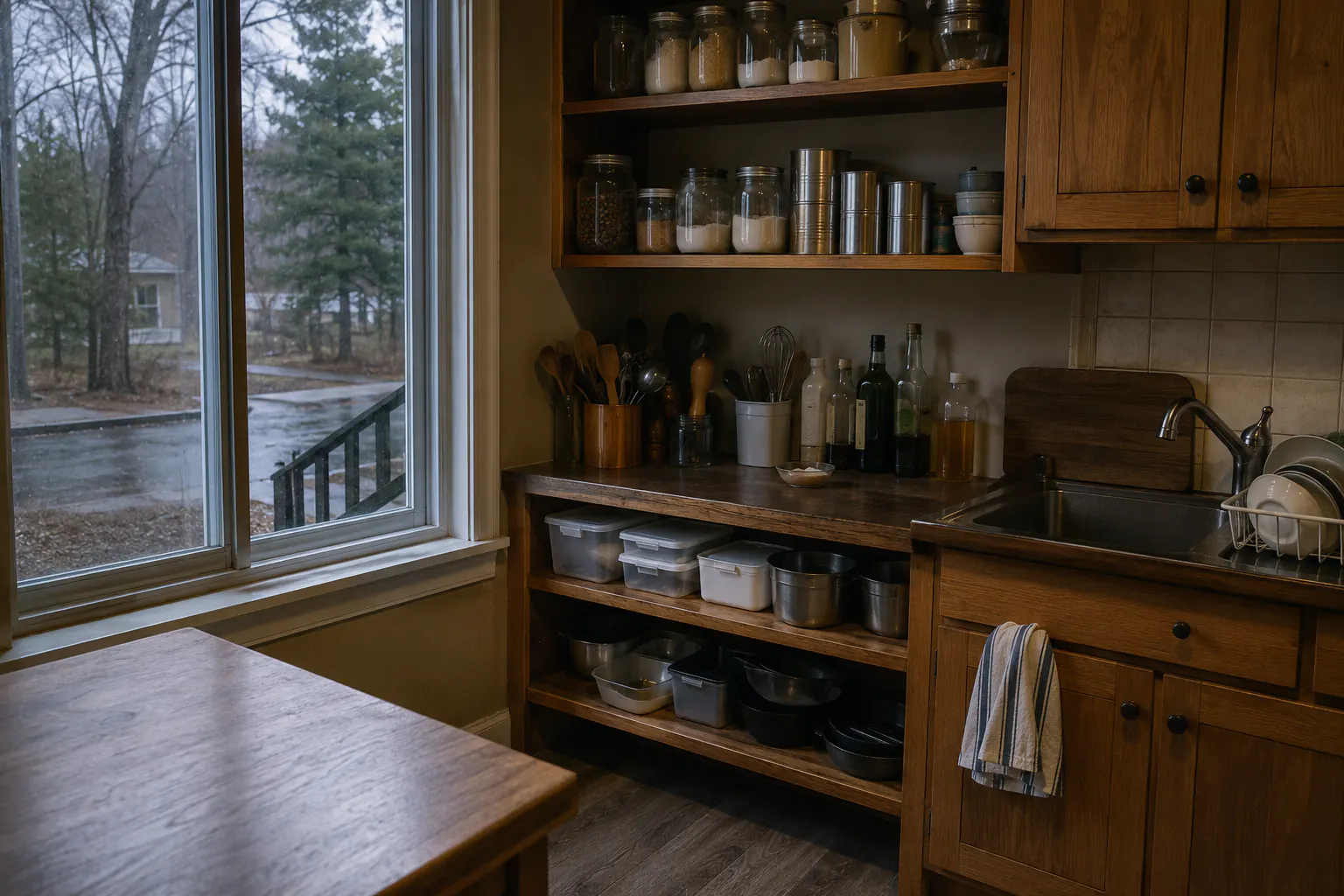
Define the missing function
Name the result, duration, environment, users, and consequence of failure. “Keep frequently used paper instructions dry for two days indoors” is bounded. “Make waterproof storage” is too broad.
Record:
- exact function and why it is needed;
- how long the substitute will be used;
- who will handle it, including children, older adults, pets, and people with access needs;
- heat, water, food, electrical, chemical, load, hygiene, or outdoor exposure;
- what happens if it leaks, tears, tips, disconnects, burns, blocks, contaminates, or is mistaken for something else;
- inspection frequency and replacement trigger;
- correct item or service that will end the substitution.
If failure could injure, poison, trap, burn, shock, suffocate, contaminate, flood, cause collapse, disable communication, or damage a critical system, do not improvise.
Use a consequence ladder
Low consequence: reversible organization where failure is visible and non-injurious. Examples include a known clean lidded tote for dry nonfood supplies, a plain paper log instead of an unavailable app, or a known clean cloth cushioning a light nonfood item inside a closed box. A loose cloth on a walking surface can create a slip or trip hazard.
Moderate consequence: failure can damage property or interrupt readiness. Use only a responsible exact instruction, supervision, clear limits, and frequent checks. Examples can include temporary rain protection over already weather-resistant closed containers, never over powered equipment or ventilation.
High consequence: no household substitution. This includes life safety, health, food and drinking water safety, structure, electricity, combustion, pressure, fall protection, transport, security egress, hazardous materials, and emergency response.
Cost, urgency, confidence, or prior luck does not lower consequence.
Exclude life-safety systems
Life-safety equipment is the one category where the correct product, in its correct place, is the only acceptable answer. A flashlight can provide household task light; it does not replace required building emergency lighting. The emergency-lighting plan owns safe layers without flame-based improvisation.
Hard limits — no substitution for any of these, ever:
- smoke or carbon-monoxide alarms, and never borrow their batteries for another device;
- fire extinguishers, sprinkler components, fire doors, and egress hardware — no propped doors, covered alarms, blocked vents, narrowed exits, storage in stairs or corridors, or added locks that delay escape;
- emergency lighting required by code;
- child restraints, helmets, life jackets, fall protection, rescue gear, respiratory protection, and medical alert systems.
Use the exact approved equipment and the current authority or manufacturer route.
Keep electricity and batteries exact
Electricity is where substitution stops completely, because connector fit does not prove voltage, polarity, current, temperature, enclosure, moisture, or fault protection. What a household can do is plan around exact, rated equipment — the backup-power hub and basic electrical safety hub show how, and a qualified electrician with exact equipment instructions controls permanent or code-related work.
Hard limits:
- no improvised cords, adapters, plugs, splices, grounding, transfer equipment, battery packs, chargers, inverters, solar connections, fuses, breakers, generators, or appliance power;
- no vehicle batteries, loose cells, damaged packs, homemade jumpers, cut extension cords, or unknown chargers as a household power substitute;
- no backfeeding a building or energizing fixed wiring from a receptacle.
Warm the household without improvised combustion
Safe warmth during a disruption comes from clothing layers, safe-room planning, building heat, and official warming options — the extreme-cold hub organizes all four. Carbon monoxide can be odorless, and a connection that appears tight is not proof of safe combustion or venting.
Hard limits:
- no grills, camp stoves, charcoal, generators, engines, outdoor-only or unapproved fuel-burning heaters, or improvised burners indoors or where exhaust can enter an occupied enclosure; installed heating systems remain subject to their instructions and qualified service, not a substitution recipe;
- no heater built from candles, flowerpots, cans, alcohol, fuel, batteries, wire, or resistive elements;
- no substituted pipe, hose, regulator, valve, container, sealant, or fitting in gas, fuel, chimney, exhaust, pressure, HVAC, or refrigeration systems;
- no open flame for lighting.
Preserve food and water boundaries
Known clean food-grade containers may be reassigned within their instructions and compatible food use, with clear labels — that is the entire safe surface of this category. A recycling code alone is not permission for hot food, long storage, pressure, reuse, or drinking water. The water treatment limits guide and the food-outage guide own the actual safety decisions.
Hard limits:
- no drinking water or food in a container that held chemicals, fuel, pesticides, cleaners, medicines, automotive products, industrial material, or unknown contents — EPA warns that hazardous-product residue can remain even in empty containers;
- no improvised filter, cloth, coffee filter, household pitcher, pool chemical, alcohol, sunlight, freezing, or boiling to declare unknown water safe;
- no invented canning, vacuum-sealing, fermentation, dehydration, thawing, refrigeration, or cooking processes — and outdoor cold, a balcony, snow, an unmeasured cooler, or an unplugged appliance is never refrigeration evidence.
Keep medical and hygiene functions controlled
What a household can safely do here is organizational: an ordinary clean basin can group unopened hygiene supplies, and a towel can mark a dry clean zone. Neither becomes a potable-water container, PPE, or a contamination barrier. For anything clinical, contact the clinician, pharmacist, manufacturer, supplier, public health, or emergency service before the plan fails.
Hard limits:
- no substituted medicines, doses, dressings, disinfectants, sterile supplies, device power sources, oxygen parts, refrigeration methods, mobility equipment, feeding supplies, infant formula water, or clinician-directed equipment;
- no mixed cleaners, no home-made “stronger” disinfectant, and no chemicals transferred into drink bottles — the cleaning-products warning owns chemical boundaries.
Keep loads and structures out of scope
Low-consequence temporary organization is fine when it stays at floor level, away from exits and utilities, with light known loads — run candidates through the material assessment first. Above that line, tape, rope, furniture, scrap lumber, blocks, books, buckets, and crates are not structural engineering.
Hard limits:
- no improvised supports, jacks, braces, shoring, stairs, railings, roof patches under load, overhead storage, ladders, towing points, lifting slings, hammocks, child furniture, vehicle parts, or fall protection from reclaimed or household material;
- no entering or working below a damaged structure to place a temporary support — that belongs to emergency services, building officials, and qualified structural or trade professionals.
Build substitutions from known modules
Prefer a role change that preserves the item’s ordinary limits:
| Need | Bounded approach | Stop condition |
|---|---|---|
| Offline tracking | Blank paper, pencil, dated entries | Medical/legal/security data needs protected handling |
| Dry supply grouping | Known clean intact tote for dry nonfood items | Unknown history, chemical odor, damage, heavy load |
| Visual separation | Plain removable card or colored cloth outside containers | Color alone could be misread or item needs hazard labeling |
| Temporary privacy | Existing curtain or screen that preserves ventilation and egress | Blocks heat source, detector, exit, or supervision |
| Task lighting | Rated battery flashlight or lantern used as instructed | Damaged battery, heat, wet location, required building system |
| Small-parts sorting | Known clean cups/trays for nonfood hardware during supervised work | Children/pets, chemicals, sharps, batteries, food area |
These are examples of decision structure, not universal authorization. Confirm the item, environment, household, and current event.
Label the temporary state
Mark the function, owner, start date, limits, inspection time, and end trigger. Use words, not color alone. Keep the substitute visible and reversible.
Tell every affected person what changed. Do not let a temporary container resemble food, medicine, drinking water, fuel, waste, or a child’s object. Do not publish household shortages or exact inventory during unrest or a prolonged disruption.
Check after movement, weather change, temperature change, children or pets entering the area, a new user, and every planned interval. End the substitution immediately for damage, heat, odor, leakage, instability, confusion, blocked access, or scope drift.
Replenish the correct module
Log why the correct item was unavailable. Add a reasonable spare, supplier route, maintenance interval, or earlier reorder trigger to the reuse and repair worksheet. Do not stockpile a workaround that should disappear.
Return borrowed equipment clean and complete under the program’s rules. Replace consumed neighbor supplies as agreed. Dispose of damaged or recalled items through the correct route rather than passing them onward.
Return to the Salvage, Reuse, and Resourcefulness hub. The goal is not to prove that anything can replace anything. It is to preserve a narrow household function without weakening the systems that keep people alive and able to leave.