
Choose one ordinary item whose ownership and transfer are already clear, then ask about its history before handling or cleaning it. If identity, exposure, or the intended use remains uncertain, keep it out of service and use the responsible manufacturer, authority, or qualified review route. A rinse cannot supply missing evidence.
Use this checklist for ordinary household material already in your custody or explicitly transferred by a verified owner. Disaster debris stays with the no-looting and debris-ownership warning and the post-storm hazard owner.
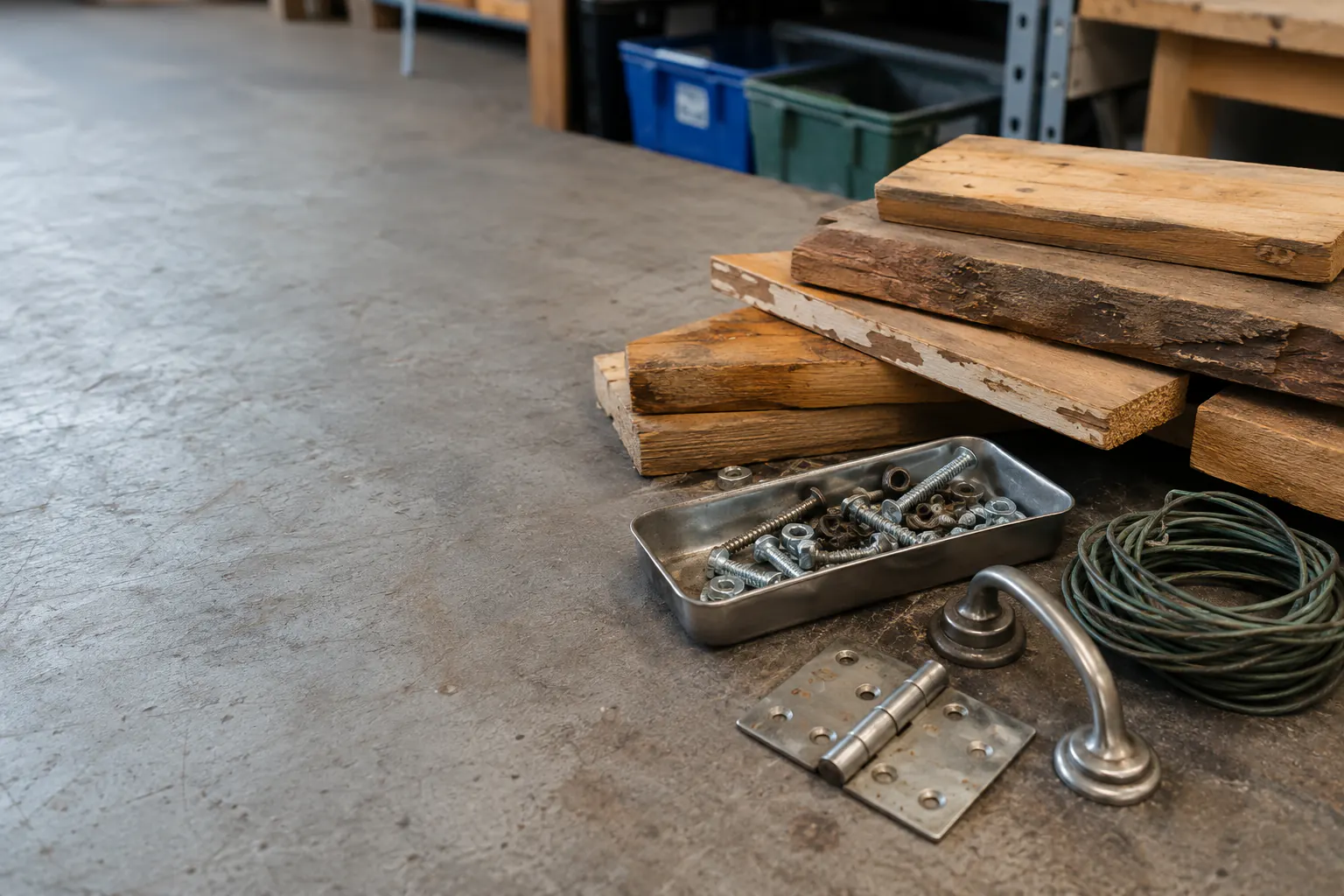
Open an item record
Assign one item or homogeneous batch a record before moving it into storage. Capture:
- verified owner and transfer date;
- exact source location and prior use;
- manufacturer, model, serial, material grade, dimensions, labels, ratings, and age where applicable;
- storage, repair, modification, impact, moisture, heat, fire, chemical, pest, and contamination history;
- included parts, guards, fasteners, manuals, receipts, and recall remedy records;
- intended new function and consequence if it fails;
- decision owner and qualified review needed.
Do not mix materials from different sources or histories. A clean board from a dry indoor shelf and a similar board from a flooded garage are not one batch.
Photograph labels and condition without publishing private addresses, serial numbers, access details, or household inventory. Preserve claim or warranty evidence before cleaning or dismantling.
Verify permission and release
Confirm that the person transferring the item owns it or has authority to transfer it. A renter, employee, contractor, volunteer, neighbor, waste hauler, or family member may not control every item present.
Write the exact item, quantity, condition, transfer type, permitted modification, pickup location, and date. For borrowing, add return date, condition at checkout, consumables, damage reporting, and no-onward-loan terms.
Do not accept material subject to an insurance hold, police or fire investigation, landlord decision, warranty return, recall return, municipal collection, utility ownership, financing lien, estate dispute, or contractor custody until the controlling party releases it.
Reject unknown event history
Ask whether the item experienced:
- floodwater, sewage, roof leaks, prolonged dampness, mold, or unknown water;
- wildfire ash, structure fire, smoke, soot, extinguishing water, or high heat;
- pesticide, herbicide, fuel, oil, solvent, cleaner, paint, lead dust, asbestos dust, industrial use, or spill;
- impact, overload, drop, crash, bending, crushing, freezing, ultraviolet degradation, or pest damage;
- unqualified repair, removed guard, drilled hole, cut cord, bypass, altered finish, unknown coating, or mismatched part;
- storage with chemicals, food, medicine, animals, waste, batteries, or leaking containers.
Unknown answers do not become “probably fine.” Exclude the item from household reuse or route it to an authority qualified for that exact hazard and material.
Identify before evaluating
Material appearance is not a specification. Similar-looking plastics, metals, lumber, fasteners, coatings, wires, hoses, glass, fabrics, and containers can have different temperature, load, pressure, chemical, flame, food-contact, electrical, or outdoor ratings.
Require original markings or reliable documentation. Do not infer:
- structural grade from dimensions or straightness;
- electrical rating from plug shape, wire color, or thickness;
- food safety from a recycling symbol or clean appearance;
- chemical compatibility from container material alone;
- pressure suitability from a hose or fitting that threads together;
- child safety from sturdiness;
- fire resistance from metal, thickness, or prior location;
- treated-wood chemistry from color or age.
Missing identity limits the item to a genuinely low-consequence use that does not rely on an unknown property. It may instead require formal disposal.
Check recalls and prohibited transfer
Search the current CPSC recall database and manufacturer information using the exact model, serial, date code, and other identifiers. Check every powered product, charger, battery, appliance, furniture item, child product, tool, ladder, protective item, and safety product before exchange or use.
CPSC states that selling recalled products is unlawful, and some affected items must not be donated or given away. Follow the exact remedy. Do not improvise a repair, assume the remedy from a similar model, remove the label, or transfer the problem to someone else.
Reject banned products, counterfeit or altered labels, unknown batteries or chargers, missing guards, incomplete child products, damaged protective equipment, and items whose safe configuration cannot be established.
Inspect only inside a safe scope
Place an accepted ordinary item in a clean, dry, well-lit work area with clear egress. Keep children, pets, food, water, medicine, and unrelated projects away. Use task-appropriate handling and stop if inspection reveals dust, odor, leakage, heat, swelling, corrosion, pests, sharp contamination, unstable parts, or unknown residue.
For nonpowered low-consequence material, inspect all faces and connections for cracks, splitting, distortion, rot, delamination, corrosion, stripped threads, missing parts, sharp edges, embedded fasteners, coating failure, and repairs. Do not create dust by sanding, grinding, drilling, scraping, or sawing an unknown coating or material.
Do not plug in, charge, fuel, pressurize, heat, or load-test an uncertain item. An ordinary visual check cannot clear hidden electrical damage, battery defects, structural capacity, pressure integrity, gas safety, contamination, or code compliance.
The hand-tool maintenance guide owns ordinary known hand tools. Licensed electrical boundaries remain in jobs to leave to an electrician.
Treat cleaning as hygiene, not clearance
Use the manufacturer or responsible material-specific source for an identified, suitable item. Test any allowed cleaner on a noncritical area and preserve labels. Prevent runoff, dust, cross-contamination, and incompatible chemicals.
Never mix cleaners. Never put household hazardous waste in a food container. EPA warns that even empty hazardous-product containers can retain dangerous residue; keep such products in their original labeled containers and follow local hazardous-waste instructions.
Do not repurpose pesticide, fuel, oil, solvent, automotive, pool, laboratory, industrial, medicine, or unknown containers for food, drinking water, pet supplies, garden irrigation, hygiene water, toys, or household storage. A rinse, odor-free surface, bleach solution, pressure wash, paint, liner, or sun exposure does not establish a safe new use.
Reject porous material affected by unknown contamination rather than inventing a universal cleaning process. Qualified environmental or restoration advice controls when a documented material has a recognized decontamination route.
Match the exact new function
Write the intended use in a complete sentence: “This identified board will support a labeled lightweight storage divider at floor level,” not “wood for projects.” Then ask:
| Question | Required answer |
|---|---|
| Environment | Indoor/outdoor, wet/dry, heat/cold, UV, chemical and pest exposure known |
| Load | Exact expected load and responsible design/approval route known |
| Interface | Dimensions, fasteners, connectors and surrounding materials compatible |
| Failure | Visible, gradual, contained and non-injurious |
| Inspection | Condition remains accessible and monitored |
| Exit | Removal does not damage a system or erase evidence |
Unknown reclaimed material does not belong in structural, overhead, stair, railing, child, vehicle, towing, lifting, fall-protection, fire-safety, security, electrical, gas, fuel, pressure, potable-water, food, medical, or animal-feed use.
Building-code officials and qualified designers control structural reuse. Manufacturers and licensed trades control system parts. Do not drill, trim, splice, bypass, adapt, shim, or combine components to force compatibility.
Run a low-consequence acceptance check
For an eligible ordinary item, use only the responsible instruction and intended loading. Keep the first use supervised and accessible. Stop for movement, cracking, heat, odor, leakage, noise, discoloration, loosening, deformation, or another unexpected condition.
Record accepted function, limitations, inspection date, next check, and who must not use it. Label material so its source and limits remain attached. Do not let an accepted low-consequence use become evidence for a different use.
Choose one disposition
- Controlled reuse: all gates pass for the exact low-consequence function.
- Qualified review: identity and ownership pass, but a competent professional must assess a specific property.
- Hold: owner, insurer, landlord, investigator, recall remedy, or authority has not released it.
- Formal transfer: known safe item moves through a program with documentation.
- Responsible disposal: local waste, hazardous-material, electronics, battery, construction, or recall route controls.
- Do not disturb: uncertain contamination, utility, structure, cylinder, debris, or access hazard remains.
Update the reuse inventory worksheet. Return to the Salvage, Reuse, and Resourcefulness hub whenever source, ownership, item identity, intended use, or condition changes.