
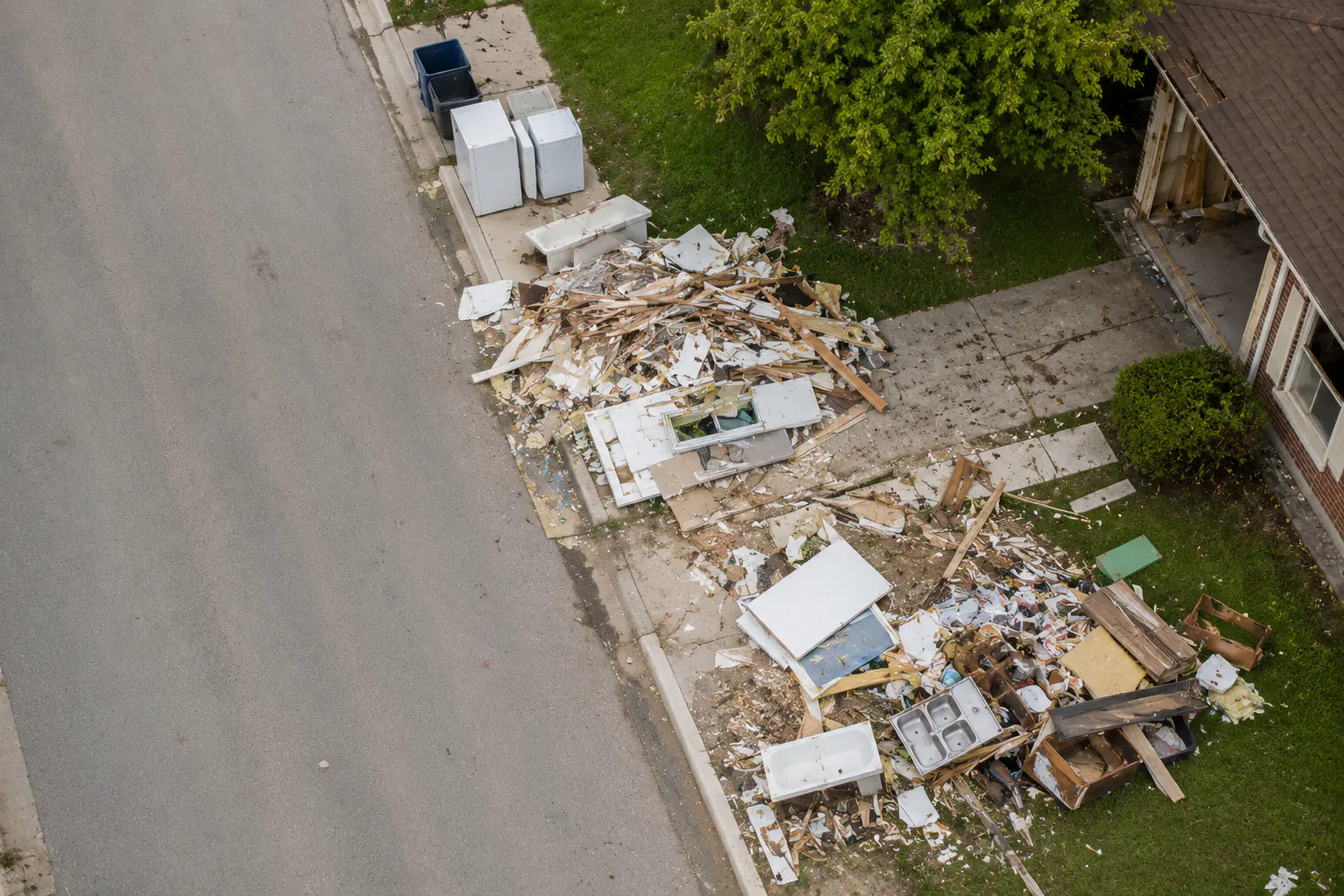
A pile of material at a curb after a storm looks abandoned. It is not. It is someone’s destroyed property, staged for a removal process that has rules, and it usually sits in a legal and physical situation that a passerby cannot read from the sidewalk.
This page draws one boundary for the whole salvage and reuse cluster: discarded-looking is not the same as free. It is not a guide to acquiring disaster material. It explains why the answer is almost always no, and what the narrow exception actually requires.
The rule
Do not enter, move, inspect, strip, or take disaster debris without current, explicit permission from the exact owner and from the authority controlling the area.
Not “nobody seemed to mind.” Not “it was at the curb.” Not “it was going to a landfill anyway.” Not “I asked a neighbor.” Permission comes from the person who owns the item and, during a declared event, from the authority controlling access.
Taking property that belongs to someone else during or after a disaster is theft, and in many places it carries enhanced penalties precisely because it happens when people cannot protect what they own. Local law and emergency orders govern this, and they change during an event.
Debris on private property stays private
Federal debris programs are explicit about ownership, and their own structure makes the point better than any warning could.
FEMA’s public assistance guidance treats debris removal from private property as generally the responsibility of the individual property owner. (Source: FEMA, Public Assistance Debris Removal; FEMA, Debris Removal Guidance, Category A.) Where removal from private property is funded at all, it requires advance approval and a finding that debris is so widespread it threatens public health, safety, or economic recovery.
Then the detail that settles the question: for those programs, crews obtain a signed Right of Entry form in which the owner consents to access and accepts the conditions. (Source: FEMA, Right of Entry guidance.)
Read that plainly. If a federal agency with a disaster declaration needs written permission from the owner to touch debris on private land, a private individual has no lesser standard. A form exists because ownership does not evaporate when property is damaged.
The curb does not transfer ownership
Material moved to a public right-of-way is staged for a specific municipal or contracted collection process — often reimbursed for a limited period. (Source: FEMA, Public Assistance Debris Removal.)
That staging is a step in someone’s recovery, not a donation:
- The owner may be sorting insurance evidence from genuine waste. Removing an item can destroy proof of loss — see documenting damage before cleanup.
- The pile may contain items the owner intends to keep, clean, or claim.
- Collection contracts, waste-stream separation, and local orders may make removal by others a violation.
- What looks like one pile is often several categories that must stay separated.
Curbside placement changes location. It does not change title.
Even with permission, most of it is not safe to touch
Ownership is only the first gate. EPA describes disaster debris as including building rubble, sediment, vegetative debris, household hazardous waste, electronics, appliances, vehicles, and vessels — material streams that require separation and controlled handling. (Source: EPA, What Is Disaster Debris?; EPA, Management Options for Materials and Wastes from Disasters.)
Leave these alone regardless of who says yes:
- Downed or sagging lines, anything touching them, and anything near them. Assume energized; call the utility.
- Unstable structures, leaning walls, damaged roofs, and voids. Collapse does not announce itself.
- Flood, sewage, fire, or chemical impact. Contamination is not visible and cleaning does not repair unknown exposure.
- Unknown containers, cylinders, drums, and fuel. Unlabeled is a stop condition, not a puzzle.
- Batteries, appliances, and electronics — damaged lithium cells fail with delay.
- Suspected asbestos, lead, or treated material in older building debris. Disturbing it is the hazard.
- Vehicles and vessels, which carry title, fluids, airbags, and fuel systems.
The physical hazards belong to the post-storm debris hazard guide and the post-disaster cleanup hub. This page stops at the ownership boundary; those pages own what the material can do to you.
Volunteering is not salvaging
Helping a neighbor clear their property is not the same activity as taking material from it, even when you are invited and useful.
Keep the two separate and explicit:
- Work only where the owner has asked you, within what they asked for.
- Follow the authority’s access rules. A cordon, curfew, or restricted zone applies to helpers too.
- Removing an item for yourself requires a separate, explicit conversation with the owner — not an assumption that helping earns salvage rights.
- If the owner offers you something, the neighborhood material exchange checklist covers doing that cleanly, and the ownership and permission assessment covers whether the item is usable at all.
The awkward conversation is the safeguard. Skipping it is how goodwill turns into a dispute or a charge.
The narrow exception, stated honestly
There is a legitimate path, and it is narrower than people hope:
- You own it, or the verified owner gives explicit permission for the specific item.
- The area is not restricted. No cordon, no emergency order against entry, no active operation.
- The item is not in a hazard category above, and its exposure history is known.
- The item’s identity and status are verifiable — including CPSC recall status by exact model, because a damaged item’s history does not improve by being free.
- You have documented the permission in writing, however briefly.
If any of the five is uncertain, the answer is no. Uncertainty is the common case after a disaster, which is why “no” is the common answer.
Why the reasoning fails in the moment
The arguments that lead people across this line are predictable, and each one sounds reasonable until it is written down:
- “It was going to be thrown away anyway.” Intent to discard is not the same as having discarded, and it is not yours to infer. The owner may be sorting, waiting on an adjuster, or simply not finished.
- “Nobody was around.” Absence is not permission. After a disaster the owner is often displaced — which is precisely when their property is least protected and most legally protected.
- “It’s just going to a landfill.” Where material ends up does not determine who owns it today, and waste-stream separation is often a legal requirement rather than an accident.
- “I’m helping clean up.” Removal and salvage are different activities. One is asked for; the other requires its own conversation.
- “It’s only worth a few dollars.” Value does not determine the offense, and the item’s worth to the owner may be evidentiary rather than monetary.
Notice that all five substitute an assumption about the owner for a conversation with them. That substitution is the whole problem.
If you are the owner
The reverse case matters too, because most households will be on this side at some point:
- Photograph before you move anything. The damage documentation checklist exists because evidence disappears fastest during cleanup.
- Separate what you intend to keep from what is genuinely waste, and mark it if the pile will sit.
- Follow the local separation rules for vegetative debris, construction material, appliances, electronics, and household hazardous waste; EPA describes these as distinct streams for good reason.
- Do not assume curbside placement is secure. It is the least protected moment your property will have.
- Give permission explicitly, in writing, per item if you want a neighbor to take something. It protects both of you.
What this page will never say
It will not tell you a category of debris is generally fair game. It will not help you judge abandonment from appearance — that judgment is not available to you, and appearance is exactly what misleads. It will not describe entering restricted areas, bypassing barriers, or scavenging utility or infrastructure material. And it does not override local law, an emergency order, or an instruction from responders standing in front of you.
What it does is remove a temptation that shows up when a household is stressed and material is expensive: the idea that a disaster briefly suspends ownership. It does not.
Return to the salvage and reuse hub for the permission-led system, and use the reuse inventory and repair-priority worksheet to record only items whose ownership and status are already resolved.
Sources reviewed
ReadyLience reviewed current FEMA public-assistance debris-removal guidance including Category A and Right-of-Entry consent requirements, EPA disaster-debris definitions and management options, and CPSC recall resources. Federal debris programs are cited to establish that ownership and documented permission persist after a disaster, not to describe any private salvage entitlement. This page states no method for judging abandonment, no entry procedure, and no hazard-handling instruction; local law, emergency orders, the controlling authority, the verified owner, utilities, and qualified hazard professionals control every actual decision.