
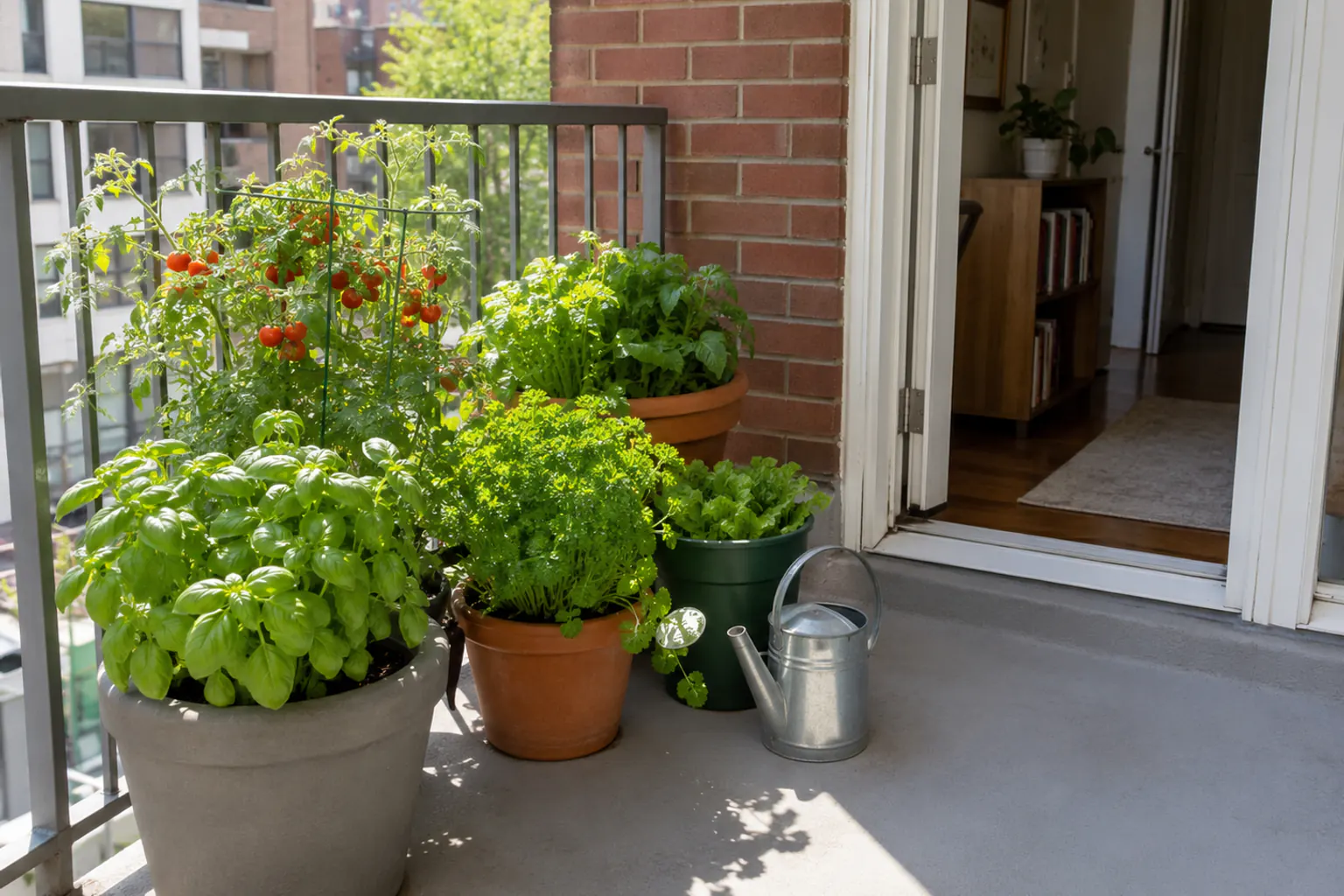
No yard is not the end of growing food — it is a different, entirely workable path. Herbs, greens, tomatoes, and peppers all grow well in containers on a balcony, a sunny windowsill, or a patio. The trade-offs are real (containers dry out faster and hold less), but a container garden is a genuine food source, not a consolation prize. This is one branch of the home food gardening hub.
Confirm what your space and lease allow
Before buying anything, check the boundaries:
- The lease and building rules. Some prohibit balcony gardening, watering that drips to units below, or soil bags in common areas. A quiet check now avoids a forced teardown later.
- The balcony’s load and drainage. Wet soil is heavy. Do not overload a balcony or let water pool or drain onto a neighbor. Keep containers clear of the apartment exit and egress path — a plant that blocks a doorway or a fire route is a hazard, not a garden.
- Real sunlight. A north-facing balcony gets far less than a south-facing one. Match crops to what you actually have (below), not what you wish you had.
Choose the right containers
Container choice is mostly about volume and drainage:
- Bigger is more forgiving. Small pots dry out and overheat fast. A 5-gallon container grows a tomato far more reliably than a 1-gallon one.
- Drainage holes are non-negotiable. Roots sitting in water rot. Every food container needs holes and, on a balcony, a tray that does not overflow onto a neighbor.
- Use food-safe containers and known potting mix, not random buckets that held chemicals or unknown soil. Produce safety starts with what the roots sit in — the same principle the produce safety guide applies to yards.
- Potting mix, not garden soil. Bagged potting mix drains and breathes; dug garden soil compacts in a pot.
Pick container-friendly crops
Some crops thrive in containers; others struggle. Reliable container starters:
- Herbs: basil, mint, chives, parsley — high value, small footprint, cut-and-come-again.
- Leafy greens: lettuce, spinach, kale — fast, shallow-rooted, tolerate partial sun.
- Compact fruiting crops: cherry tomatoes, peppers, bush beans — need the biggest containers and the most sun.
Skip sprawling crops (corn, large squash, pumpkins) — they need ground and space a container cannot give. Match the specifics to your climate with choosing reliable, high-value crops.
Manage water — the container-garden skill
Containers dry out far faster than ground, sometimes daily in summer heat. This is the number-one reason container gardens fail.
- Check daily in warm weather; stick a finger an inch down — water when it is dry there.
- Water until it runs from the drainage holes, then stop.
- Bigger containers and mulch on top buy you time between waterings.
- Group containers so they shade each other’s roots and are easier to tend.
A container garden’s water demand is small compared with a yard, but it is steady and unforgiving of a skipped week.
Growing food indoors
A sunny south-facing window grows herbs and some greens year-round. Fruiting crops (tomatoes, peppers) usually need more light than a window gives and struggle indoors without strong supplemental grow lights. Start indoors with herbs and greens; treat indoor tomatoes as an experiment, not a staple.
Keep it honest
A balcony or windowsill garden is a real, satisfying food source and a durable skill — and, like any garden, a supplement rather than a survival plan. Grow the herbs and greens you actually use, keep the containers out of your exit path, and let the setup grow with your experience.
To stock a small-space garden, seed selection, storage, and saving covers choosing seed suited to your space, and gardening tools and supplies covers the few tools a container grower actually needs.
When you have a harvest to keep, food preservation and dehydration owns storing it; a plant you did not deliberately grow is a foraging identification question, not a garden one.
Sources reviewed
- USDA National Institute of Food and Agriculture: Cooperative Extension
- Centers for Disease Control and Prevention: safer fruits and vegetables
- U.S. Food and Drug Administration: selecting and serving produce safely
Sources reviewed July 29, 2026. Local Cooperative Extension, building rules, and current produce-safety guidance control real growing and safety decisions.