
Choose a permitted observation-only outing or qualified guided session, then check the route, conditions, communication, and return plan. The outing can be useful with no specimens or food brought home. Do not follow an interesting organism off the authorized route or extend the trip to fill a basket.
Use this plan for an observation-only field session. Do not taste, consume, distribute, sell, preserve, or bring an uncertain item into a food area. A photo or note can support later education, but it cannot confirm edibility. The remote-identification warning explains why an app, AI answer, online group, common name, or single image cannot authorize food use.
Define one modest learning objective
Choose a goal that does not require identification or harvest. Examples include learning how to follow the site’s posted rules, observing how habitat changes along an authorized path, practicing location notes, or attending a physical class led by a qualified regional instructor.
Write the objective before departure. Also write what the session will not include:
- no consumption or taste testing;
- no collecting for food;
- no entry beyond the authorized route or teaching area;
- no climbing, wading, digging, cutting, or reaching into concealed spaces;
- no roadside, railroad, utility, flood, fire, agricultural, industrial, or waste-area detour;
- no handling when identity, contact hazard, site status, or instructor scope is unresolved;
- no change of destination because a map pin, social post, or visible organism looks promising.
An instructor-led activity can have narrower authorized handling rules. That does not convert a beginner into an independent identifier, and it does not make every observed item food.
Verify the exact place and activity
Access and collection are separate permissions. Confirm the exact parcel, entrance, date, hours, parking or transit point, route, closure status, group rules, pet rules, and permitted activity with the current owner or land manager. A public trail does not automatically authorize removing a plant, fungus, fruit, seed, nut, aquatic item, soil, wood, or cultural object.
Use the legal and sustainable harvest workflow before any later collection proposal. For this observation trip, record the authority, page or office consulted, date checked, contact channel, exact location, and decision. Save the source offline if reception may be poor.
Cancel when boundaries are unclear, signs conflict with online information, the land manager cannot be identified, a closure or permit question remains open, or the route would cross private, Tribal, restoration, research, protected, rail, utility, agricultural, or disaster-affected land without explicit authorization.
Screen the site before departure
Run the wild-food contamination stop rules even for an observation exercise. A safe educational route should not require contact with floodwater, sewage, sprayed vegetation, wildfire debris, an active spill, dumping, heavy roadside dust, rail property, animal-waste concentration, harmful water, or unknown industrial land.
Observation does not justify entering a contaminated or unstable area. Cancel or relocate through the responsible authority when an event has changed the site. Never assume that distance, rain, time, appearance, gloves, washing, or later cooking resolves an unknown exposure.
Check current official weather, alerts, fire restrictions, flood conditions, air quality when relevant, daylight, water releases, trail notices, and land-manager messages. Use the exact area and planned time window. A pleasant forecast for a nearby town may not describe heat, cold, wind, lightning, smoke, tides, water, or elevation at the site.
Match the route to the least mobile participant
Choose a maintained, familiar, authorized route with a clear turnaround point. Account for the participant with the shortest safe walking duration, highest heat or cold sensitivity, least stable footing, most restrictive medical plan, and greatest supervision need. The field session is not the place to test a new mobility limit.
Record:
| Field | Decision before departure |
|---|---|
| Start and finish | Exact authorized entrance and planned return time |
| Route | Maintained path or instructor-controlled teaching area |
| Turnaround | Time or location that preserves the return margin |
| Weather triggers | Conditions that cancel or end the session |
| Communication | Primary device, limitations, and backup plan |
| Check-in | Named person, route, vehicle details, and escalation time |
| Medical needs | Participant-owned plan, medicines, devices, accessibility |
| Children and pets | Continuous responsible supervision and current site rules |
Do not separate to cover more ground. Do not follow an organism off route. Do not cross water, unstable slopes, ice, storm debris, fences, barriers, road traffic, or tracks to obtain a closer view. When the planned route changes, the original permission, timing, weather, contamination, and check-in assumptions no longer apply.
Build a communication and return plan
Tell a reliable person the exact destination, route, participants, vehicle or transit details, start time, planned return, and the time they should escalate if no check-in arrives. Agree on what escalation means. Do not make the contact guess which ranger, owner, emergency service, or family member to call.
Carry a charged communication device appropriate to the area, but do not treat reception or a battery percentage as guaranteed. Download the authorized route and key contact information before leaving. If the activity depends on live identification, live navigation, or a last-minute permission message, it is not ready.
Start the return early enough to preserve daylight, transportation, weather, mobility, and communication margins. Leave immediately for a closure, alert, thunder, rapidly changing weather, smoke, rising water, route uncertainty, injury, illness, lost participant, failed communication, supervision problem, or unexpected hazard. Finding something interesting is not a reason to extend the deadline.
Keep the carried kit ordinary and bounded
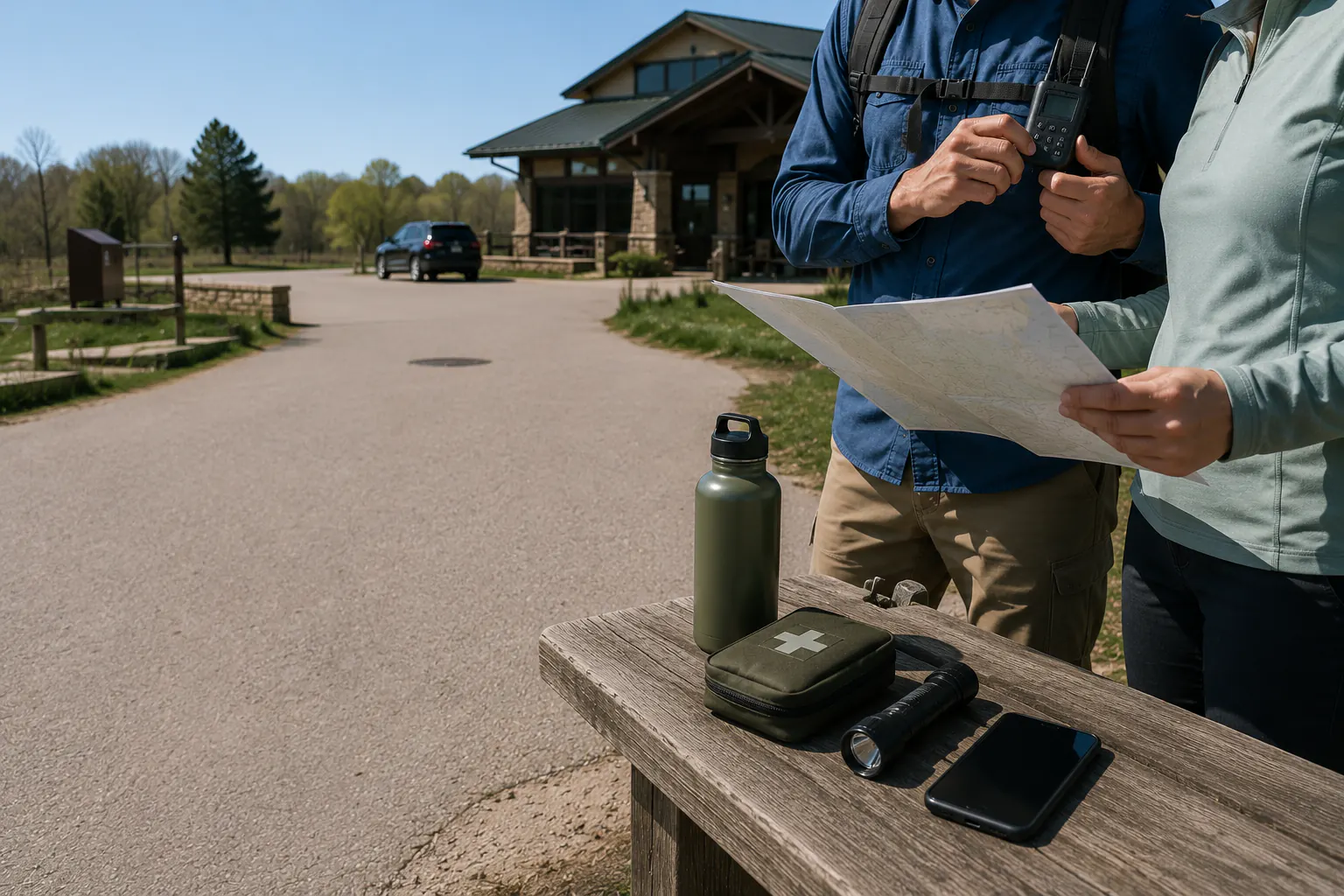
Bring the normal essentials appropriate to the route, weather, participants, and land-manager guidance: suitable clothing and footwear, household-approved water and food, charged communication, required medicines or devices, a compact first-aid kit, identification, route information, and any site-required safety item. The outdoor skills hub owns broader navigation, weather, communication, and practice planning.
Do not carry harvesting knives, saws, digging tools, hooks, or climbing equipment merely because foraging is the theme. Tools create legal, injury, sanitation, and supervision questions. Use only equipment authorized for the exact class or site, within demonstrated competence and the manufacturer’s instructions.
If a qualified instructor requests teaching specimens, they should define who may collect, what may be collected, how much, where, how it is contained, and what happens afterward. Keep every teaching item away from food, drink, medicines, children, pets, and unprotected skin as the instructor directs. Never place an unknown item loose in a pocket, backpack, vehicle cupholder, or kitchen container.
Supervise children, pets, and groups
An adult responsible for instruction should not also assume that every child, pet, or mobility-limited participant is being watched by someone else. Assign supervision explicitly. Keep the group together and preserve ordinary hand-to-mouth controls.
Children should not taste, pick, crush, rub, or pocket an item. Pets should remain under the exact site rules and away from unknown organisms, bait, carcasses, waste, water hazards, traps, pesticides, and teaching containers. If supervision cannot remain continuous, end the exercise.
For a group, count participants at departure, route transitions, stops, turnaround, and return. Make one person responsible for time and one for the permission file. Nobody should extend the route or collect privately outside the agreed plan.
Use a no-consumption field record
Record observations without naming an item as food:
- date, time, general authorized area, and instructor if present;
- habitat and substrate without disturbing either;
- weather and recent event context;
- what was observed and which structures were not visible;
- uncertainty, questions, and the next qualified learning route;
- explicit outcome: observation only, no food retained.
Avoid publishing precise locations for vulnerable, protected, culturally sensitive, or heavily pressured resources. Follow the owner, land manager, instructor, and conservation authority on photography and location sharing.
A field note is not a food label. Repeated observation is not physical confirmation for a future batch. Seasonal change, life stage, damage, contamination, location, and similar-looking organisms can alter the question.
Respond to contact, ingestion, or illness
Stop the activity after suspected ingestion, eye or skin exposure, a sting or bite, breathing symptoms, sudden illness, injury, or significant contamination. Move away from immediate danger without creating another exposure. Follow current professional instructions rather than improvising a remedy.
In the United States, contact Poison Control at 1-800-222-1222 promptly for suspected poisonous ingestion or relevant exposure. Call 911 for collapse, breathing difficulty, seizure, severe confusion, loss of consciousness, or immediate danger. Do not induce vomiting, give a home remedy, or make the person consume more material for comparison.
Preserve remaining material, photographs, packaging, times, and notes only as professionals direct and without exposing someone else. Tell responders explicitly that a wild item may be involved. The compact first-aid hub does not replace emergency or poison expertise.
Close the trip before planning another
Check every participant back in, notify the outside contact, and account for authorized teaching containers. Clean ordinary footwear and equipment as the land manager directs to reduce transport of soil, seeds, pests, or pathogens. Do not move an uncertain specimen into the kitchen for internet research.
Debrief the original objective: Was permission current? Did the route remain controlled? Which stop rules appeared? What questions require the instructor, land manager, Extension route, public health, conservation staff, or a clinician? Record any near miss without turning it into an anecdote of competence.
Return to the Foraging and Wild Foods hub. A successful beginner trip can end with zero collected items and better judgment. That is progress, not an empty basket.