
A phone can produce a plausible name in seconds. That speed does not convert an image into a food-safety decision. The missing information may be exactly what separates an intended organism from a dangerous look-alike, or a correctly named organism from a contaminated or unsuitable meal.
This page intentionally does not teach identification. It explains why common shortcuts fail and how to keep digital tools in a non-consumption learning role.
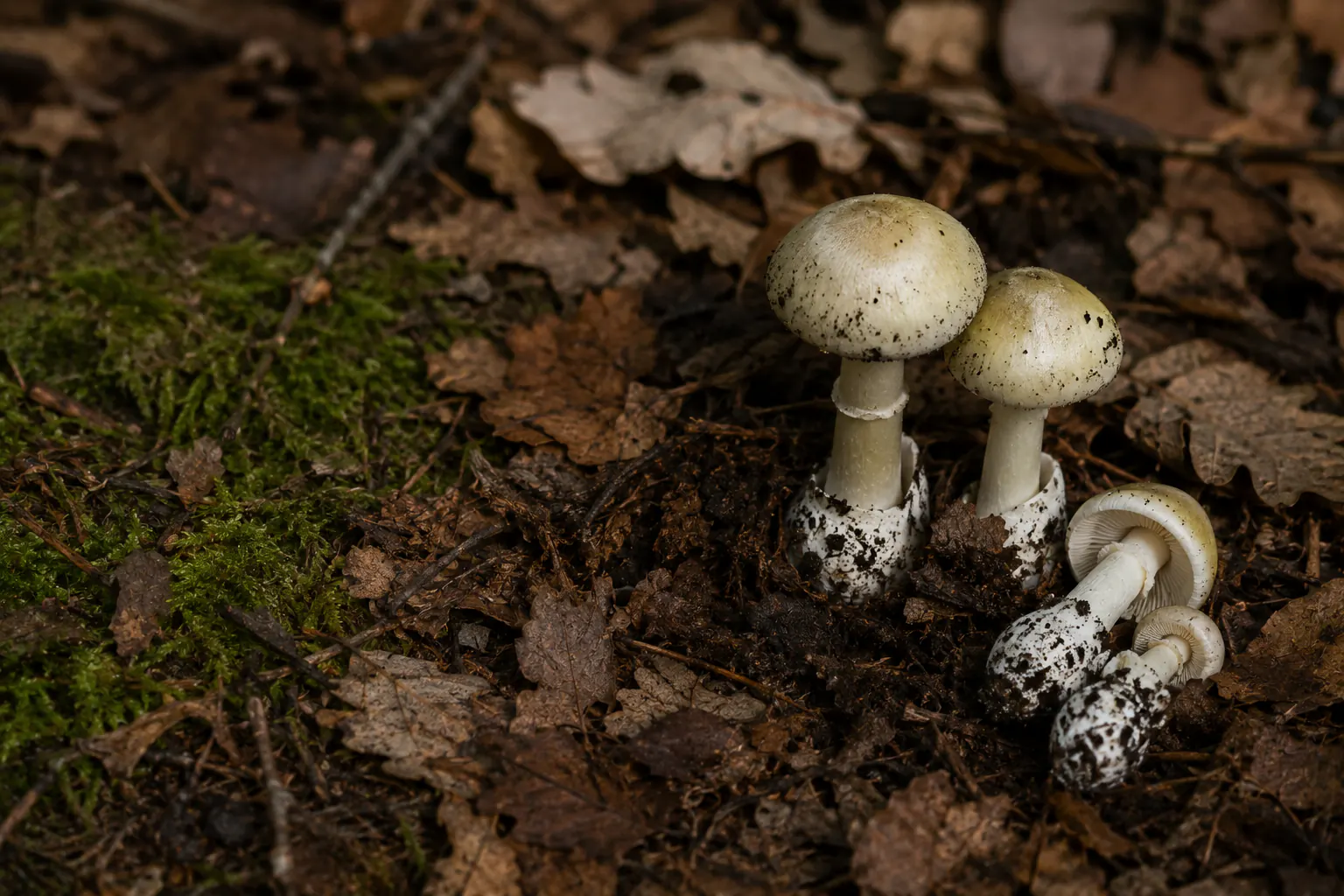
Start with the consequence, not confidence
CDC’s 2026 report on an amatoxin mushroom outbreak in northern California described 39 cases, three liver transplants, and four deaths. Misidentification can produce delayed severe illness, and no FDA-approved clinical test confirms amatoxin ingestion. A 2021 CDC analysis likewise concluded that wild mushrooms should not be consumed unless identified by an expert.
An app’s confidence percentage, several agreeing commenters, or a familiar visual match does not measure the medical consequence of being wrong. When the downside can include organ failure or death, “probably” is not a food category.
A photo removes physical evidence
A photograph chooses one angle, distance, light, focus, and moment. It may omit the full base, attachment, underside, stem, interior, bruising or change over time, odor, texture, substrate, surrounding population, host, habitat, and scale. Cleaning, trimming, age, insects, weather, handling, or compression can remove more evidence.
The problem is not solved by uploading more pictures. A remote reviewer still cannot control whether all images show the same item, whether a structure was detached, whether location metadata is correct, or whether the specimen changed between collection and photography.
Qualified physical examination is not infallible, but it allows the expert to decide what evidence is needed, reject an incomplete specimen, use regionally appropriate references, and state uncertainty. A digital system is not entitled to fill missing evidence with a confident label.
Common names collapse different organisms
One common name can refer to different organisms across regions, languages, communities, and markets. Different life stages can look unlike one another, while unrelated organisms can look similar. A name remembered from another country or state may not map safely to the current place.
Do not convert a common name into a scientific name by search, then treat the scientific result as confirmation. The original identity problem remains unresolved. Likewise, a scientific-looking app label can be wrong or too broad for a food decision.
Record names only as learning notes linked to the instructor and physical specimen. Never use a name alone to authorize a second collection.
AI and apps optimize for an answer
Image-recognition and conversational systems can return a best match even when the correct output should be “insufficient evidence.” Their training data, regional coverage, taxonomy, image quality, update process, and error rates may be unknown. A model may also repeat internet myths or blend preparation advice from different organisms.
Keep apps in these bounded roles:
- recording a location for a lawful observation without exposing a sensitive population;
- organizing photographs for later in-person instruction;
- retrieving current owner/manager contacts;
- checking weather and return logistics;
- maintaining a list of unanswered questions.
Do not use an app to approve touching, collecting, tasting, preparing, dosing, preserving, serving, or treating an exposure. Never let a child or pet interact with an item because a screen displayed a reassuring result.
Online groups cannot assume custody
A forum, social-media group, message thread, or video audience does not control the specimen, location, land permission, contamination, medical context, or follow-up. Votes measure agreement among visible accounts, not competence. The most confident reply may have no relevant regional scope.
Do not post “edible?” and act on the fastest answer. A responsible remote community may refuse a food verdict; that refusal is a safety feature, not a failure. Move the question to the qualified-instruction workflow and keep the item out of food areas.
Avoid publicly exposing exact locations of protected, culturally sensitive, rare, or heavily pressured populations. Current land manager and instructor guidance controls location records.
Field guides are study tools
A printed guide can help prepare questions and learn vocabulary. It cannot inspect the item, verify that the book covers the current region and taxonomy, resolve a damaged specimen, or know current contamination and legal conditions.
Publication quality varies. Check author qualifications, geographic scope, edition, taxonomy updates, errata, source references, and whether the guide tells readers when not to identify. A compact guide chosen for portability should not be treated as more decisive than a complete regional reference.
Use books before and after qualified teaching, not as a solo permission slip. Do not mark a page “safe forever” after one class.
Folk tests do not establish edibility
Reject tests based on color change, metal objects, peeling, boiling water, smell, taste, bitterness, staining, insects, wildlife feeding, companion organisms, location folklore, or whether an older relative ate something similar. The absence of an immediate reaction is not evidence of safety.
Do not taste and spit. Exposure can occur through ingestion of a small amount, cross-contamination, or another route depending on the organism. Do not ask another person or animal to test a batch.
This page publishes no folk test in procedural form because demonstrating a myth can make it easier to try. The controlling rule is simpler: only a qualified regional expert physically examining the complete specimen and context can move the identity gate, and other legal/contamination/health gates still remain.
Cooking does not repair uncertainty
Poison Control warns that cooking does not make a poisonous mushroom safe. More broadly, heat, soaking, rinsing, peeling, drying, freezing, fermenting, pickling, smoking, or canning cannot be assumed to neutralize an unknown natural toxin, contaminant, allergen, or wrong identity.
Preparation instructions can be organism-, part-, maturity-, region-, and process-specific. Do not search for “how to make this safe” when identity is uncertain. Discard or retain for expert teaching only as directed; do not move the question into the kitchen.
The food-preservation handoff begins only after physical expert confirmation and every other gate passes.
Prior success cannot validate the next batch
Eating something before without an obvious reaction proves only that no recognized immediate outcome occurred that time. It does not prove the prior identity, rule, contamination, dose, delayed effect, or suitability for another person. The next item, site, season, maturity, or batch may differ.
Do not transfer confidence from:
- one specimen to neighboring specimens;
- one site to another;
- one season or life stage to another;
- one instructor’s scope to a different organism group;
- one household member to another;
- market-purchased food to a wild look-alike;
- a cooked batch to raw material;
- an adult’s experience to a child or pet.
Each batch requires its own physical confirmation and complete chain.
Keep uncertain material out of the household
Do not carry an uncertain item loose in a pocket, mixed basket, reusable grocery bag, food cooler, vehicle cup holder, or kitchen container. Keep lawful teaching specimens separately contained and clearly marked not for consumption, away from children, pets, food, medication, and living areas.
Wash hands and manage surfaces only under the instructor or poison professional’s direction for the exposure. Do not compost an uncertain organism or release it in a new location without land-manager guidance.
Respond to suspected ingestion
In the United States, contact Poison Control at 1-800-222-1222 promptly after a suspected wild-plant or mushroom ingestion. Do not wait for symptoms, rely on an app, induce vomiting, administer charcoal, give food/drink or a home antidote, or drive unsafely while searching for identification.
Call 911 for collapse, breathing difficulty, seizure, severe confusion, loss of consciousness, or immediate danger. Follow professional instructions about remaining material, photographs, packaging, timing, and transport. Tell clinicians explicitly that a foraged item may be involved.
Return to the Foraging and Wild Foods hub. The safest digital result is often an unresolved question preserved for qualified in-person learning, not a name followed by dinner.