
Ask a local accountable institution who offers observation-only teaching for the specific region and organism group. Verify the educator and physical teaching method before paying, traveling, collecting, or eating. A directory, audience size, or institution name is a starting lead, not proof of the instructor’s scope.
Build a qualification file before paying, traveling, collecting, or eating. The file should make it easy to reject a charismatic but unsafe class.
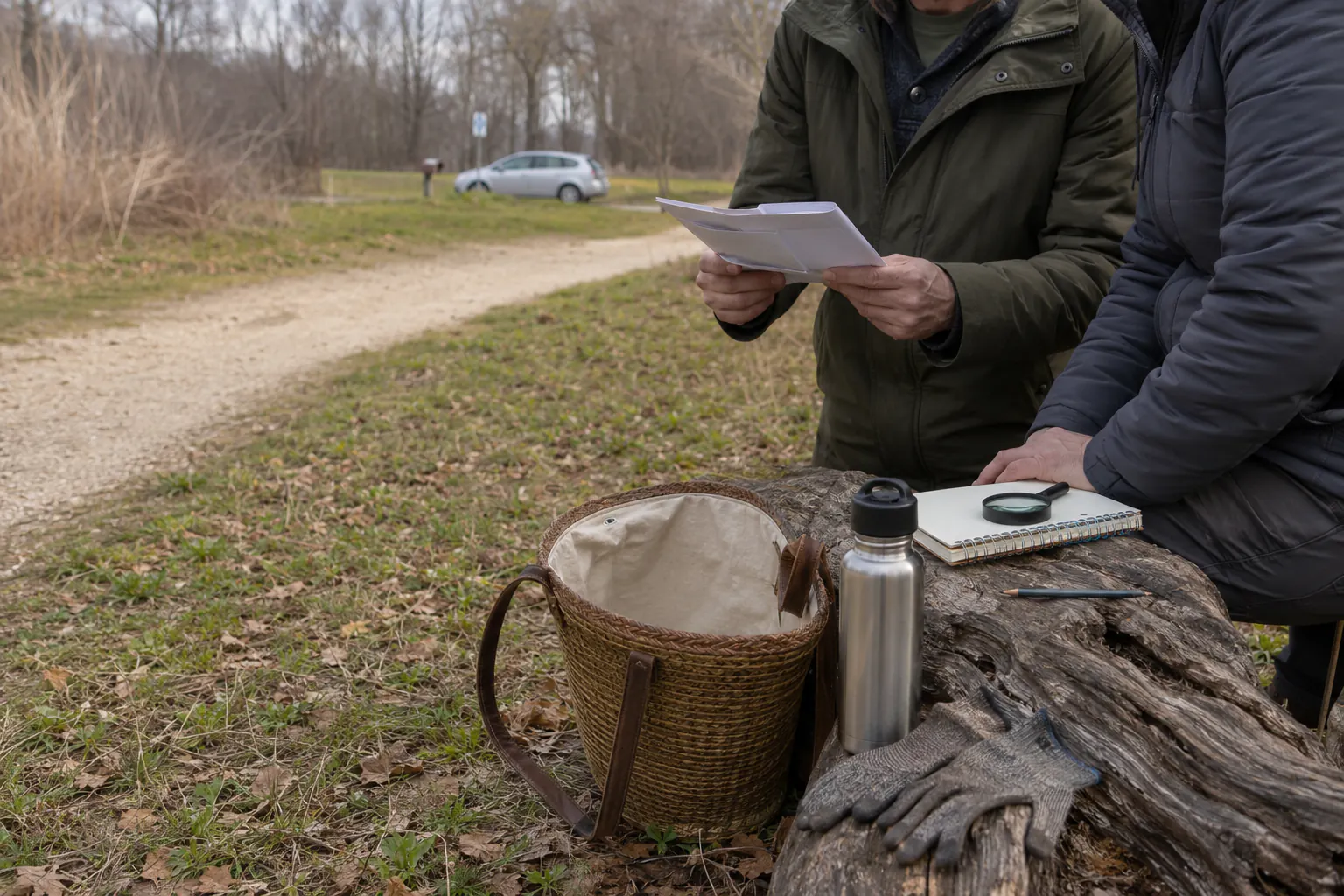
Start with accountable institutions
USDA’s National Institute of Food and Agriculture describes Cooperative Extension as a county-connected network of land-grant universities, scientists, subject-matter experts, and educators. Its land-grant university directory is a useful starting route for state and regional contacts.
Ask the relevant Extension office whether it offers or recognizes:
- regional botany or mycology education;
- Master Gardener or natural-resource programs with a clearly defined scope;
- university herbarium or mycological contacts;
- food-safety and home-preservation educators;
- poison-center or public-health education;
- conservation and invasive-species programs;
- Tribal, state, county, park, forest, or land-manager contacts for current rules.
Do not assume that the first office, program, or person can identify food. Ask who owns the exact question. A directory page is not a recommendation of a private instructor and does not transfer an institution’s authority to an unaffiliated event.
Other potential starting points include accredited universities, herbaria, recognized mycological organizations, botanical gardens, public land education programs, and established conservation groups. Verify the exact educator rather than relying only on the host’s reputation.
Define the scope you need
Write the region, season, environment, organism group, and learning goal before searching. “Wild foods” is too broad. A beginner may need an observation-only introduction, while another learner may need a qualified food-preservation educator after identity is established.
Ask whether the instructor’s competence covers:
- the exact county, ecoregion, coast, elevation, or habitat;
- plants, fungi, algae, lichens, or another group, without assuming crossover;
- the life stages and seasons in the class;
- toxic and protected look-alike risk in that region;
- physical specimen examination and when a specimen is insufficient;
- current taxonomy and common-name ambiguity;
- legal access and collection rules for the actual site;
- contamination, food handling, and individual-health limits;
- emergency and poison-center response.
An honest instructor narrows scope and says “I don’t know.” Reject anyone who claims universal identification ability or guarantees that participants will leave with food.
Verify identity and qualifications
Record the instructor’s full professional identity privately, employer or organization, relevant education/training, field experience, geographic scope, references, and current contact. Verify claims with the named institution or credential issuer where feasible.
Qualifications may be academic, professional, community-held, cultural, or based on documented mentored field practice. Respectful verification does not require dismissing traditional knowledge. It does require clarity about who is teaching, what community or institution recognizes the role, what may be shared publicly, and where the teacher’s authority ends.
Do not turn cultural knowledge into scraped content, a public location list, or a commercial claim. Follow consent, attribution, access, and intellectual-property boundaries established by the knowledge holder.
Treat these as warning signs:
- anonymous or unverifiable identity;
- credentials unrelated to the organism group or region;
- app results presented as final confirmation;
- remote photo identification used to authorize eating;
- “secret test,” universal rule, or detoxification claim;
- pressure to taste during the first class;
- no Poison Control or emergency plan;
- collecting without documented site permission;
- mixing unknown specimens in one food basket;
- children or pets able to access specimens;
- selling supplements, extracts, kits, or food as proof of expertise;
- dismissing allergy, medication, pregnancy, immune, or clinician questions;
- no refund/cancellation plan for unsafe weather or site closure.
Require physical teaching
For food-related learning, the instructor must explain how complete specimens and context are examined in person, what evidence must remain attached, and when no identification is possible. A classroom photo deck or video can prepare observation but cannot confirm the learner’s later batch.
Ask how the class separates:
- observation from collection;
- teaching specimens from food;
- one species/site/date batch from another;
- instructor-confirmed items from participant guesses;
- legal identity from contamination and food-safety decisions;
- general preparation concepts from exact research-tested processes.
Do not accept a take-home promise that “anything matching today’s example is safe.” The instructor should require new confirmation when site, season, maturity, specimen, or condition changes.
Audit the site and permission
The class host must identify the owner or land manager, boundaries, access route, parking, hours, group authorization, collection permission, quantity/method limits, protected areas, commercial restrictions, and current closure process. A public park is not automatically open to collecting.
Ask whether the class is observation-only. If collection is permitted, verify whether each participant needs an individual permit, whether material may leave the site, and whether commercial teaching or fees change authorization. The legal and sustainable harvest workflow owns the dated record.
Do not attend an event that advertises an undisclosed location, trespass, roadside stopping, closed-area access, or rule evasion as part of the adventure.
Check safety and accessibility
Obtain the route, distance, surface, elevation, weather exposure, water edges, traffic, hunting-season context, restroom/sanitation, communication, emergency location, group size, supervision, and return time. Ask about mobility, vision, hearing, language, cognitive, allergy, medication, child, and caregiver accommodations without expecting the instructor to provide medical advice.
The class should have stop/cancellation criteria for severe weather, wildfire smoke, flood impact, lightning, unsafe heat/cold, inaccessible route, active pesticide application, land closure, and inadequate supervision. It should not require tasting, climbing, wading, entering traffic, leaving the authorized route, or using a cutting tool beyond the learner’s instruction.
The conservative trip plan remains controlling even for a paid event.
Separate identification from food service
An identification educator may not be qualified or permitted to serve food. Ask who owns food handling, handwashing, potable water, allergen disclosure, temperature control, kitchen authorization, leftovers, and illness reporting.
Do not eat from a communal mixed basket where batch identity and confirmation are lost. Do not let a waiver substitute for safe practice. If tasting is optional, a beginner can decline and still complete the educational objective.
For household use after class, the expert must physically confirm that exact batch, and the cleaning and preservation handoff must pass independently.
Ask for the poisoning response
The instructor should tell participants to contact Poison Control promptly after suspected ingestion and to call 911 for immediate danger or severe symptoms. They should not promise to diagnose by text, recommend induced vomiting, offer a home antidote, or tell someone to wait for symptoms.
Record:
- U.S. Poison Control: 1-800-222-1222;
- local emergency route and meeting location;
- how remaining material and batch records are protected under professional direction;
- who informs the venue and public-health authority if needed;
- how participant privacy is protected;
- how an incident triggers suspension and review of the class.
The First Aid hub supports contact readiness, not poisoning treatment.
Review commercial conflicts
An instructor may earn income, sell books, lead tours, or sell food lawfully. The conflict must be visible. Ask whether recommendations produce commissions, whether a specific product is required, whether permits and insurance cover the activity, and whether class success is tied to collecting or buying.
ReadyLience has no affiliate relationship with instructors or foraging products. A future recommendation would require documented qualification checks, class observation, safety boundaries, accessibility, incident process, and transparent conflicts. Popularity and customer ratings would not be enough.
Use a selection record
| Field | Evidence |
|---|---|
| Instructor identity | Verified name, organization, contact |
| Scope | Region, organism group, season, limits |
| Qualification | Issuer, training, mentorship, references |
| Physical method | Complete specimen/context and refusal criteria |
| Site authority | Owner/manager, date, class and collection permission |
| Safety | Route, weather, group, communication, emergency plan |
| Food boundary | Identity, contamination, food service, preservation ownership |
| Poisoning plan | Poison Control, 911 triggers, evidence custody |
| Conflicts | Fees, sales, commissions, sponsors |
| Decision | Observation-only, suitable within scope, or reject |
Recheck the file for a new instructor, location, season, organism group, host, or food activity. Return to the Foraging and Wild Foods hub with a narrow learning goal. The best instructor does not make the learner feel certain about everything; they make uncertainty visible and actionable.