
Find the actual parcel owner or land manager and ask separately about access and collection before planning a harvest. Specify the place, date, item, amount, method, and purpose. Public access, a permit for another activity, or visible abundance does not grant collection permission or food-safety approval.
National Park Service policy allows a superintendent to designate certain fruits, berries, nuts, or other specified natural products under defined limits, but individual park rules differ. Current Forest Service examples likewise range from limited personal collection without a permit to item-specific permits, quantity limits, prohibited zones, and commercial restrictions. A national summary cannot replace the exact manager’s current file.
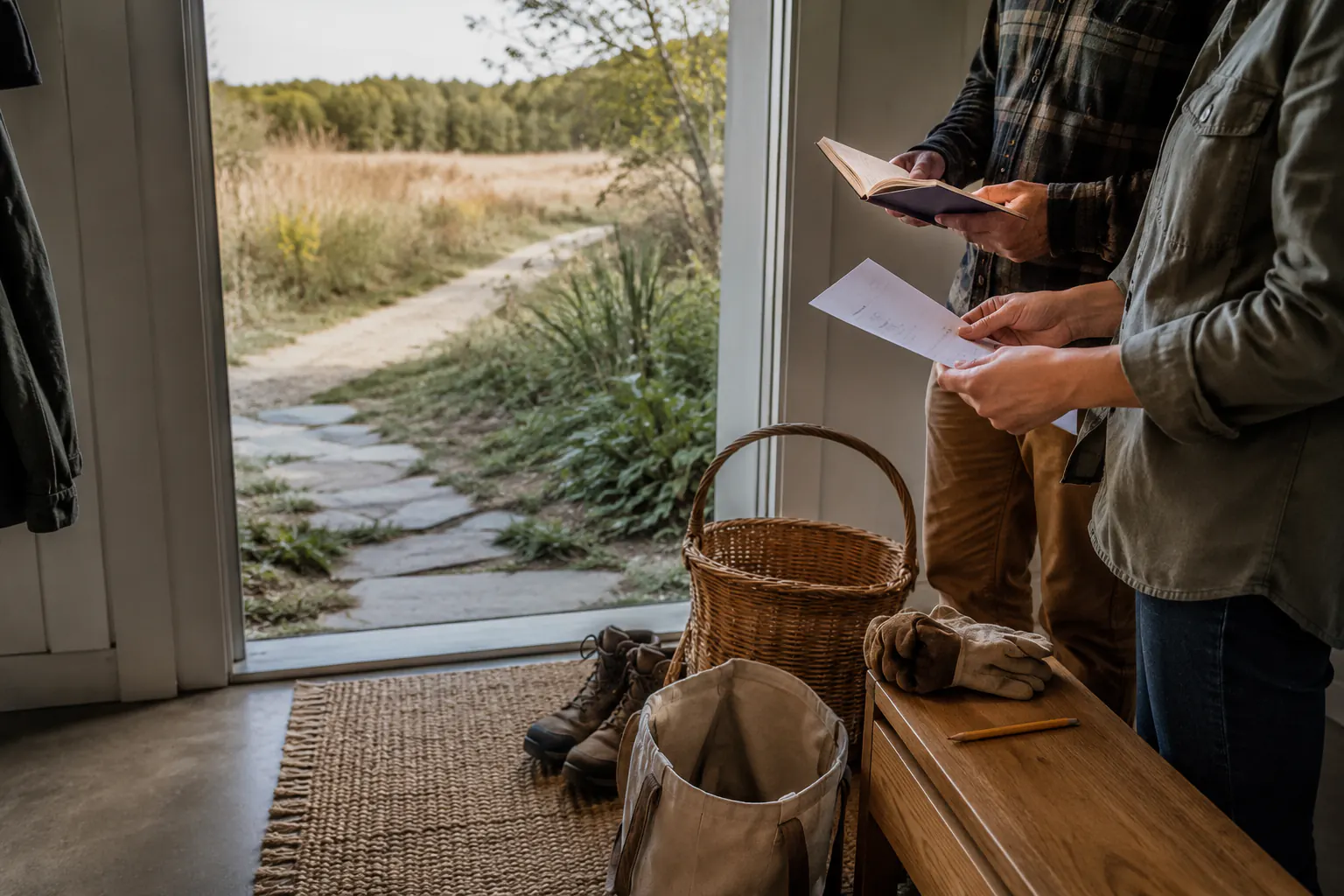
Identify the controlling parcel
Start with an official map and owner/manager contact. Record:
- precise parcel or managed unit;
- access point and legal route;
- boundary evidence usable on the ground;
- federal, Tribal, state, county, municipal, private, easement, right-of-way, or mixed status;
- adjacent parcels that must not be entered;
- current closures, hours, parking, group, event, and commercial-activity rules;
- emergency or ranger contact;
- date/time the information was checked.
A map app, fence, worn path, old sign, property listing, geotag, or another collector’s statement is not enough. Boundaries can be unmarked or inaccurate on consumer maps. If the manager cannot resolve the intended location, do not collect.
Do not publish exact locations of rare, protected, culturally sensitive, heavily pressured, research, or restoration populations. Follow the authority and knowledge holder’s privacy requirements.
Separate access from collection
Permission to hike, camp, park, photograph, or attend an event does not automatically include permission to remove a natural product. Verify collection as a separate action.
For private land, obtain explicit permission from someone authorized to grant it. Record the item, area, date, amount, method, purpose, vehicle/parking, guests, cleanup, and whether anything may leave the property. A tenant, neighbor, employee, contractor, or online host may not control the right being offered.
For public land, use the exact current manager page, order, permit office, superintendent’s compendium, district instruction, or other controlling source. Ask whether a printed or electronic permit must be carried, whether each person needs one, and whether reporting or check-out is required.
Permission can be revoked. A permit does not override a closure, fire restriction, emergency order, protected-resource rule, unsafe condition, or instruction from authorized staff.
Define the exact item and part
Rules may distinguish fruits, berries, nuts, mushrooms, entire plants, leaves, flowers, seeds, roots, bark, sap, seaweed, or other products. Removing a fruit may be treated differently from uprooting or cutting the organism. An “edible species” phrase in a rule does not identify a specimen or declare it safe.
Record the authority’s wording without translating it into a broader category. The qualified regional expert owns physical identity; the authority owns legal status. If the two descriptions cannot be matched confidently by the responsible people, do not collect.
Check current federal/state protected, threatened, endangered, rare, invasive, noxious, culturally protected, and regulated status. Do not assume an invasive organism may be taken, transported, propagated, sold, or discarded freely. Control programs may require specific authorization and biosecurity.
Record amount, method, and purpose
Copy the current limit and unit exactly: per person, group, household, species, day, week, season, or year. Determine whether the limit applies at collection, possession, transport, home storage, sale, or all of them. A legal maximum is not a harvest target.
Verify:
- hand collection versus tools;
- digging, cutting, climbing, raking, pulling, or disturbing substrate;
- container or quantity measurement;
- specimen marking, splitting, tagging, or permit display;
- designated and prohibited areas;
- road, trail, off-trail, vehicle, and parking limits;
- immediate consumption versus removal from the site;
- personal use, gifting, barter, exchange, teaching, research, or sale;
- group class, guide, filming, or other commercial authorization.
Do not divide a commercial or over-limit collection among people to simulate personal use. Do not sell or exchange material collected under a personal-use rule unless the authority explicitly permits it.
Add Indigenous and cultural boundaries
Tribal sovereignty, treaty rights, reserved rights, cultural practices, and access are not generic public permissions for other people. ReadyLience does not interpret or transfer those rights.
Do not collect on Tribal land, imitate a protected practice, disclose a sensitive place, or commercialize traditional knowledge without the authorization of the relevant Tribe and knowledge holders. Follow current cultural-resource and archaeological protections. An apparently ordinary plant population may have cultural significance unknown to a visitor.
When a class or source uses Indigenous knowledge, verify consent, attribution, scope, and restrictions. Respect a refusal to disclose locations or techniques.
Make sustainability site-specific
Low-impact harvest cannot be reduced to one percentage. Population size, reproduction, growth form, plant part, season, wildlife dependence, disease, drought, fire, flood, invasive pressure, visitor use, and cumulative collection all matter.
Use the land manager and qualified regional conservation expert to decide whether any collection is appropriate. Observation-only is the default when population or impact evidence is missing.
Record:
- manager’s conservation objective;
- population status and monitoring source;
- permitted part and method;
- amount below the legal maximum chosen for impact reasons;
- no-collection buffer or sensitive stage;
- wildlife and pollinator needs;
- soil/substrate disturbance boundary;
- disease and invasive-species sanitation;
- cumulative group impact;
- condition that ends collection immediately.
Do not pull roots, strip bark, break branches, compact sensitive ground, remove all visible fruiting bodies, disturb nests/den sites, spread soil, or create a new trail based on generic advice. The exact authority and expert control.
Include the entire group
One informed organizer does not legalize the group. Confirm permits and limits for every participant, supervision of children, animal rules, parking, and group-size authorization. Keep participants within the approved boundary and method.
Do not let a child taste or carry an uncertain specimen. Keep pets away from collected and standing organisms. A class waiver does not replace land permission, conservation, or food-safety duties.
Set a stop phrase anyone can use. End collection when identity, boundary, quantity, method, weather, contamination, group control, or staff instruction becomes uncertain.
Build a dated rule ledger
| Question | Controlling evidence |
|---|---|
| Where | Official parcel, boundary, access, prohibited zones |
| Who | Authorized collector, age/group/permit conditions |
| What | Exact item and part, protected status |
| When | Season, day, hours, closure and recheck date |
| How much | Unit, personal/group/possession limit |
| How | Hand/tool/method and disturbance limits |
| Why | Personal, teaching, gifting, research, sale or commercial status |
| Conservation | Manager/expert impact limits and stop conditions |
| Transport | Marking, containment, movement and invasive-species rules |
| Source | Issuer, title, section, effective/access dates, contact answer |
Save the official file where permitted and mark it expired after the trip. Do not overwrite a historical record with a new rule and then claim the old action was compliant.
Recheck at the site
Before collection, compare the rule file with posted signs, closures, fire/flood conditions, restoration markings, research plots, active treatment notices, and authorized staff instructions. If on-site direction is more restrictive or conflicts with the file, stop and ask the authority.
The contamination guide can prohibit food use even when collection is legal. The trip safety plan can cancel a legally permitted outing. The physical expert-identification boundary remains independent.
Return to the Foraging and Wild Foods hub with the closed file. Lawful and sustainable collection is not inferred from abundance. It is a dated, site-specific decision issued by the people who control the land and understand the resource.