
Before trying to rest during a blackout, check whether the home is still an appropriate place to stay. Required care, emergency help and necessary departure come before bedtime arrangements. If staying is appropriate, start with a light within reach and a way to receive essential alerts. You do not need to finish a worksheet or reorganize the bedroom first.
A dark room, unfamiliar noise or another person needing reassurance can make an ordinary night difficult. The aim here is a workable household arrangement, not a promise of sleep or a treatment for sleeplessness.
This page is household planning, not sleep treatment. It does not give medical advice, temperature thresholds, medication guidance, or a workaround for a clinical, fire, evacuation, or carbon-monoxide risk.
It belongs to the Mental and Emotional Preparedness hub, where household routines remain separate from clinical care and event authority.
Do not turn rest into a reason to stay unsafe
Before setting up for sleep, check the current official instruction and the physical conditions of the home. Do not settle in when an evacuation order, fire, smoke, floodwater, carbon monoxide alarm, dangerous indoor temperature, unsafe building condition, medical need, or immediate security threat requires a different action.
Use the safe winter outage sequence for cold conditions, the extreme heat action plan for heat, the Medical Device and Medication Continuity plan for clinical equipment or medication, and the Family Communication Plan for contacts and check-ins. A blanket, quieter room, or bedtime routine cannot solve a condition that needs relocation, emergency action, or qualified care.
Choose a place to rest
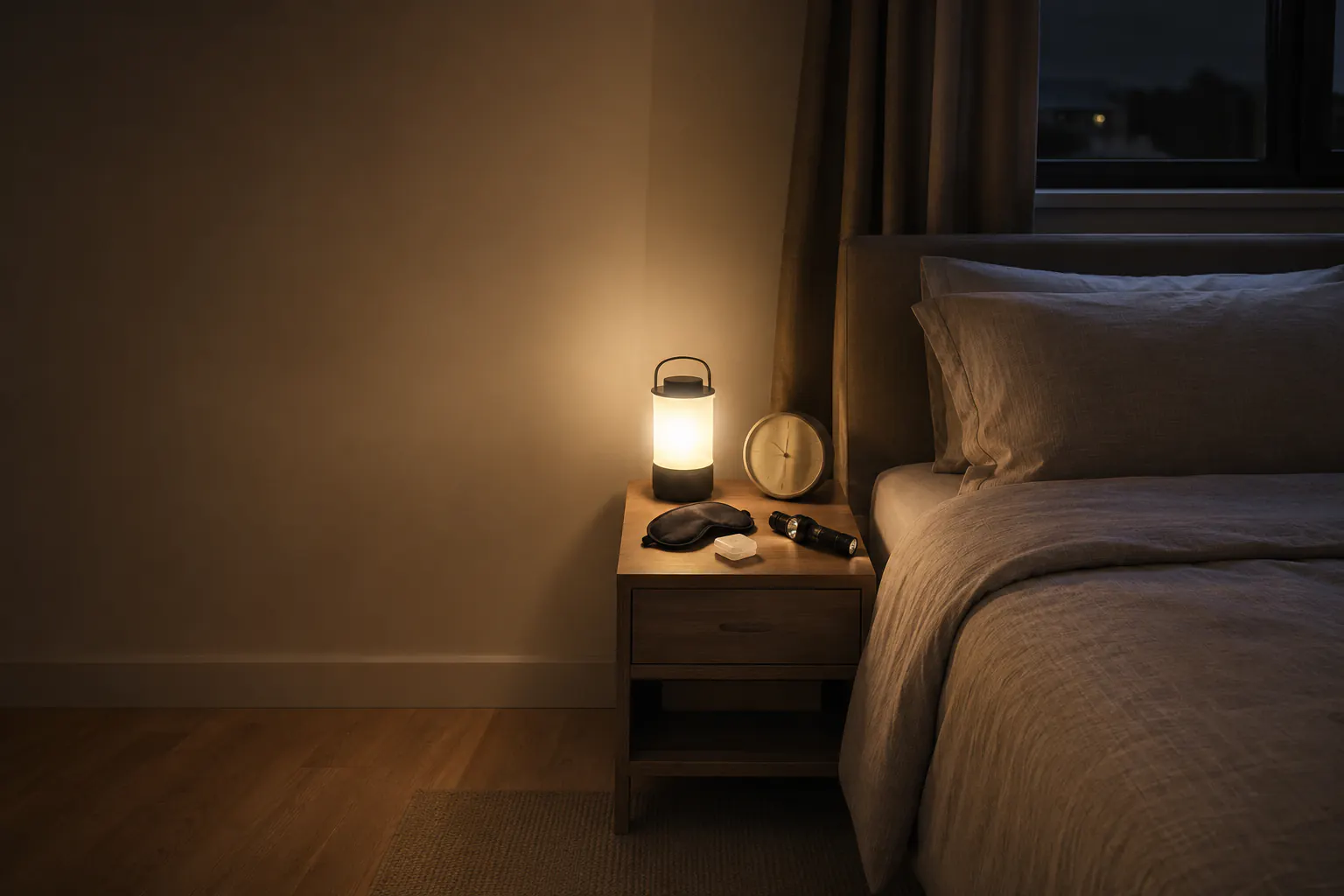
Choose a room only after checking its exit path, light, temperature conditions, occupants, and purpose. Keep the floor path to the door clear of bags, chargers, furniture, water containers, loose bedding, and shoes. A light should be reachable without standing in darkness, but it should not create glare, heat, or a trip hazard.
Set out only what the household needs for the next sleep period:
- a working battery light used according to its instructions, with a backup lighting option;
- a phone or alert device with the planned charge arrangement;
- glasses, mobility aids, hearing aids, or other personal essentials;
- an optional private reminder of the next check and contact fallback;
- safe bedding and clothing appropriate to the actual room conditions;
- a familiar quiet item for a child or anxious household member.
Do not use candles, indoor combustion equipment, improvised heaters, a vehicle, or a blocked exit to make a room feel more comfortable. Ready.gov’s power-outage guidance recommends flashlights rather than candles. The Emergency Lighting plan helps you arrange lighting for the room and exit path.
A reminder is optional, not permission to postpone care or an official instruction. Keep any contact or care details private. This page does not collect household notes.
Decide who watches alerts
Choose an alert path you can receive and act on from where you rest. A person living alone does not need a second adult to make a plan: keep the necessary device reachable, with its essential alerts enabled. In a shared household, agree who will monitor updates rather than expecting everyone to refresh every device all night. A weather warning, official evacuation message, building instruction, medical/device issue, or agreed missed check-in may require action. A routine social-media update usually does not.
An optional check reminder can help, but writing a schedule is not a prerequisite for rest. Take turns only with a willing, capable adult when the arrangement actually covers required care. If you cannot meet an essential care need, seek appropriate help rather than assuming that staying awake will solve it. Reduce optional monitoring without interrupting prescribed care, required devices or essential alerts. Do not make a child responsible for weather alerts, phones, younger siblings, or waking the household for ambiguous information.
The local emergency alerts guide explains backup channels and which instructions to follow. Keep those necessary channels available while stepping away from repeated rumor checks.
Lower stimulation without hiding important information
Small changes can make the room less activating: reduce unnecessary screen brightness, use a quiet familiar activity, put nonessential notifications aside, and avoid replaying upsetting video or rumor threads. Keep official alerts reachable. Do not silence a required alert, place a phone so far away that it cannot be heard or reached safely, or give a person a false promise that there will be no change overnight.
Use a plain update before lights are lowered: what is known, what is unknown, what happens if an alert arrives, and when the next planned check occurs. For children, use simple truthful words. “The power is out. The lantern is here. I am checking the official alerts. If an official instruction means we need to act, we will follow our plan.” Avoid graphic details, adult speculation, and a promise that nothing bad can happen.
Keep comfort arrangements physically safe
Comfort is useful only when it does not create a new hazard. Keep bedding clear of lights, chargers, outlets, heaters, and exits. Do not cover a charging device, run a cord under bedding or use a damaged cable. Follow the exact equipment instructions for charging, storage and clearances; a bedside arrangement does not establish that a device is suitable for that location. A power bank is not a substitute for a dependent person’s clinical device-continuity plan.
If people gather in one room, preserve enough space for each person to move and for an adult to assist a child, older adult, or person with a disability. A familiar toy, book, blanket, or quiet audio can be part of a routine, but do not rely on headphones when they would prevent someone from hearing an emergency warning they must receive.
Plan the morning before sleep begins
Choose one first task for when you wake, such as checking current official information or contacting the person covering the next care period. Required care and urgent instructions cannot wait for a planned morning check. Food, water, charging and other routine checks can follow when appropriate; you do not need a full recovery schedule before bed.
If useful, keep one private reminder of what needs changing: a missing flashlight, an exit narrowed by bags, a child who needed a different explanation, or a care arrangement that did not work. Adjust nonessential notifications without weakening alarms or required alerts. Make the practical correction during normal conditions. Do not criticize someone for sleeping, needing reassurance, or feeling unsettled after an unusual night.
Prepare the room before the forecast changes
During ordinary daylight conditions, review the route with the people who use it, respecting their abilities and care arrangements. Check access to the door, light, footwear, phone and needed personal aids without moving storage. Do not remove child-safety or security safeguards to make a practice easier. Check that curtains, fans, bedding, charging gear, and furniture do not hide a release or narrow an exit. Revisit the arrangement after a move, new roommate, new baby, mobility change, or care-plan change.
Keep this preparation modest. A household does not need a special blackout bedroom or a complex collection of sleep products. Work on a clear exit route, an understandable alert-and-wake plan, and ordinary comfort items that do not compete with medical, heating, cooling, evacuation, or emergency-lighting priorities. Start with one correction you can make while the home is calm. CDC’s disaster-coping guidance places ordinary sleep routines within general coping advice, not a replacement for qualified care.
Seek the right support when household routines stop being enough
Call 911 for immediate danger, fire, medical emergency, violence, or a person who cannot be kept safe. For crisis support in the United States and territories, call or text 988. SAMHSA’s Disaster Distress Helpline is available by call or text at 1-800-985-5990 for disaster-related emotional distress.
For a child, older adult, caregiver, or anyone whose reactions continue, worsen, or disrupt ordinary care and functioning, seek appropriate qualified support rather than trying to optimize the bedtime routine. The household can provide a calm room, truthful information, and a contact path; it cannot diagnose or treat what is happening.
Sources reviewed
- Centers for Disease Control and Prevention: disaster coping and healthy stress-response context
- Ready.gov: household power-outage preparation
- Substance Abuse and Mental Health Services Administration: Disaster Distress Helpline
Sources reviewed July 15, 2026. This is household preparedness guidance, not medical, sleep, mental-health, pediatric, or emergency-response advice.