
Almost everything written about household preparedness quietly assumes one thing: that you are at home when it happens. The supplies are in your closet, the plan is on your fridge, and the people you would check on are down the hall. But a good share of ordinary disruptions — a storm that grounds flights, a regional outage, a road closure, an illness — reach people in a hotel three states away, or on the second day of a road trip.
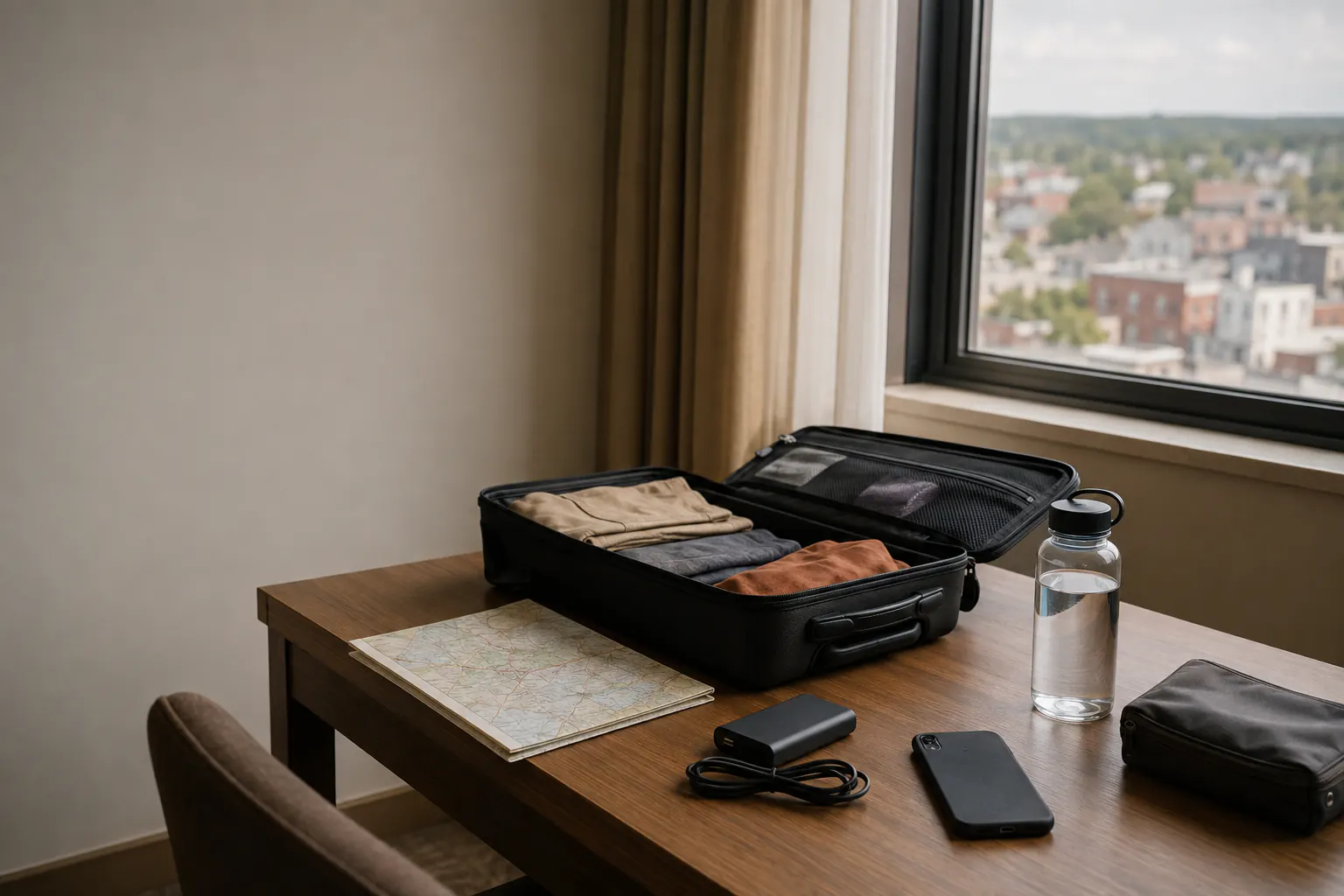
This is the other half of the plan. Not a survival course, and not a reason to travel anxiously: a short set of things to carry, know, and decide in advance so that being away is an inconvenience rather than a scramble.
What this cluster covers, and what it does not
Being away from home splits into two very different problems, and mixing them is what makes most advice useless.
- Close to home — a few miles, a familiar city, your own car. That is a get-home problem, and the realistic get-home plan already owns it: routes, walking distance, what lives in the vehicle. The wider evacuation and bug-out planning framework sits above both.
- Far from home — a flight away, an unfamiliar region, no car of your own, no way to simply walk back. That is what this cluster covers. Distance changes the answer: you are not returning today, so the questions become shelter, money, medication, documents, and communication.
The line is roughly “could I reasonably get back under my own power today?” If yes, use the get-home plan. If no, you are in travel-preparedness territory.
The four things that actually matter away from home
Long checklists do not survive a real trip. Four categories cover most of what goes wrong:
- Medication and health. The single most common serious problem. A two-day delay is trivial unless it is two days without a prescription you depend on. Medication and health on the road covers carrying, timing, and what to do when a trip runs long.
- Documents and money. Identification, a way to pay when a card fails, and access to the records you would need to prove who you are. Travel documents and payment backups covers the copies worth having and where they live; the fuller household set belongs to essential documents to take during evacuation.
- Communication. Knowing how to reach your people, and how they reach you, when the usual app or network does not work at your destination. Your household’s family communication plan still applies; staying reachable while traveling covers what changes on the road.
- A place to be. When a flight is cancelled or a road closes, the question is where you sleep tonight. When travel plans break covers the decision, and the vehicle as temporary shelter covers the narrow, real case where a car is the honest answer for a night.
Prepare for the trip you are actually taking
The useful preparation is proportionate. A weekend at a relative’s house two hours away needs almost nothing beyond your medication. A two-week trip across several states, or international travel, is worth twenty minutes of planning:
- Check the destination, not just the route. Hurricane season, wildfire season, and winter storms are regional and predictable enough to look up before booking.
- Know who to contact where you are going. For international travel, the State Department’s traveler checklist covers enrollment, embassy contacts, and entry requirements. (Source: U.S. Department of State, Traveler’s Checklist.)
- Leave an itinerary with one person at home. Not for drama — so that someone knows roughly where you are if you go quiet.
- Assume your phone is the single point of failure, because it usually is: boarding pass, map, payment, contacts, and the photos of your documents all live there.
The honest boundaries
- Local authority always wins. An evacuation order, a shelter instruction, an airline rule, or your accommodation’s emergency procedure outranks any general plan, including this one.
- This is not medical, legal, insurance, or destination-risk advice. It does not assess a country, a route, an airline, or your health.
- A car is not a substitute for lodging. Sleeping in a vehicle is occasionally the right call for one night; the temporary shelter guide is deliberately narrow about when and how, because the risks are real.
Travel preparedness is a small amount of thinking done in advance so that an unremarkable problem stays unremarkable. The rest of this cluster is that thinking, broken into the four decisions above.
Sources reviewed
- Ready.gov: Vehicle and travel readiness
- U.S. Department of State: Traveler’s Checklist
- Centers for Disease Control and Prevention: Travelers’ Health
- Transportation Security Administration: What can I bring?
Sources reviewed August 4, 2026. Local authorities, your carrier, your accommodation, and current official destination guidance control real travel decisions.