
Start with the room people will use, the cooling equipment you already have, and a place you could go if the home gets too hot. Write down what needs service, what needs permission, and who will arrange it. You do not need to buy a heat-season bundle to begin.
A pre-season audit gives those arrangements time to happen. It is not a cooling procedure: the cool a home without air conditioning guide covers the response. If heat is already affecting the household, use the current alerts and heat plan instead of finishing this checklist first.
EPA advises having air-conditioning units cleaned and serviced before heat arrives. Arrange the permitted occupant maintenance or qualified service for your exact system. (Source: EPA, Extreme Heat and Indoor Air Quality.)
When to run it
Run the full audit once in spring, before the first heat event, and re-check the short list after any move, renovation, equipment change, or new household member. Pair it with the spring section of the seasonal energy efficiency checklist so the envelope and the equipment get handled in one pass.
Work through the record in manageable sections. A damaged connection, unusable escape opening, failed cooling system, or person already affected by heat needs its own response; it is not a routine item to leave until spring.
Section 1: Map the sun before you buy anything
Record where sunlight enters before choosing a covering. Existing shades may already address some windows; privacy and other household needs may also influence the choice.
From normal, accessible positions, note which windows get direct sun at roughly 9 a.m., noon, 3 p.m., and 6 p.m. Treat those times as a sample, not a required outdoor inspection or a prediction for every season.
For each sun-exposed window, record:
- what shading exists now (blinds, curtains, exterior awning, trees, nothing);
- whether the window is an emergency escape opening;
- whether it is landlord-controlled, historic, or restricted by lease or condominium rules;
- whether exterior shading is physically possible and permitted.
EPA notes that outdoor awnings and louvers can reduce incoming heat more than indoor shades. Check property permission and installation requirements before committing to exterior work; the audit does not authorize it.
Section 2: Verify the cooling equipment you think you have
Do not assume. Check.
- Central system or heat pump: check its service record and arrange any service due under its instructions. The seasonal HVAC checklist separates occupant observations from professional work; appointment availability varies.
- Window or portable units: use only the normal checks permitted by the exact instructions, including any operating-temperature limits. Do not run damaged or uncertain equipment to see what happens. Note accessible seal or filter issues without reaching outside, moving a heavy unit, or opening service equipment.
- Filters: follow the exact system’s permitted replacement or cleaning instructions and schedule; leave inaccessible or uncertain work to service.
- Fans: inspect normally accessible exterior condition and placement before permitted normal operation. Keep a damaged, unstable, or abnormal fan out of use rather than testing every speed.
- Thermostat: confirm it works and that the cooling schedule is set for the season, not left on the winter program.
Refrigerant, electrical work, and opening service equipment belong to qualified professionals. Record the responsible contact and follow the equipment’s stop-use instructions when a fault is present.
Section 3: Find the windows that will not cooperate
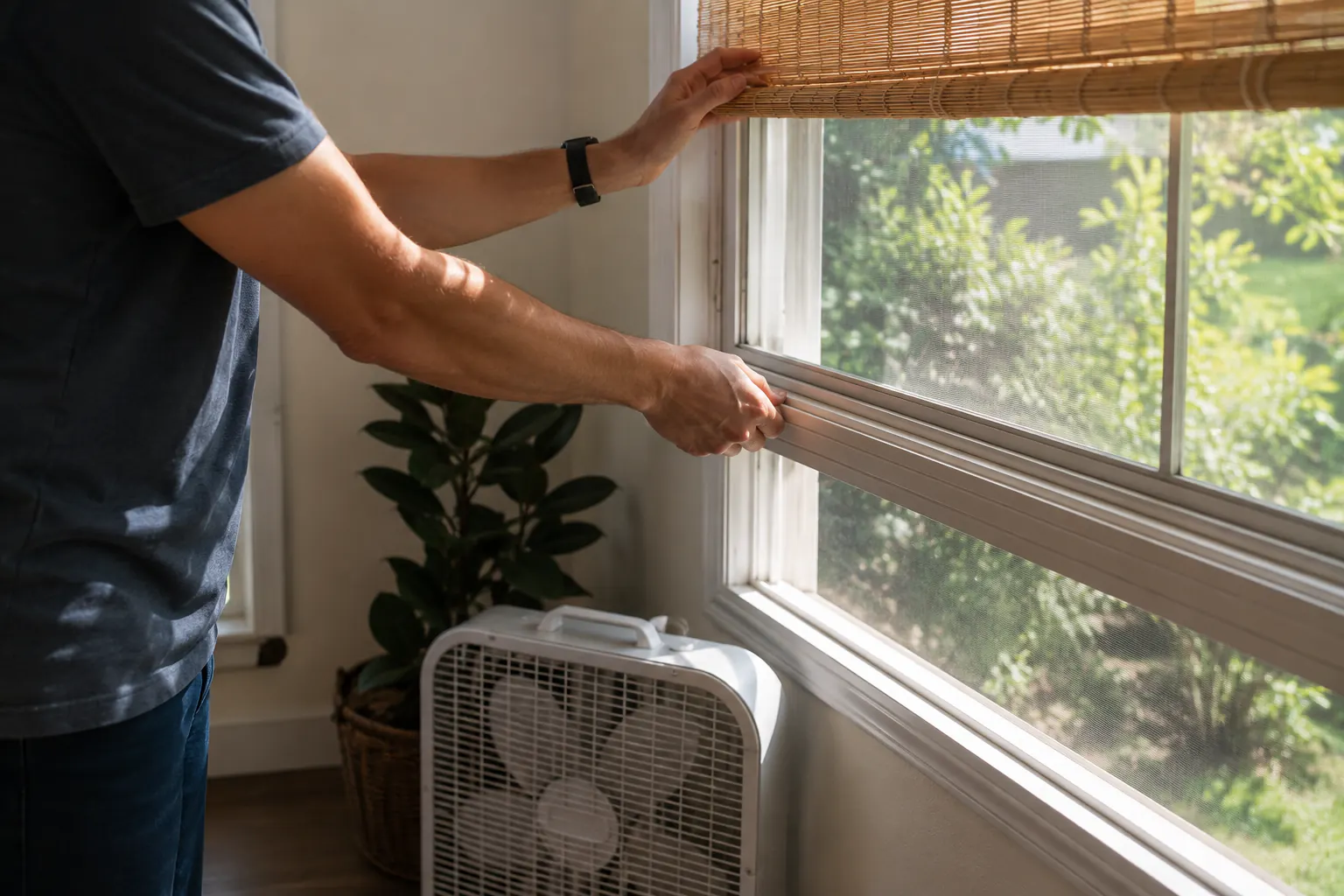
Before relying on night ventilation, check whether the intended windows can open, close, and stay secure without compromising falls protection or escape. Do not force a stuck or damaged window.
For each window you would rely on:
- Does it open and close with normal force, and latch?
- Is a screen present and intact? A screen is not a fall guard.
- Can it be secured against falls, intrusion, and rain if left open overnight?
- Is it an escape opening that must stay usable?
EPA’s ventilation rule is conditional, not automatic: if the outdoor air is hotter than indoors, close the windows; if it is cooler, open the shades and the windows. It also advises checking outdoor air quality before opening. (Source: EPA, Extreme Heat and Indoor Air Quality.) A window you cannot secure at 2 a.m. is not part of the plan, and neither is one you should not open on a smoky night.
Note possible inlet and outlet openings, but keep fire-rated doors and required building separations closed. An opening is useful only when the temperature, air quality, weather, security, and access conditions permit it.
Section 4: Measure your baseline
Locate a suitable indoor thermometer and use its placement instructions in the occupied room. Record an ordinary warm-day reading as context, not a safe-temperature certification or a forecast for a power outage.
This matters because CDC’s fan guidance is a temperature threshold, not a feeling: use fans only if indoor temperatures are below 90°F, because above that a fan can increase body temperature rather than cool you. (Source: CDC, About Heat and Your Health.) You cannot apply that rule without a number, and a heat wave is a poor time to start looking for a thermometer. The fan safety warning explains why this limit is not intuitive.
Section 5: Decide where people will go
Identify air-conditioned relief before the household needs it. CDC names local health departments, emergency management, and 2-1-1 as ways to find it. Availability, opening hours, power, and access must be confirmed during the actual event. (Source: CDC, About Heat and Your Health.)
Before the season, write down:
- two air-conditioned destinations you could reach, with their hours;
- how to find local cooling centers — 2-1-1, the local health department, or emergency management;
- how each household member would get there, including anyone who does not drive;
- who cannot be left to decide alone, and who checks on them.
Keep the contacts accessible without a working phone connection. Reconfirm the destination before travelling, including transport, accessibility, pets, and any essential medical needs.
Section 6: Identify who is at higher risk
CDC lists groups that may need additional action on hot days, including infants and young children, people 65 and older, pregnant people, people with asthma or heart disease, and anyone working or exercising outdoors. (Source: CDC, Preventing Heat-Related Illness.)
Record, per person: heat risk factors, medications and any fluid restrictions, whether they can communicate discomfort reliably, and who is responsible for checking on them. Fluid and medication instructions come from a clinician, never from a preparedness checklist.
With their agreement, include neighbors who want a check-in. Keep private health details out of a shared neighborhood record and agree what a missed contact should trigger.
Section 7: Check the outage overlap
Heat waves and power outages arrive together often enough to plan for it. The heat power-outage plan owns the response; the audit just confirms you have what it needs:
- a permitted charging plan for the communications and lighting equipment you rely on; a fan is not a substitute for safe cooling;
- the exact equipment and loads your approved backup supply can support, using the backup power for cooling guide rather than assuming it will run air conditioning;
- appliance thermometers for refrigerated food and any temperature-sensitive medicine;
- the departure and assistance triggers from the household’s heat plan, written down before conditions deteriorate.
A one-page audit record
| Item | Finding | Action | Who | By when |
|---|---|---|---|---|
| Sun observations (9 a.m./noon/3 p.m./6 p.m.) | ||||
| Shading gaps and permissions | ||||
| Cooling equipment service | ||||
| Filters | ||||
| Fan condition and permitted operation | ||||
| Windows: open/close/secure | ||||
| Indoor thermometer placed | ||||
| Cooling destinations + transport | ||||
| Higher-risk people + check-ins | ||||
| Outage overlap items |
Keep it with the household emergency records and update it when the home, the equipment, or the people change.
What this audit deliberately does not do
It does not tell you your home is safe in a heat wave. No inspection can promise that, because the hazard depends on the weather, the building, the power, and the person. It does not authorize any equipment purchase — the cooling products comparison is a research framework, not a recommendation. And it never overrides a clinician’s instructions or an official heat warning.
Keep the finished record short enough to use: the room, the equipment contact, the check-in person, and the cooling destination. The extreme heat action plan connects those arrangements to the current conditions.
Sources reviewed
ReadyLience reviewed current extreme-heat prevention, heat-health, indoor-air-quality, and cooling-maintenance guidance from CDC, EPA, Ready.gov, and ENERGY STAR. The 90°F indoor fan limit is cited as current CDC guidance rather than a household test result. Individual heat risk, hydration, and medication instructions come from clinicians; equipment service, refrigerant, electrical, and building modifications belong to qualified professionals and property authority. ReadyLience has tested no cooling product. The room monitor above is an unranked documentary example, not a tested recommendation or a cooling result.
Narrow source check October 2, 2026: CDC’s indoor fan guidance and EPA’s servicing, shade, ventilation, and outdoor-air conditions were checked for this revision. This is not a new review of every linked source or an equipment inspection.
TempPro’s TP50 information, linked instruction manual 50-V20260528 EN and exact Amazon Classic single-unit variant were checked October 12, 2026 for ordinary room observation. Conflicting marketing about backlighting and calibration is not adopted; no accuracy or heat-safety test was performed, and the earlier official-source review remains separate.