
Before adding cooling gear, write down the job it needs to do: shade a sun-facing window, show the occupied-room temperature, or provide permitted airflow for one person. Check what you already own against that job. Keep a confirmed air-conditioned destination and transport plan separate from the equipment list.
This is a research-based comparison of categories, not a hands-on review or product ranking. No device on this page has been tested by ReadyLience. Start with the extreme heat preparedness hub if the household still needs its destination, assistance contact or departure plan.
Do not delay needed care or departure to shop, finish a calculation or try more equipment. CDC advises using air conditioning or finding a location that has it through 2-1-1, local health departments or emergency management. Confirm availability, accessibility and transport; a product category is not proof that a heating home is safe. (Source: CDC, About Heat and Your Health.)
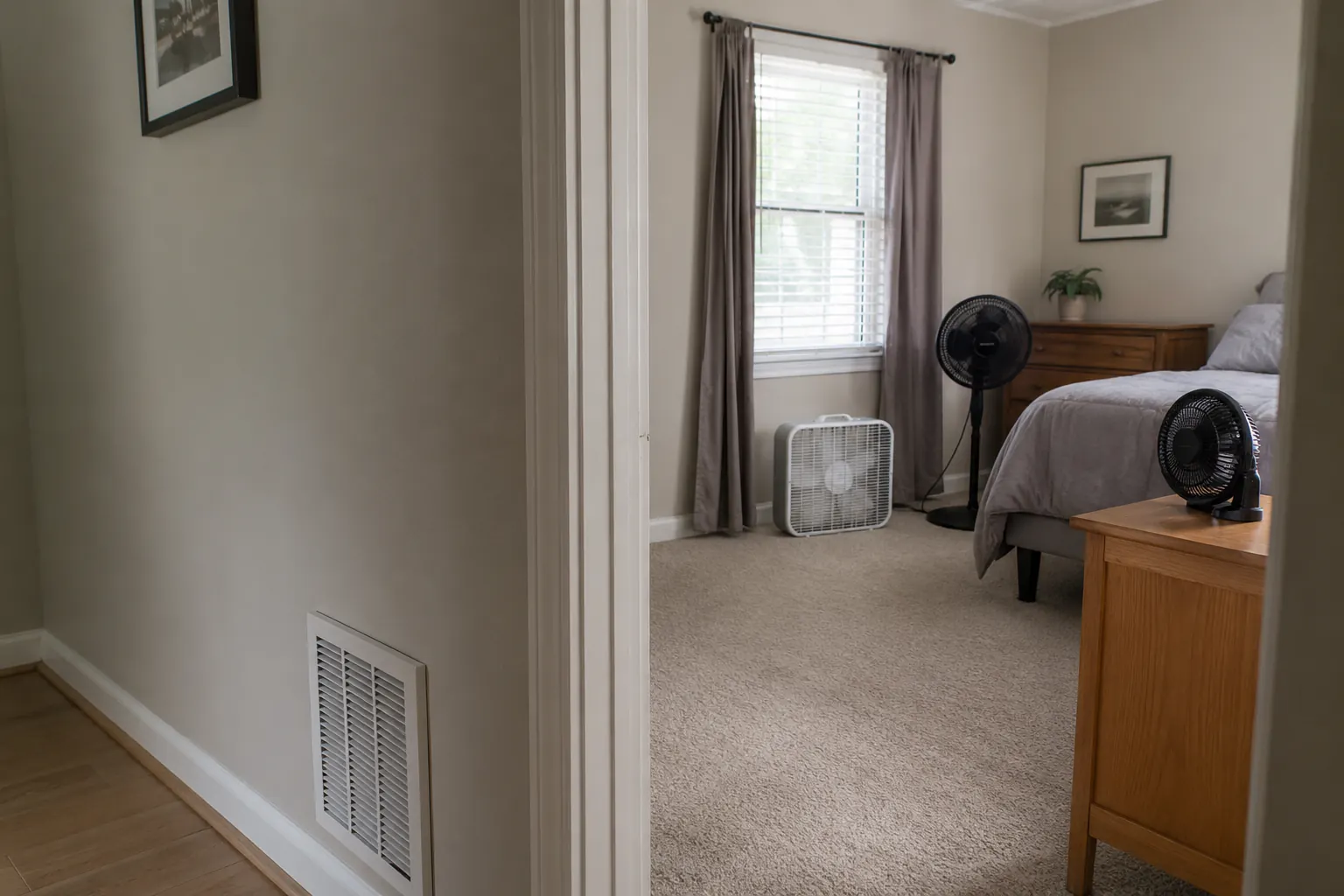
The safety boundary that governs every category
CDC is specific and counterintuitive: use fans only if indoor temperatures are below 90°F, because above that a fan can increase body temperature rather than lower it. Electric fans may provide comfort, but in the high 90s they will not prevent heat-related illness. (Source: CDC, About Heat and Your Health.)
Below that limit is not a guarantee of safety for a particular person. Symptoms, the person’s clinical plan and current official instructions still take priority. The fan safety warning explains those limits; this comparison does not override them.
The categories
| Category | Power need | What it actually does | Hard limit |
|---|---|---|---|
| Battery / USB fans | Model-dependent | Moves air; may provide comfort below 90°F indoors | Follow CDC’s indoor limit and exact instructions; does not lower room temperature |
| Interior shading (blinds, curtains, film) | None | Blocks solar gain before it heats the room | Prevents gain; cannot remove heat already stored |
| Exterior shading (awnings, screens) | None | Intercepts sun before the glass — more effective than interior | Usually needs permission; rarely installable mid-event |
| Evaporative methods (wet towels, misting) | None to low | Cools skin directly through evaporation | Much weaker in humid air; not a treatment for heat illness |
| Thermometers | Model-dependent battery or other supply | Records temperature at the occupied location | A reading does not establish personal safety |
| Portable AC / window units on backup power | Exact running and total startup demand | Removes heat through a properly installed system | Requires permitted installation, connection, output and capacity; see below |
| Cooling towels / personal cooling items | None | Comfort at the individual level | Comfort only; no room effect |
These categories solve different problems. Shading reduces incoming heat; a fan moves air; air conditioning needs an appropriate installation and supply. Compare only the category that addresses the household’s actual gap.
Battery fans: the honest entry point
A battery or USB fan may suit a small airflow task within the temperature and operating limits above. A working fan already in the home may be enough; a purchase is not the first step for every household.
- Check: the exact fan’s documented draw, permitted supply and expected use time. A small battery does not guarantee a long runtime.
- Limit: it cools people, not rooms, and only below the 90°F indoor threshold. It moves air; it does not remove heat from the building.
- What to look for in research: actual measured draw rather than a marketing figure, runtime on a stated battery, stability, and whether it can be repositioned toward a person rather than a room.
Begin with exact manufacturer documentation. The plug-in watt meter guide covers the limits of permitted measurement for suitable equipment; it is not an instruction to improvise adapters or open electrical equipment. The runtime calculator estimates hours from stated assumptions, not compatibility or safe operating conditions.
Shading: start with the windows receiving sun
Use existing shades before adding materials. Check the windows receiving morning or afternoon sun, while keeping exits and required ventilation accessible.
EPA describes closing windows when outdoor air is hotter and opening when it is cooler, with outdoor air quality considered first. Use only safely accessible openings that preserve fall protection, security and exits. (Source: EPA, Extreme Heat and Indoor Air Quality.)
- Interior (blinds, curtains, compatible reflective film): consider the actual window, permission and installation requirements. An existing curtain and a new film are not interchangeable decisions.
- Exterior (awnings, shade screens): more effective because it stops the energy before glass and room absorb it. Almost always needs property authority, and cannot be improvised during a heat wave.
The catch is timing. Exterior shading is a pre-season decision, which is why it belongs in the pre-season cooling audit rather than an emergency shopping list. Do not press improvised reflective material against insulated glass without checking the window manufacturer’s guidance; the cool without AC guide explains the glazing-stress caution.
Evaporative methods: real physics, real limits
Personal cooling items are separate from room cooling. Check the person’s clinical plan, water access and the item’s instructions rather than assuming that every method is suitable or available during an outage.
Two limits matter. Evaporative cooling weakens sharply as humidity rises, so the same wet towel that helps in a dry climate does much less in a humid one. And evaporation is comfort and cooling support — it is not a treatment for heat illness. Suspected heat stroke (hot red skin, confusion, slurred speech, unconsciousness) is a 911 call, not a towel.
Thermometers: make readings useful
Check whether you already have a readable indoor thermometer. A reading helps compare conditions with the fan limit and outdoor temperature; it does not replace symptoms, clinical instructions or the departure plan.
Use its placement and accuracy instructions at the occupied location. Consider display readability, operating range, battery needs and how someone will access it without extra exertion.
Portable AC on backup power: the expectation to reset
Do not assume that a portable battery can run the air conditioner already installed. Identify the exact appliance and backup supply before considering additional capacity.
Check documented continuous demand, total startup demand with other running loads, output limits, required exhaust and permitted connections. Capacity math matters only after those conditions are resolved. The backup power for cooling guide explains why advertised watt-hours alone do not establish runtime.
The historical DOE energy-use guidance distinguishes estimates from measured use. Do not turn that distinction into a home experiment: exact manufacturer instructions and a qualified professional control uncertain installations, connections or measurement. A larger battery does not resolve an incompatible supply.
A decision path
- Confirm the destination and assistance plan. Do not depend on owning a car or on an unconfirmed cooling location.
- Check existing shades and a thermometer, before making a shopping list.
- Consider a fan only for a permitted job, within CDC’s indoor limit and the exact device instructions.
- Treat towels and other personal cooling items as support, not as treatment for heat illness.
- Resolve AC installation and supply requirements before runtime estimates, using documented specifications and qualified help where needed.
- Buy only for an identified gap. Leave the equipment decision for later when care or departure is needed now.
Evidence to look for before comparing a model
Read the exact model’s documentation and distinguish specifications from an independently recorded test. Useful records identify:
- measured watts and real runtime from a stated battery, not marketing claims;
- airflow at a defined distance, and stability in normal household use;
- for shading, measured indoor temperature difference under stated sun conditions;
- humidity conditions for any evaporative claim;
- thermometer accuracy against a reference;
- exact test conditions, ambient temperature, home type, and instruments.
These are questions for published evidence, not instructions to conduct a heat or outage trial at home. This page offers category criteria, not a tested recommendation.
Sources reviewed
The historical source list covers heat health, prevention, indoor air quality and appliance energy use from CDC, EPA, Ready.gov and the Department of Energy. Individual heat risk, hydration and medication instructions come from clinicians. ReadyLience has tested no cooling product; these are criteria for comparing documented options, not tested recommendations.
Narrow check October 3, 2026: CDC’s indoor fan limit and cooling-location guidance, and EPA’s shading, ventilation and air-quality conditions. Other source metadata remains historical; this is not a new comprehensive review or a product test.
TempPro’s TP50 information, linked instruction manual 50-V20260528 EN and exact Amazon Classic single-unit variant were checked October 12, 2026 for ordinary ambient observation. Conflicting backlight/calibration marketing is not adopted. No reference-instrument comparison, clinical test or cooling performance was measured here.