
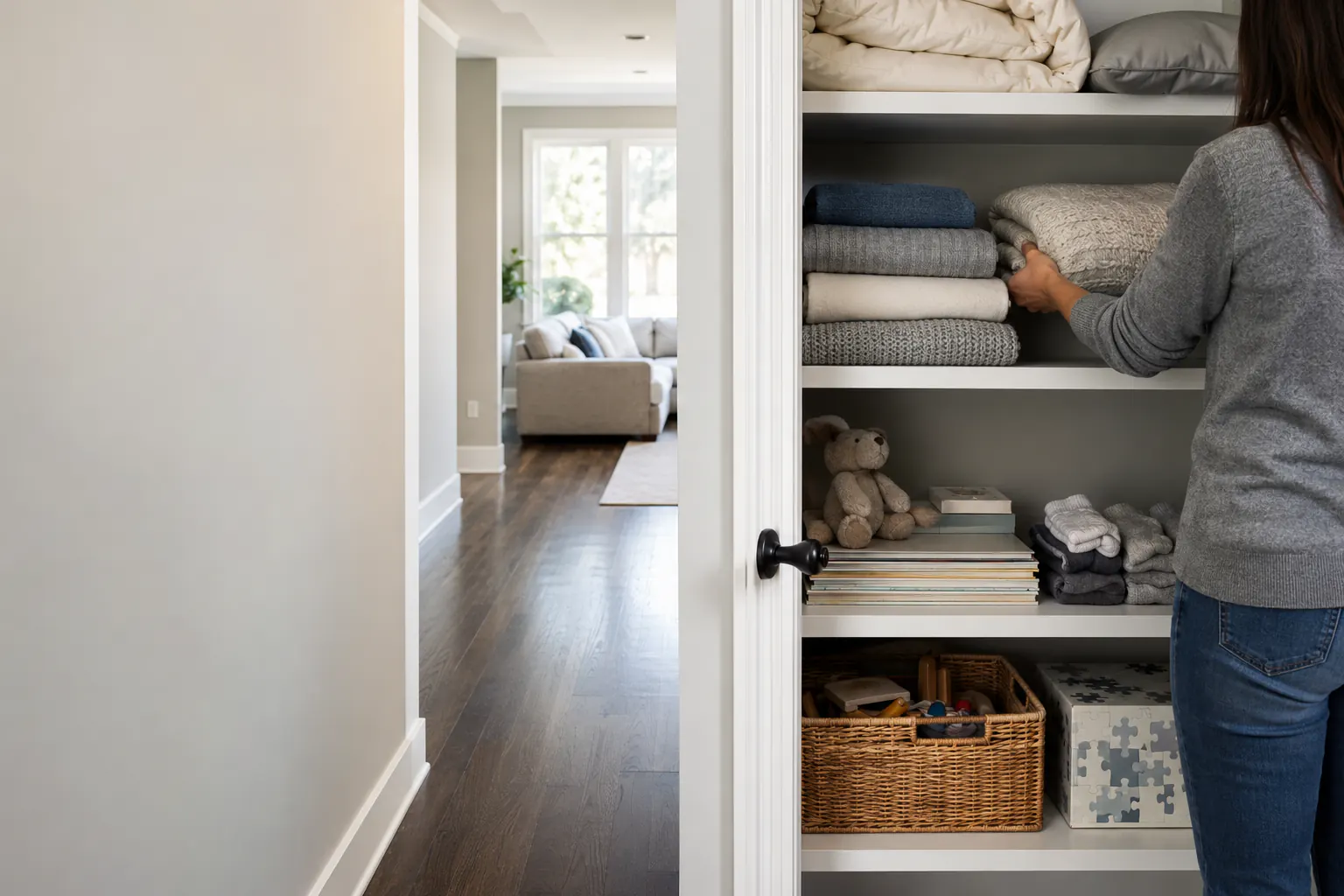
Choose one familiar item the household already uses: a book, a small game or a child’s comfort item. Keep it easy to reach without blocking a route or displacing essential supplies. There is no need to buy a separate morale kit or finish a checklist before offering an ordinary comfort.
Comfort does not replace required care, food, water, safe temperature or emergency action. Choose items that fit the people who will use them: familiar, accessible, quiet and usable in the actual space. Nobody has to join an activity.
This checklist is one practical layer in the Mental and Emotional Preparedness hub.
Keep essentials first
Do not trade water, required food, medication, medical equipment, safe light, weather protection, sanitation, communications, mobility equipment, or evacuation capacity for entertainment. Use the household go-bag checklist for portable essentials, the Emergency Food Storage hub for food planning and the Emergency Sanitation plan for hygiene when utilities fail.
Comfort supplies cannot make a dangerous temperature, unsafe building, official evacuation order, fire, smoke, floodwater, sewage exposure, violence, or medical problem acceptable. Follow the controlling instruction first.
Start with something familiar
Choose one or two ordinary objects already enjoyed by the people involved. These are options, not a shopping list:
- a paperback or short story already enjoyed by the household;
- a small deck of cards or known travel game with complete pieces;
- blank paper, pencils, crayons, or a compact notebook;
- a familiar washable comfort item for a child;
- an unbreakable cup or utensil that supports an established meal routine;
- a plain clock or watch that does not depend on the household network;
- an optional private reminder of an existing meal, care or rest routine.
Avoid anything that requires an open flame, creates choking or ingestion hazards for the household, blocks an exit, produces excessive noise in shared shelter, relies on the only phone, or consumes scarce backup power. A device may be useful, but it should not be the only option.
Keep a few activities together
If loose items are hard to find, put a few suitable activities in an accessible pouch or shallow bin. Keep the set small enough to inspect and easy to open in the available light.
| Option | Check before putting it away |
|---|---|
| Book or notebook | Readable in the available safe light; suitable for the person using it. |
| Cards or compact game | Complete, familiar and suitable for the people present. |
| Paper and drawing supplies | Age-appropriate; no leaking, sharp or hazardous item. |
| Familiar fabric item | Clean and wanted by its user; stored clear of exits and required equipment. |
| Clock or optional reminder | Usable without the household network; private care details kept private. |
Do not assume every person finds the same activity calming. Touch, noise, group conversation, prayer, exercise, darkness, and close proximity can be uncomfortable or inaccessible. Offer choices without forcing participation.
For an adult’s familiar paperback, use an owned light and a stable reading position first. If a room light or worn lamp does not suit the page, Mighty Bright NuFlex 47818 is a page-directed clip format to compare. This is the three-AAA battery model, not a rechargeable light; do not charge its AAA cells. Check the support and follow the full battery, eye and care instructions, including the manufacturer’s BPA cancer/reproductive-harm warning. It is not intended for children under 13. Keep it dry and clear of exits. It does not replace essential lighting or establish eye-health, stress or sleep benefits. (Source: Mighty Bright, NuFlex information, user manual and warning notice.)
Add practical comfort, not decorative clutter
Useful comfort often comes from ordinary maintenance: a clean shirt, dry socks, an accessible washcloth, lip balm already tolerated by the user, hair ties, tissues, a familiar hygiene product, or a spare pillowcase. Keep these separate from contaminated cleanup supplies and chemicals.
The sanitation plan controls safe water and hygiene methods. Do not use scented products around someone with sensitivities, put an unfamiliar substance on another person, or treat a comfort item as first aid. Store personal items in labeled private pouches when the household shares space.
For a shelter stay, choose compact, quiet items that respect other occupants. CDC shelter guidance includes maintaining supervision of children and using simple activities such as games or coloring. Follow the shelter’s current rules for space, charging, food, pets, noise, and prohibited items.
Include children without making a disaster kit frightening
Let a child choose one or two safe familiar items during ordinary conditions. Explain that the pouch is for power outages, storms, travel delays, or times when routines change. Do not tell a child that the object will keep bad events away or ask them to pack for an invented catastrophe.
Choose an activity a willing, capable caregiver authorized for that role can recognize and use. Consider whether a treasured item could be lost or damaged; do not insist that a child leave it behind merely to complete this list. Avoid graphic disaster materials, complicated instructions, toys that imitate weapons, and anything requiring continuous adult assembly. The children and uncertainty guide explains truthful updates and bounded choices.
Plan for adults, caregivers, and accessibility
Adults may prefer a book, offline audio already stored on a personal device, knitting or another familiar quiet hand activity, paper correspondence supplies, or a simple shared game. These are optional ways to spend time, not treatment or a promise of calm. Do not require an exhausted caregiver to organize everyone else’s morale. Keep essential alerts available even when taking a break from commentary.
Check access in the actual conditions. Can a person with low vision distinguish the items? Can someone with limited dexterity open the pouch? Are instructions available in the needed language or format? Will headphones block an alert the user must receive? Is the item usable without sitting on the floor or moving a mobility aid?
Keep glasses, hearing aids, communication aids, mobility equipment, medical devices, and care supplies with their proper plans. They are essential continuity items, not morale accessories.
Protect sleep without creating a hazard
An already used sleep item may be worth keeping nearby, but a new pouch or written wake plan is not required. Use an eye mask or familiar earplugs only when required care, supervision and essential alerts remain covered in the actual arrangement. If you are alone, do not assume someone else will hear a warning. Alerts, exits, temperature, medical needs, child supervision and emergency lighting come first.
Do not use candles, flame-based fragrance, unprescribed sleep products, alcohol, a covered charger, loose batteries in bedding, or headphones that hide required warnings. Use the blackout sleep guide for lighting, care coverage and essential alerts.
Store and rotate the layer deliberately
Use one location that does not narrow a doorway, stair, hall, or mobility route. Apartment residents may use a shallow bin, one shelf, or a pouch attached to the broader household kit. Do not build a large decorative “morale box” that competes with water or evacuation space.
Inspect it with the ordinary emergency-supply review:
- remove leaking, damaged, moldy, recalled, sharp, or incomplete items;
- clean textiles under their care instructions and replace items that no longer fit the household;
- update activities for age, vision, dexterity, language, and interest;
- confirm that batteries are stored under manufacturer instructions and outside toys when appropriate;
- verify that every electronic item works offline and does not require an unknown password or subscription;
- return essential supplies mistakenly placed in the comfort layer to their proper kits.
Review after a move, child-development change, disability or care change, household separation, new roommate, or shelter stay. Donate usable items that no longer fit instead of letting the bin grow without limit.
Use supplies to support a rhythm
You might offer cards after an update, drawing in a suitable supervised place, or a familiar story before rest. These are examples, not a timetable or a reason to delay care. The stress-regulation routine offers optional ways to focus on one manageable task.
Do not schedule forced cheerfulness. A person may decline an activity, want privacy, or need qualified support. The household can offer a safe choice and keep the next practical action clear.
Keep a no-shopping version
Before buying anything, choose one item already owned and try it during an ordinary evening if the person wants to. Check access, available light, noise and storage. Do not cut power, interrupt care, silence essential alerts or remove child-safety or security safeguards for this exercise.
If the item is awkward to use, address that specific obstacle rather than expanding the kit. Keep the next step small: one familiar choice, in a place the person can reach. This page contains no product ranking and ReadyLience has not tested commercial comfort kits.
Sources reviewed
- Centers for Disease Control and Prevention: disaster coping, household routine, children, and disaster-shelter context
Sources reviewed July 15, 2026. This checklist supports ordinary household comfort only. It does not provide medical, mental-health, pediatric, sanitation, shelter, or emergency-response advice.