
Children notice disruption before they understand it. A dark apartment, a cancelled school day, adults checking phones, a changed bedtime, or a packed bag can make uncertainty feel larger than the event itself. The useful household task is not to produce perfect reassurance. It is to give a child truthful, understandable information, a safe adult, and a few predictable next steps.
This guide is practical family preparation, not pediatric or mental-health treatment. It does not diagnose a child, judge a reaction, replace a parent or guardian, or decide when a family should ignore an official safety instruction.
It is the child-focused spoke of the Mental and Emotional Preparedness hub.
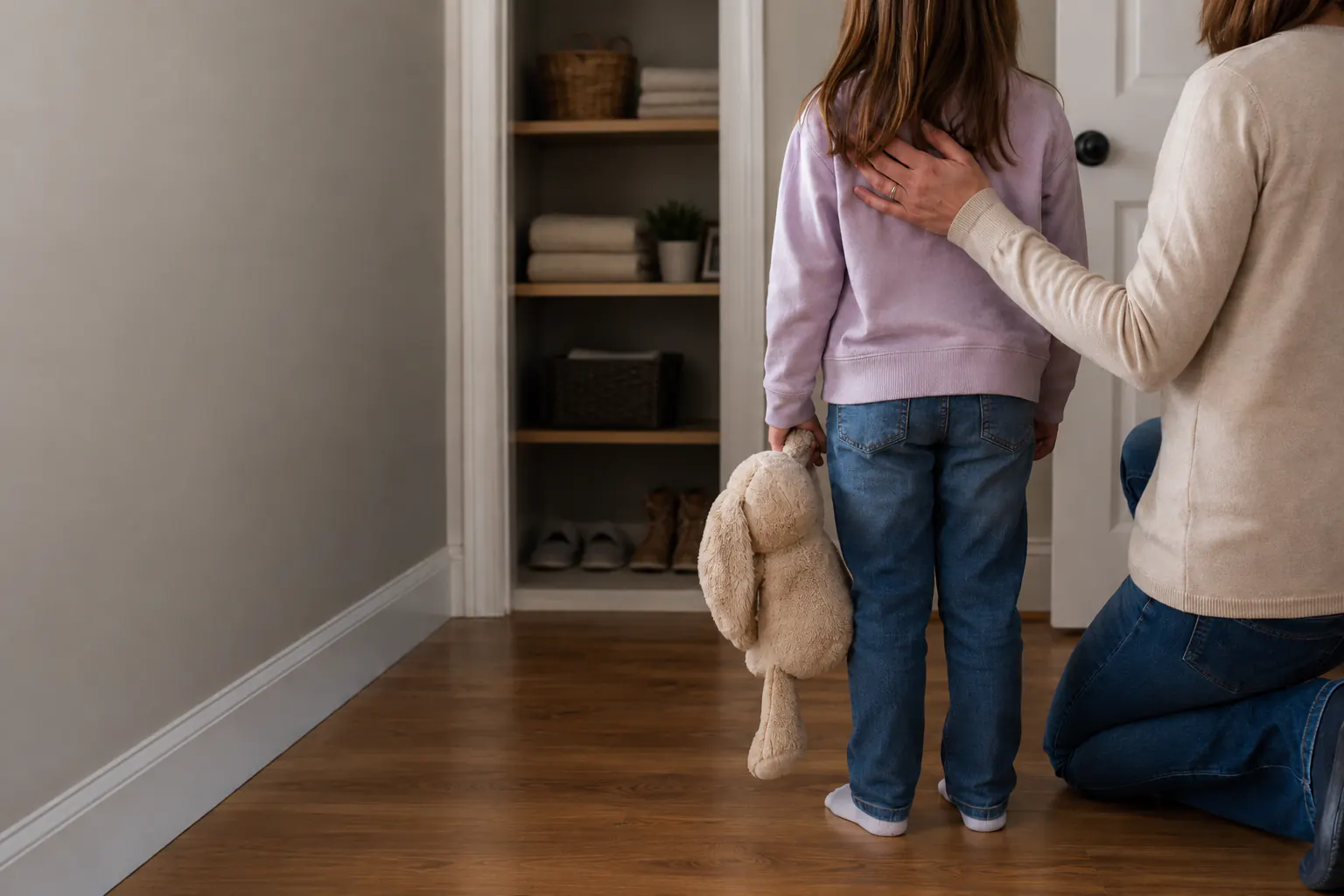
Start with physical safety and the responsible adult
Follow any evacuation, shelter, fire, medical, school, building, or public-authority instruction first. Do not use a conversation, game, snack, or comfort routine to delay leaving danger. Once the household is safe enough to pause, make sure the child knows which adult is responsible right now and how to get that adult’s attention.
The Family Communication Plan owns contacts and meeting places. The evacuate-or-shelter framework owns movement decisions. This page helps adults explain those decisions without turning a child into an emergency coordinator.
Say what is true in small pieces
Use words the child already knows. A helpful update has four parts:
- What happened: “The power is out” or “There is a storm warning.”
- What adults know: “The official update says we should stay inside for now.”
- What adults are doing: “I have the lantern and I am checking the alerts.”
- What happens next: “We will eat, play this game, and check again after dinner.”
Avoid promises such as “Nothing will happen” or explanations built from rumors. It is okay to say “I do not know yet.” Pair uncertainty with the next real action. CDC advises adults to answer children truthfully and understandably, make room for questions, correct misinformation, and rebuild routines where possible.
Keep one or two familiar anchors
An emergency can remove school, screens, meals, sleep, friends, and ordinary privacy at once. Choose a small number of familiar anchors rather than trying to recreate a normal day. Examples include a usual snack if available, a story, a quiet toy, a short family check-in, pajamas, or a predictable bedtime phrase.
The anchor must fit the safety situation. Do not make a child stay in a room that has become unsafe, block an exit with bedding or toys, use candles, or preserve a routine that conflicts with an evacuation, medication, temperature, or care plan. A familiar item is support, not a reason to remain in danger.
Give safe choices, not adult responsibility
Children often regain some steadiness when they can choose between two safe options: the book or drawing paper, the blue or gray blanket, sitting near one adult or another, helping gather flashlights or putting toys in a bag. Keep choices small and real.
Do not ask a child to monitor alerts, protect siblings, carry private family information, decide whether to evacuate, negotiate with strangers, investigate noises, or keep an adult’s crisis secret. A child may help with an age-appropriate ordinary task, but the responsible adult remains responsible.
Protect children from information overload
Repeated disaster footage, adult speculation, alarming social-media posts, and overheard arguments can make a child relive uncertainty without adding useful information. Keep official updates available to the designated adult and reduce unnecessary exposure for everyone else. Do not show graphic images to prove that an event is serious.
Ask what the child heard and correct only what needs correcting. A child may repeat an alarming story from school, a group chat, or another adult. Respond with the source you can verify and the household’s next step, not a debate.
Notice changes without labeling them
Children can become quieter, clingier, restless, angry, tired, distracted, or more likely to ask the same question. Those observations do not tell a household what diagnosis applies. They do tell an adult to slow down, preserve safety, maintain simple routines, and consider whether the child needs more support.
CDC notes that reactions vary by age and experience. Seek qualified guidance when a child’s distress continues, worsens, or significantly disrupts school, relationships, ordinary care, or the ability to function. Do not dismiss a child as difficult, but do not turn a household checklist into clinical assessment either.
Prepare a caregiver handoff
During a disruption, a teacher, relative, babysitter, neighbor, or other approved caregiver may need to take over briefly. Keep the handoff simple: the child’s name, the responsible adult’s contact route, the current official instruction, a safe comfort item, allergies or care information only as chosen by the parent or guardian, and the next check-in. Store private details privately.
The First Aid Kit Planning guide owns medical-kit access and protected care information. Do not ask an informal caregiver to improvise clinical care or interpret a private health plan.
Re-enter ordinary places with a simple plan
School, child care, a relative’s home, and a familiar activity can all feel different after an emergency. Before the child leaves the household, explain the practical plan: who is taking them, who collects them, what the contact fallback is, and what changes have actually been confirmed. Do not make a child carry a detailed family emergency story to explain to other adults.
Tell the school or child-care provider only the information needed to support the child and reach the responsible adult. A child may want privacy, and an adult should not post their reactions, drawings, location, or photos online as a family update. If a routine cannot return yet, say what will happen instead and when the household will review it again.
After the disruption, ask one concrete question: “What made that part harder or easier?” The answer may reveal a missing light, confusing alert sound, lost comfort item, unclear caregiver handoff, or too much media exposure. Correct the household plan during calm conditions. Do not turn the review into an interrogation or a test of whether the child was brave enough.
Practice before an emergency without making it scary
Use short ordinary practice: show where the flashlight is, identify the safe adult, rehearse the plain contact message, and let the child choose a comfort item for a go-bag or safe room. Keep the practice brief and truthful. Do not simulate violence, use frightening sound effects, lock a child in a room, make a child play rescuer, or require a child to repeat an emergency drill until distressed.
The purpose is familiarity, not toughness. A child should leave practice knowing where to go, whom to ask, and that adults will use the plan together. Review after a move, new school, custody or caregiver change, disability or communication change, or any event that changes who can collect or support the child.
Know when the household needs outside help
Call 911 for immediate danger, violence, fire, medical emergency, or a child who cannot be kept safe. For disaster-related emotional distress in the United States and territories, SAMHSA’s Disaster Distress Helpline is available by call or text at 1-800-985-5990. Call or text 988 for crisis support.
The best sentence an adult can offer is sometimes: “I see this is hard, and we are getting another adult to help.” That is not failure. It is the household using the right support rather than asking a child to carry a situation beyond its role.
Sources reviewed
- Centers for Disease Control and Prevention: helping children cope before, during, and after emergencies
- Substance Abuse and Mental Health Services Administration: Disaster Distress Helpline
Sources reviewed July 15, 2026. This page is non-clinical household guidance, not pediatric, mental-health, crisis-assessment, or emergency-response advice.