
If water is collecting beside the home, start by keeping people away from unstable ground, loose gutters, floodwater, and electrical hazards. In calm conditions, record where the water leaves its intended route from a safe occupied area or stable ground, then report the change to the owner or a qualified drainage professional. Do not climb or redirect water to test a theory.
The safe household role is to observe the route during ordinary dry weather and from shelter during rain. It is not to climb a wet ladder, reach from a window, enter floodwater, or diagnose a foundation from one damp mark.
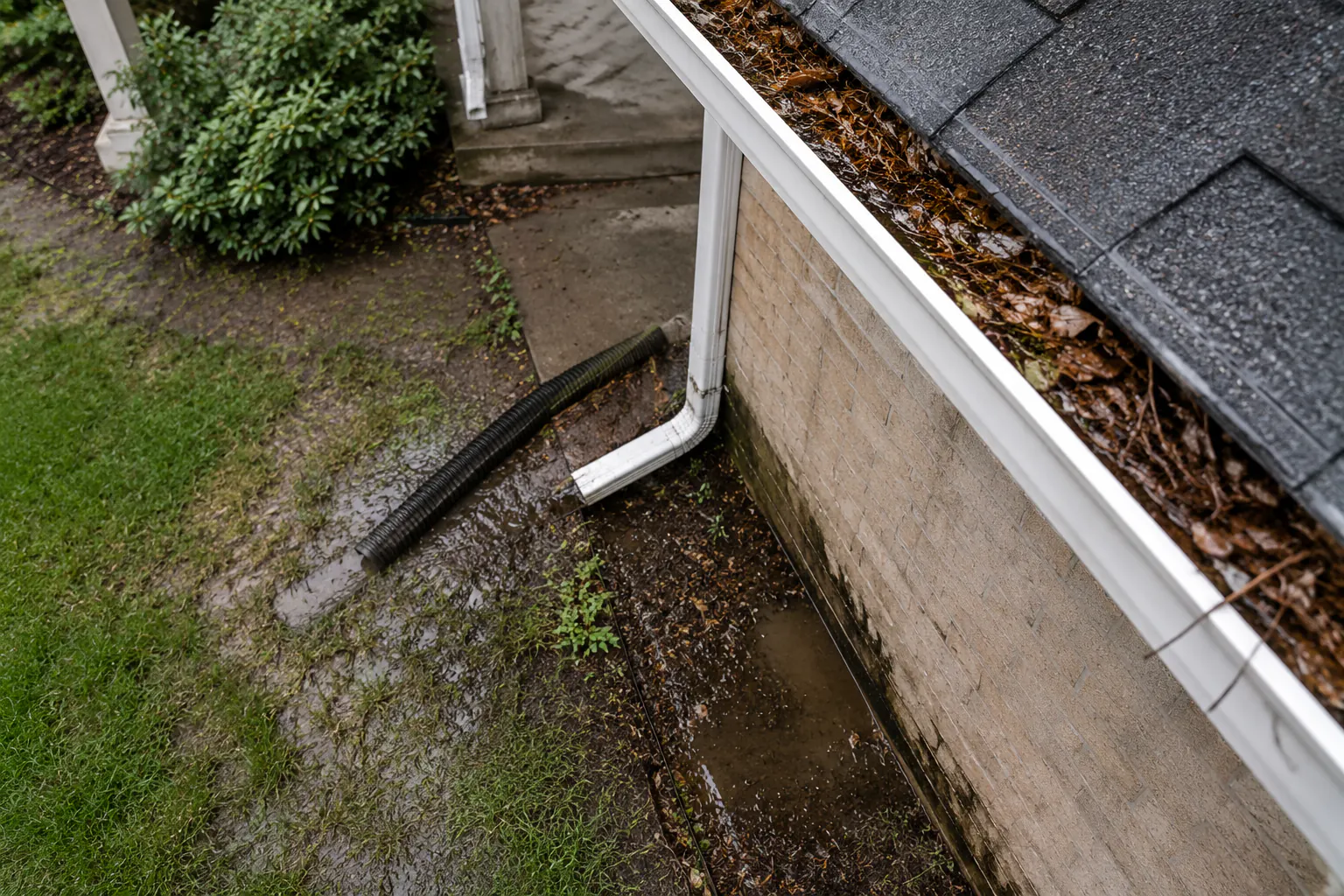
Stop for immediate hazards
Call 911 for collapse, severe injury, active arcing, rapidly moving water, or immediate danger. Stay away from downed lines and anything they touch. Follow local emergency and utility instructions around floodwater, damaged services, sewage, and reentry.
Do not inspect or clear drainage when there is:
- lightning, high wind, heavy rain, hail, snow, ice, wildfire smoke, extreme heat, or darkness;
- a sagging roof edge, loose gutter, falling branch, unstable masonry, or damaged facade;
- water near electrical equipment, an egress route, a fuel system, or a utility service;
- rapid erosion, a sinkhole, retaining-wall movement, foundation displacement, or ground collapse;
- sewage, chemical, fuel, floodwater, pests, sharps, or unknown contamination;
- any need for a ladder, roof access, climbing, excavation, confined-space entry, or shared-system control.
Observe from a safe indoor location or stable ground only. Zoom is safer than proximity.
Follow water from source to destination
Divide the path into five zones and photograph each from a repeatable safe position.
| Zone | Warning signs | What the pattern may require |
|---|---|---|
| Roof edge | Water overshoots, runs behind the gutter, or concentrates at one corner | Qualified review of roof edge, slope, drainage capacity, attachment, and blockage |
| Gutter or roof drain | Overflow, standing water, sagging, separation, vegetation, ice, or repeated debris | Professional cleaning, repair, sizing, or roof-drain assessment |
| Downspout | Leaking joint, split, disconnection, crushed section, vibration, or discharge at the wall | Repair and route review without climbing or disassembly during rain |
| Ground outlet | Ponding, splashback, erosion, ice, reverse slope, or outlet buried by soil | Site drainage correction that respects code and neighboring property |
| Building interior | Basement water, damp wall, stain, odor, efflorescence, swelling, or recurring finish damage | Source investigation across roof, site, foundation, plumbing, and envelope systems |
One symptom can have several sources. Basement water is not proof of a gutter failure; gutter overflow is not proof of foundation damage. The useful evidence is timing and connection across the route.
Observe one ordinary rain safely
From behind glass, a covered position, or another safe location, record where runoff begins, where it leaves the intended path, and where it collects. Note rain intensity only from an official report or ordinary description; do not stand in the storm with a measuring device.
Record:
- which roof side and gutter section are involved;
- whether water overshoots, overflows the front, runs behind, or leaks at a joint;
- downspout flow and any visible split or disconnection;
- outlet location and direction;
- ponding duration after rain ends;
- erosion, sediment, splash marks, and vegetation change;
- basement, crawlspace, slab-edge, wall, window, or door symptoms;
- previous repair and whether the same pattern returns.
Do not use a hose to reproduce leakage near a roof, wall, electrical service, basement, or uncertain underground drain. Artificial testing can create damage and does not reproduce storm conditions reliably.
Distinguish maintenance from system design
Visible leaves at a safely reachable ground outlet can look simple, but repeated overflow may involve roof area, rainfall intensity, gutter geometry, slope, supports, outlet count, underground leaders, ice, or building movement. A downspout extension can also create a trip hazard, cross a property line, ice a walkway, saturate another area, or conflict with local stormwater rules.
Use qualified design or trade help when:
- overflow returns after ordinary professional cleaning;
- several roof sections converge on one outlet;
- water travels behind siding, fascia, soffit, or trim;
- the gutter sags, twists, detaches, or pulls material with it;
- discharge enters an underground pipe of unknown route or condition;
- the site slopes toward the building or water crosses a neighbor’s property;
- a retaining wall, foundation, patio, driveway, or soil is moving;
- water enters occupied space or affects electricity, HVAC, stored materials, or egress;
- snow, ice dams, wildfire debris, tree work, or storm damage is involved.
Do not seal, drill, rehang, cut, excavate, or redirect a system before understanding where the water is allowed to go.
Connect exterior patterns to interior evidence
Map each exterior discharge point to the nearest interior wall, opening, basement area, crawlspace boundary, or slab edge. Record symptoms during rain and again after drying.
Look for new:
- staining, peeling, swelling, soft finish, or musty odor;
- white mineral deposits or corrosion;
- wet stored items or floor-edge change;
- window-well water or door-threshold entry;
- sump or drain behavior change;
- crack, separation, or opening-operation change.
Do not enter an unsafe basement or crawlspace, open finishes, sample mold, or use a consumer moisture reading as structural clearance. Use the water-intrusion guide and structural red-flags guide when the pattern crosses systems.
Plan seasonal observations
Before the wet or hurricane season
Arrange ground and roof-drainage inspection early enough for qualified repair. Confirm that outlets are visible, normal walking routes remain clear, and contractors understand site discharge constraints.
During leaf fall
Increase safe ground-level observation where trees affect the roof. Tree and roof work belongs to qualified professionals; do not combine gutter cleaning with improvised branch work.
Before freezing weather
Document prior ponding and ice locations. Do not climb to remove ice, strike frozen gutters, apply heat, or create hot-water runoff. Correct the source through appropriate roof, insulation, air-sealing, and drainage assessment.
After severe weather
Inspect first from indoors and stable ground. Stay away from lines, trees, debris, damaged facades, floodwater, and snow or ice fall zones. Compare against pre-event photographs before cleanup changes the evidence.
The seasonal home inspection calendar consolidates these checkpoints; keep the dates in the early-warning record as well.
Ask for a whole-route repair scope
A useful proposal should state:
- roof area and runoff route assessed;
- defect, blockage, capacity, or attachment condition found;
- outlet destination and local requirements;
- effects on foundation, envelope, walkways, neighboring property, and accessibility;
- temporary risk control and permanent scope;
- buried drain testing method and restoration responsibility when relevant;
- permits, warranties, maintenance interval, and completion evidence;
- how performance will be observed during the next relevant rain.
Product size or a longer extension alone does not prove that the complete site route works.
Give renters and apartment residents a written route
Report overflow, facade water, basement or unit intrusion, blocked egress, ice, sewage, and shared drainage immediately. Include the building side, floor, time, safe photographs, and affected common areas.
Do not access the roof, fire escape, window exterior, locked yard, basement, mechanical room, or shared drain. Ask management for temporary access restrictions, the responsible contractor, drying and inspection plan, neighboring-unit checks, and written completion.
Verify after the next relevant rain
Compare the same roof edge, downspout, outlet, ground, and interior locations. Record whether water stayed in the intended route and whether ponding, erosion, staining, odor, or interior moisture returned.
Keep the repair record with the early warning hub. Reopen the issue when the route fails again; a dry sunny-day photograph cannot verify storm performance.
Sources reviewed
- U.S. Environmental Protection Agency: Moisture Control Guidance for Buildings; Indoor Environmental Concerns During Remodeling; Moisture Control in the Home
- Federal Emergency Management Agency: Building Codes and Basement Backup; Basement Flood Mitigation
- Ready.gov: Floods
Sources reviewed July 14, 2026. Current alerts, emergency services, utilities, property authority, permits, stormwater rules, site conditions, and qualified roofing, gutter, drainage, civil, geotechnical, foundation, plumbing, sewer, building-envelope, restoration, and arborist professionals control actual action.