
Start with one familiar item you can see safely, such as a chair or small appliance. Take a photo with a phone or camera you already have, if available, and keep it privately with a short room label. If a photo would expose private material or require moving something, leave it out and make a brief note instead. A new camera, an app, a video tour, and a complete room survey are not prerequisites.
This guide is for ordinary preparation before a loss, not an inspection, valuation, or coverage decision. If damage has already happened, retain your earlier originals and create the new damage record separately. Necessary help, care, departure, and actual reporting deadlines take priority over taking pictures. Follow local access instructions and qualified professionals for hazardous work. Use how to document damage before cleanup begins or, for flood-claim documentation, how to document flood damage for an insurance claim. Both belong to the home inventory and insurance recovery plan.
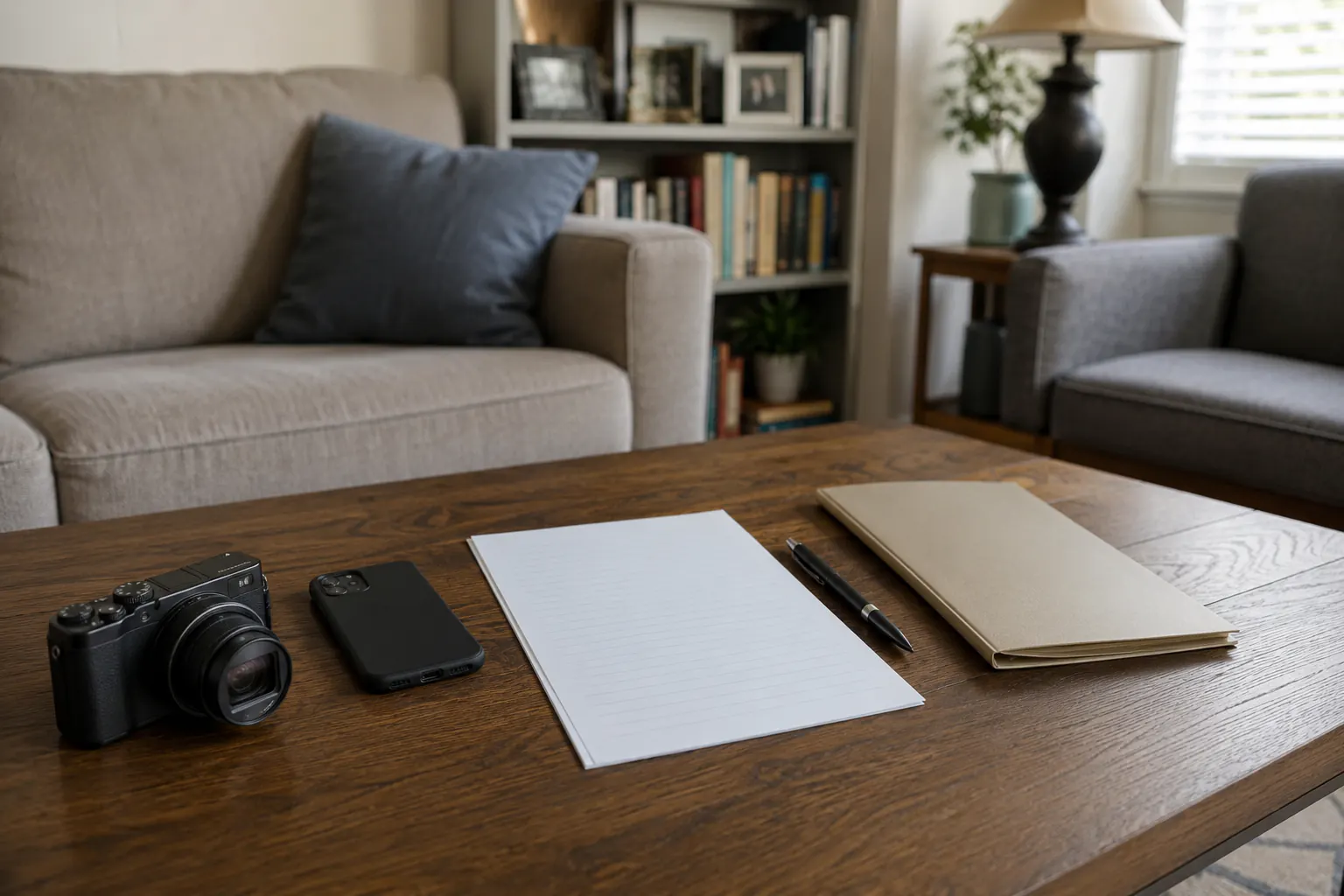
Prepare the camera without staging the home
Use an available phone or camera during ordinary, safe access. Check its date setting if convenient, but do not delay help or care to charge it, change settings, or finish this task. Do not clean or rearrange a room for the picture, make property look more valuable, or narrate a guessed claim amount.
Choose a view that excludes identity documents, addressed mail, full or partial account/policy/member identifiers, prescription labels, screens, family calendars, alarm controls, keys, financial statements, tax papers, password notes, and security-sensitive storage. Do not move heavy objects, interrupt prescribed care or required storage, or remove safeguards to arrange a shot. If you cannot exclude private details safely, skip that view. A home photo can reveal possessions, routines, and location clues even without a readable document.
Keep necessary original photos and documents in protected storage; do not delete originals merely to produce a less revealing copy. Label cropped or annotated working copies separately. Keep passwords and recovery codes out of the inventory and use the digital-security guide for their separate protection. Metadata can be wrong or lost in an export: add a short date note when known, and leave unknown details blank. None of these notes establishes ownership or satisfies every insurer’s documentation requirements.
Use a wide-to-detail room sequence
The NAIC’s home-inventory guidance describes photographs grouped by room or category. You can use that approach for one item or area rather than a whole-home session. From a stable position with ordinary safe lighting, choose whichever of these pictures or notes helps:
- An ordinary room view, if it does not expose private details.
- A familiar item or group of items in its usual place.
- An accessible make, model, serial label, or distinguishing feature, without moving equipment.
- A neutral private room label, such as kitchen or hall closet.
- A controlled location clue for an existing receipt, manual, warranty, or registration; keep the actual document protected separately.
You do not have to photograph every corner or drawer. The manageable room-by-room inventory method covers the written list. These are preparation choices, not a substitute for an insurer’s actual request and deadline.
Keep video short and useful
Video is optional; a photo or written entry is also a choice. If you record a clip, use a stable position and stop when you have captured the intended item or view. There is no required clip length. Do not walk while watching the screen, step backward toward obstacles, or enter another area just to extend the recording. A private room/date label can be written rather than spoken.
Avoid background conversations and guessed values. Obtain a person’s consent before including them; leave people out when consent is absent or unclear. Do not show a child’s routine, an accessible travel route, an alarm panel, a gun safe, a key rack, a security camera blind spot, or a document that should stay controlled.
For employer, school, landlord, client, borrowed, or shared property, check permission with the responsible party before recording it. Note an ownership category only when known; otherwise leave it unresolved. An inventory does not grant recording or account access, decide ownership, or establish who may make a claim.
Capture durable-item details safely
For a few major appliances, electronics, tools, mobility devices, or other durable items, an exterior image and an accessible model label may help distinguish one item from another. Do not pull furniture from a wall, reach behind hot equipment, unplug a running device, open a panel, climb a ladder, enter a crawlspace, or move a heavy tool to obtain a label.
When a label cannot be reached safely, record that it was not safely visible. A purchase record, manual, registration, or manufacturer account may later provide the detail. The receipt and serial-detail guide in this family covers how to keep those supporting records truthful and controlled.
Photographing a label does not prove purchase, condition, value, coverage, or claim eligibility. It is just an identity clue.
Include storage and exterior only within ordinary safe limits
Include a garage, shed, closet, basement, or storage area only if you already have safe, permitted access. An overview from a stable entry point is optional, not a reason to enter. Do not climb over stacked boxes, move stored fuel or chemicals, enter a confined space, access a roof, open an electrical enclosure, or step into water for a better shot.
Exterior views of visible doors, windows, equipment, or outbuildings are optional too, within the same safe-access limits. A photo is not a structural inspection. Use the appropriate repair, drainage, or safety specialist for a defect or hazard rather than investigating it for the inventory.
Store copies with a recovery path
The CFPB’s disaster-preparation guidance recommends separate locations for originals and copies and password protection for online copies. Choose protected storage that does not depend on the same phone or room alone, according to your access and security needs. Use digital security and data backup for emergency continuity for backups, and the household document and contact access map for limited roles and private location clues. No storage choice here promises recovery after every loss.
Do not post the full home recording or send it through a group chat or unsolicited request. If an insurer, authority, or legitimate service provider needs files, verify the request and channel, then provide only the relevant requested material. FloodSmart’s damage-documentation guidance concerns a separate record after safe return, not permission to enter a damaged home. The disaster fraud and price-pressure warning covers unexpected pressure for images, records, or payment information.
Try opening one saved entry
When convenient, try opening one saved entry through your usual authorized access. Does its label identify the room or item, and does the image open? If you are handling this alone, make that check yourself. A willing, authorized helper is optional; do not share passwords or grant account access to complete it. Skip or defer the check if it would interrupt care or another necessary task.
For example, inventory/2026/kitchen can be a private folder label; it is not a required system. If a file is confusing, add a short factual note without changing the original. Checking that one file opens does not verify a whole backup or guarantee future access.
Refresh after ordinary change
When an appliance, room, or ownership arrangement changes, add a dated new entry without overwriting the older original. Leave missing dates or details unresolved rather than guessing. If you choose a calendar reminder or pre-season check, keep it optional and separate from real reporting deadlines.
For today, one private photo or note is a place to start. Add safely accessible identifying details later with the receipt and serial-detail guide, without treating an inventory as proof of coverage, value, or payment.