
Weigh the empty bag first, then its personal, shared, and optional contents. The planner adds those weights and compares the total with a carrying limit already chosen for the person and route. It does not decide what anyone can safely carry: stairs, heat, pain, care equipment, and a delayed pickup still matter even when the total is below that limit.
Use the evacuation planning hub for the departure plan. This worksheet answers the smaller question: how much does this person’s bag actually weigh?
Interactive worksheet
Go-bag capacity planner
Add up the bag and the items you plan to carry. Compare that total with a limit already chosen for the person and route. This tool does not determine a safe lifting or carrying limit; the example numbers are not a recommendation.
Planning worksheet only. Do not use it to decide what a child, older adult, pregnant person, disabled person, injured person, or anyone else can safely carry. Individual mobility, pain, balance, terrain, stairs, weather, care equipment, and professional guidance control that question.
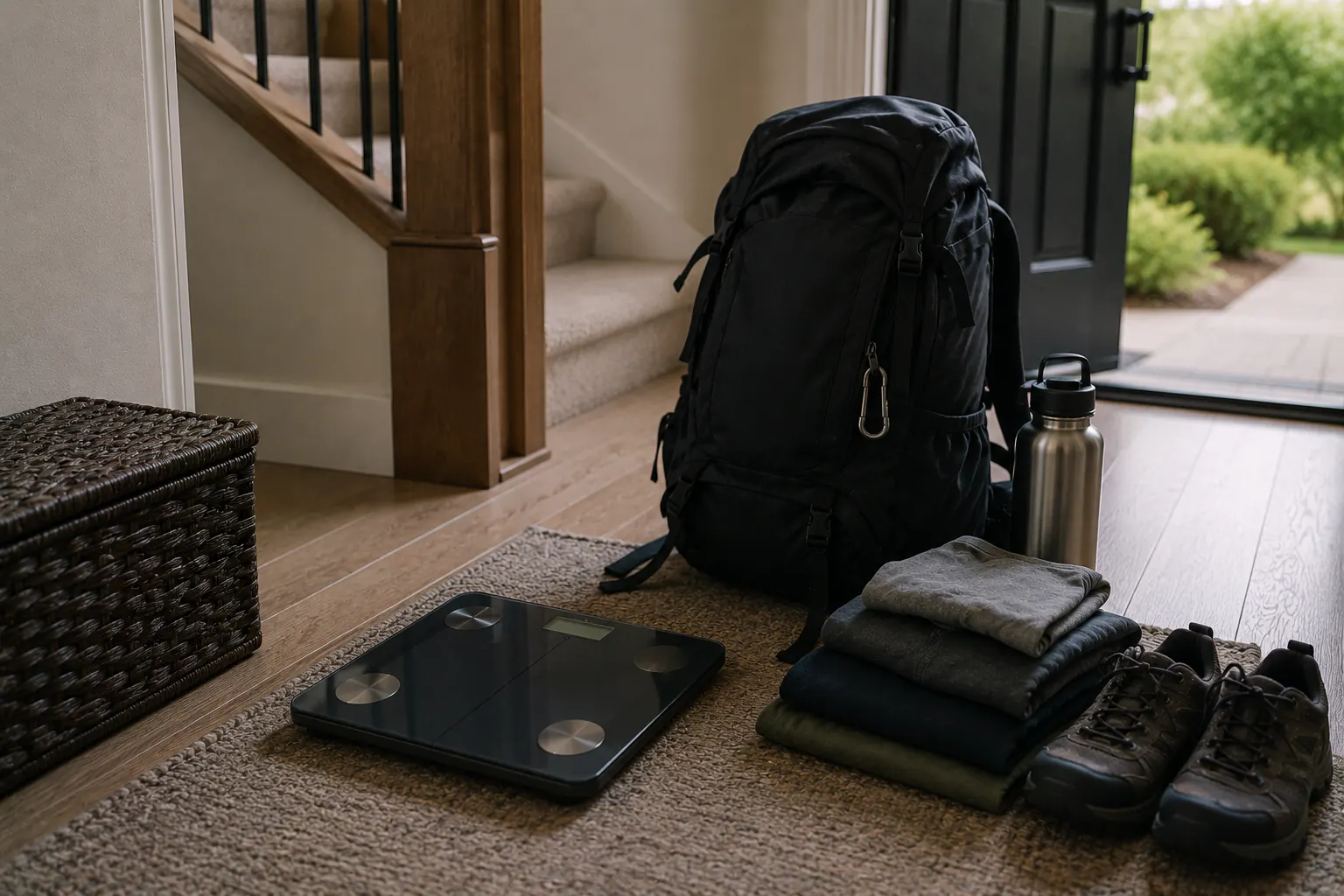
What the planner adds
The calculation is intentionally simple:
empty bag + personal essentials + shared items + optional items = planned bag weight
chosen capacity - planned bag weight = planning margin
The margin is not strength, fitness, medical clearance, or permission to add more gear. It is a prompt to look at the contents before departure. A positive number can still be a bad plan if the route includes stairs, ice, smoke, a long wait, a wheelchair transfer, a child carrier, a pet carrier, pain, fatigue, or a destination that requires more than the household assumed.
Choose the capacity from a real practice
Do not use a percentage of body weight, a social-media rule, or a product claim. Those shortcuts ignore individual mobility, injury, disability, balance, pregnancy, age, terrain, climate, equipment, and care needs.
Instead, in calm conditions, have the person choose a capacity after carrying the actual bag on the ordinary route they expect to use. That may be a short path to a vehicle, an apartment exit, a lobby, or an authorized pickup point. Stop when any activity is unsafe or unsuitable. Some people should not perform a carrying test without individualized guidance; their plan may use a rolling bag, mobility-mounted system, caregiver, driver, or official assistance instead.
Record the capacity as the person’s own planning input, not as a household standard. Revisit it after a move, illness, injury, new child, new pet, mobility change, seasonal change, or change in the route.
Weigh categories separately
Separating categories makes tradeoffs visible.
| Category | What belongs here | Question to ask |
|---|---|---|
| Empty bag and attachments | Bag, pouch, rain cover, permitted mobility attachment | Is the container itself heavier than the plan needs? |
| Personal essentials | Water, weather layer, light, communications, basic hygiene | Does this person need it immediately if separated? |
| Shared items | Map, documents, cable, radio, household hygiene or first-aid items | Can another capable person carry or duplicate it? |
| Optional items | Comfort, convenience, extra clothing, noncritical gear | Does it solve a verified problem or merely feel reassuring? |
The Practical Household Go-Bag Checklist explains how to assign these layers. Do not count medication, device, oxygen, refrigeration, or clinical equipment as a generic weight problem; those belong to the individualized Medical Device and Medication Continuity plan.
Reduce weight without removing continuity
When the total exceeds the chosen capacity, start with optional items and duplicate shared items. Replace a large household bag with distributed personal layers only if every person can manage their layer and essential care is not separated from the person who needs it. A lighter plan that strands a child, dependent adult, pet, or device user from essential support is not an improvement.
Other options may be better than forcing the bag lighter:
- place some shared supplies in a vehicle only when the evacuation plan actually includes that vehicle;
- use a rolling system only where the route, stairs, debris, and transport allow it;
- assign an item to a named caregiver or driver rather than assuming someone will help;
- reduce home-to-pickup distance by using an authorized accessible pickup plan;
- create a separate stay-at-home reserve instead of putting food and water for days into every bag.
The car-free backup transportation guide covers real baggage, accessible transit, pickup, and mobility constraints. It remains the owner of transport planning.
Make weight changes visible to the household
A written bag list is more useful than a memory of what “should” be inside. Record each item, its current weight, its owner, its function, and the condition that justifies carrying it. A household can then see when an item has silently become heavier because water was added, a child outgrew clothing, a different battery was substituted, or a pet carrier now has to be moved by a different person.
Use one line for every shared item. A radio, paper map, document sleeve, power bank, spare cable, hygiene kit, and first-aid pouch are easy to duplicate accidentally when several people pack independently. The planner does not decide which duplicate to remove. It gives the household a prompt to decide who has the item, who can retrieve it, and whether a failure of that bag would leave another traveler without a critical function.
Keep essential care equipment out of a generic optimization exercise. When a device, medication, mobility aid, communication aid, or caregiver supply is required, its owner, approved transport, and clinical or manufacturer constraints control the plan even when the number on a scale is inconvenient. Weight is one planning constraint among many, not the authority that decides continuity of care.
Plan for the route, not the parking lot
The same bag can have a different effect at a curb, on an apartment stairwell, at a transit stop, in rain, or after a delayed pickup. Before the event, write the actual route in sequence: where the bag is staged, which door opens first, whether an elevator is required, where a child or pet carrier goes, how far the pickup point is, and what happens if that point is unavailable.
This route review often reveals a better change than reducing water or removing a weather layer. The household may need a closer authorized pickup point, a driver who takes one shared item, a second adult assigned to a carrier, a different bag shape, or an earlier departure trigger. Do not solve a route failure by simply asking one person to carry more.
If the route includes a building rule, transit policy, evacuation bus limit, mobility-device restriction, or shelter process, verify it with the organization that operates it. Product dimensions, social-media packing videos, and a generic capacity calculation cannot establish what a current operator will accept.
Review after every real use
After a drill, trip, move, or actual incident, record what was difficult: a strap that slipped, a bag that could not clear a doorway, an item nobody could find, a document packet that was too exposed, or a power bank that did not work with the phone. Change the list and weigh it again. Do not let a bag become a sealed time capsule that is only opened during an evacuation.
The best outcome is not a bag at a fashionable weight. It is a household that can leave on time, keep essential support with the right person, and avoid turning a practical item into a barrier to safe movement.
Test the departure sequence
Weighing a bag in a kitchen is only the first check. In ordinary safe conditions, practise retrieving it, putting it on or attaching it, opening doors, using the planned exit, reaching the vehicle or pickup point, and sending the check-in. Note whether hands remain free for rails, mobility aids, a child, or a service animal.
Do not practise by carrying a person, overloading a mobility device, blocking an exit, using a dangerous route, or forcing a pet into distress. The goal is to identify a planning problem before an event, not to prove endurance.
Sources reviewed
- Ready.gov: Evacuation
- CDC: Be Prepared in Case You Need to Evacuate
Sources reviewed July 15, 2026. This tool compares entered planning values only. It does not provide medical, ergonomic, mobility, or evacuation advice; current official instructions and an individual care or mobility plan control a real departure.