
A slow drain is a symptom, not a request for the strongest product on the shelf. The restriction may be at an accessible stopper, in a fixture trap, farther along a branch, in a shared building line, in a septic system, or in the public sewer. The safest household response is to identify scope, stop harmful use, remove only accessible ordinary debris, and avoid creating a chemical or pressure hazard for the next person.
This guide covers one slow sink, tub, or shower with no sewage, chemical exposure, or cross-fixture backup. Use the plumbing basics hub for the larger household plan.
Stop fixture use for warning signs
Call the manager, sewer utility, septic provider, or licensed plumber when:
- more than one fixture is slow at the same time;
- a toilet bubbles when another fixture drains;
- water backs up into a tub, shower, floor drain, or lower fixture;
- sewage, solids, black water, or strong sewer odor appears;
- the blockage is complete, recurrent, or worsening quickly;
- a drain or pipe is leaking, hot, corroded, or damaged;
- a child may have inserted an object;
- jewelry, glass, a sharp object, medicine, battery, chemical, grease, plaster, or construction material entered the drain;
- someone already used a drain opener or unknown cleaner;
- the line is shared or the septic system shows warning signs.
Keep people away from backed-up material. Follow the sewage-backup stop rules; gloves do not turn sewage into a normal cleaning task. A drain that slowed after moisture appeared somewhere else may not be a drain problem at all — the hidden-leak warning signs cover that quieter failure.
Ask what happened before the drain slowed
Record which fixture is affected, how quickly water moves, whether another fixture changes it, when the problem began, and what entered the drain. Check whether building management announced line work or another unit has the same issue.
Do not keep filling a basin to “test” a nearly blocked drain. Overflow can damage cabinets, flooring, units below, and electrical equipment. Do not run a dishwasher, washer, disposal, or connected appliance into a questionable line.
In a rental, report the issue before disassembly or chemical use. The lease may assign drain work to maintenance and may prohibit products that damage shared plumbing.
Start with accessible surface debris
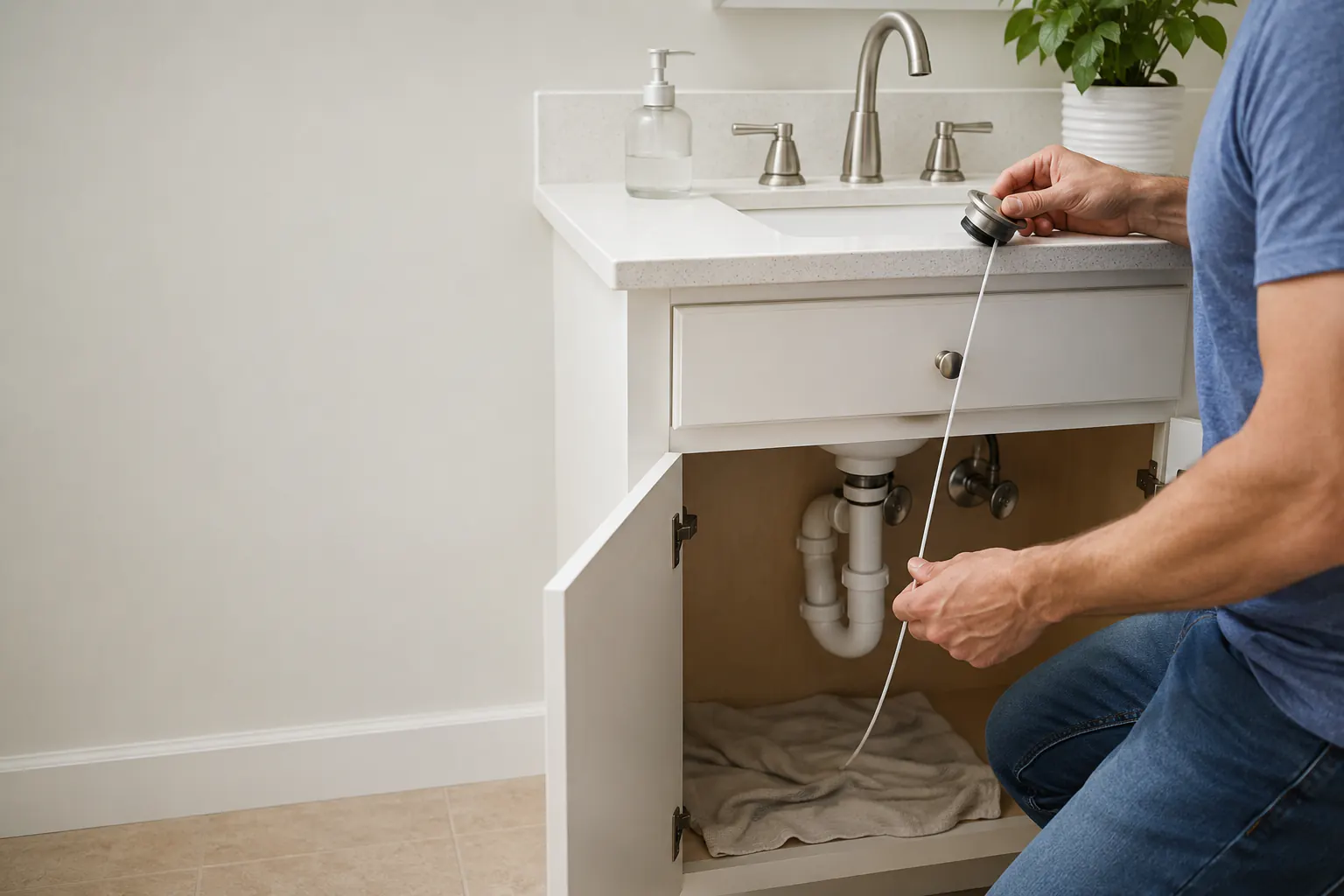
Turn off and secure any connected appliance according to its manual. Use good light and dry footing. Remove only a stopper, strainer, or removable basket designed for ordinary user access, following the fixture instructions.
Collect visible hair, soap buildup, and ordinary debris with a disposable tool or gloved hand that stays above the drain opening. Keep sharp objects out. Clean the removable part with the product and method approved for its finish, then reinstall it correctly.
Do not push debris deeper with a screwdriver, wire, coat hanger, knife, or improvised hook. Those can scratch finishes, puncture flexible components, lodge in the line, or injure the user.
Test with a small controlled amount of water. Stop if it rises, leaks below, or affects another fixture.
Use a plunger only when the fixture permits it
A simple fixture plunger may move a local soft obstruction, but it can also splash contaminated or caustic liquid, stress a loose connection, or redirect water through an overflow or another fixture.
Do not plunge when:
- any chemical drain opener or unknown cleaner may be present;
- the fixture, trap, seal, overflow, or connection is damaged or leaking;
- the line is completely blocked and likely shared;
- sewage or contaminated water is present;
- the manufacturer or building procedure excludes it;
- safe splash control and stable footing are not possible.
If approved, use the correct fixture-specific plunger and controlled strokes. Do not improvise a pressure seal, use compressed air, or combine plunging with chemicals. Stop after a brief attempt if flow does not improve; repeated force is not diagnosis.
Treat drain chemicals as a hazard, not a default
Poison Control notes that many non-enzymatic drain cleaners contain highly concentrated acids or alkalis capable of severe chemical burns. Some generate heat. Splashback can occur from a blocked drain.
Never mix drain products or combine them with bleach, ammonia, acids, toilet cleaner, vinegar, another opener, or an unknown residue. Do not add a homemade reaction to a commercial product. Poison Control explains that baking soda and vinegar usually cannot generate useful pressure in an open drain and are unlikely to dissolve a tough grease clog.
If a product is used under the exact label and property rules:
- keep it in the original child-resistant container;
- follow the label amount, PPE, ventilation, waiting, and flushing instructions exactly;
- keep children and pets away;
- do not plunge, snake, open the trap, or call someone to work without disclosing the chemical;
- retain the label and tell the plumber the product, amount, and time used.
For an exposure, use webPOISONCONTROL or call the U.S. Poison Center at 1-800-222-1222. Call 911 for serious symptoms or breathing difficulty. Do not improvise neutralization.
Do not open a trap casually
Removing a trap can release retained water, sharp debris, chemicals, sewage gas, and a lost object. Old or corroded fittings may crack; plastic connections can be cross-threaded; concealed leaks can appear after reassembly.
Leave trap removal to building maintenance or a plumber when the history is unknown, chemicals were used, the fixture is built in, access is cramped, connections are corroded or glued, the line is shared, or the user cannot verify reassembly and leakage.
If the manufacturer treats a specific removable trap as routine user maintenance, follow its exact instructions with the water supply and connected equipment safely controlled. Photograph orientation, contain residual water, use no excessive force, replace specified seals, and monitor every joint afterward. Do not generalize that permission to another fixture.
Avoid powered and improvised drain equipment
Motorized snakes, sectional machines, pressure bladders, hydro-jetting, compressed air, and large cables can cause entanglement, chemical splash, pipe damage, fixture breakage, and cross-unit discharge. They require correct cable, access, line knowledge, PPE, and training.
Do not put a drill on a hand cable unless the exact product is designed for it and the user is trained; this site does not provide that procedure. Do not run a cable through a toilet, disposal, pump, or unknown line.
A camera image also needs professional interpretation. Seeing an obstruction does not establish pipe condition, ownership, repair method, or whether roots, collapse, scale, offset, grease, or a foreign object caused it.
Prevent recurrence by controlling inputs
Use strainers approved for the fixture and clean them before flow slows. Keep grease, fats, coffee grounds, wipes, diapers, hygiene products, medicines, paint, mortar, plaster, oil, solvents, and food scraps out of drains according to local waste rules.
“Flushable” marketing does not override utility guidance. Put only bodily waste and the toilet paper approved by the wastewater authority into toilets. Maintain disposals, pumps, septic systems, and treatment equipment under their manuals and service schedules.
Track recurrence by fixture and date. A repeated slow drain needs diagnosis rather than stronger chemicals. Ask whether pipe slope, venting, damage, roots, scale, shared-line loading, or a fixture defect should be evaluated.
Confirm recovery without flooding the system
After an approved intervention, use a small amount of water while watching the fixture, cabinet, floor, trap, and room below. Increase only to normal use after drainage remains stable and no joint leaks.
Stop if another fixture reacts, odor appears, flow slows again, or a connection becomes wet. Notify the responsible professional of every product and tool already used.
Sources reviewed
- Poison Control: Drain Cleaner Hazards; Safe Spring Cleaning
- U.S. Consumer Product Safety Commission: Household Chemical Recalls
- U.S. EPA WaterSense: Home Maintenance
Sources reviewed July 14, 2026. Current product labels, fixture manuals, lease and building procedures, wastewater and septic authorities, poison-control direction, and licensed plumbing guidance control actual action.